Last Updated: 27 may 2025,
The aim of In Situ: The Modern Concrete Skyscraper, the current exhibition at the Skyscraper Museum in Lower Manhattan, is to set the record straight about tall buildings and their structural materials, says Carol Willis, the museum’s president and director. Through the 1970s, the narrative of the skyscraper was synonymous with steel, she says, but that has since changed; the second chapter of the story on tall buildings is all about concrete.

Installation view of In Situ: The Modern Concrete Skyscraper. Photo © The Skyscraper Museum
In Situ, which will remain on display at least through October, sheds light on this often-overlooked aspect of the history of tall buildings with models, diagrams, photos, drawings, and videos. Developed with guest curator Thomas Leslie, a professor of the history of architecture, engineering, and construction at the University of Illinois Urbana-Champaign, along with many collaborators, the exhibition first traces the history of concrete in broad brush strokes. With a series of thematic boards, the presentation follows the development of the material from the Romans to the Renaissance to its reemergence in the 18th century, and then—following the late 19th century invention of reinforced concrete—an experimentation with new forms and the quest for ever-increasing slenderness and height.
The exhibition calls out Cincinnati’s Ingalls Building (1903) as the first concrete skyscraper. The 16-story edifice, designed by local architecture firm Elzner and Anderson, relied on a recently patented system for reinforcing bars. In Situ also makes clear that even in early 20th century steel-framed towers, concrete played a critical role, pointing to Shreve, Lamb & Harmon’s Empire State Building. The 102-story tower, completed in 1931, contains more concrete by weight, relying on the material for its foundation system and floor slabs.
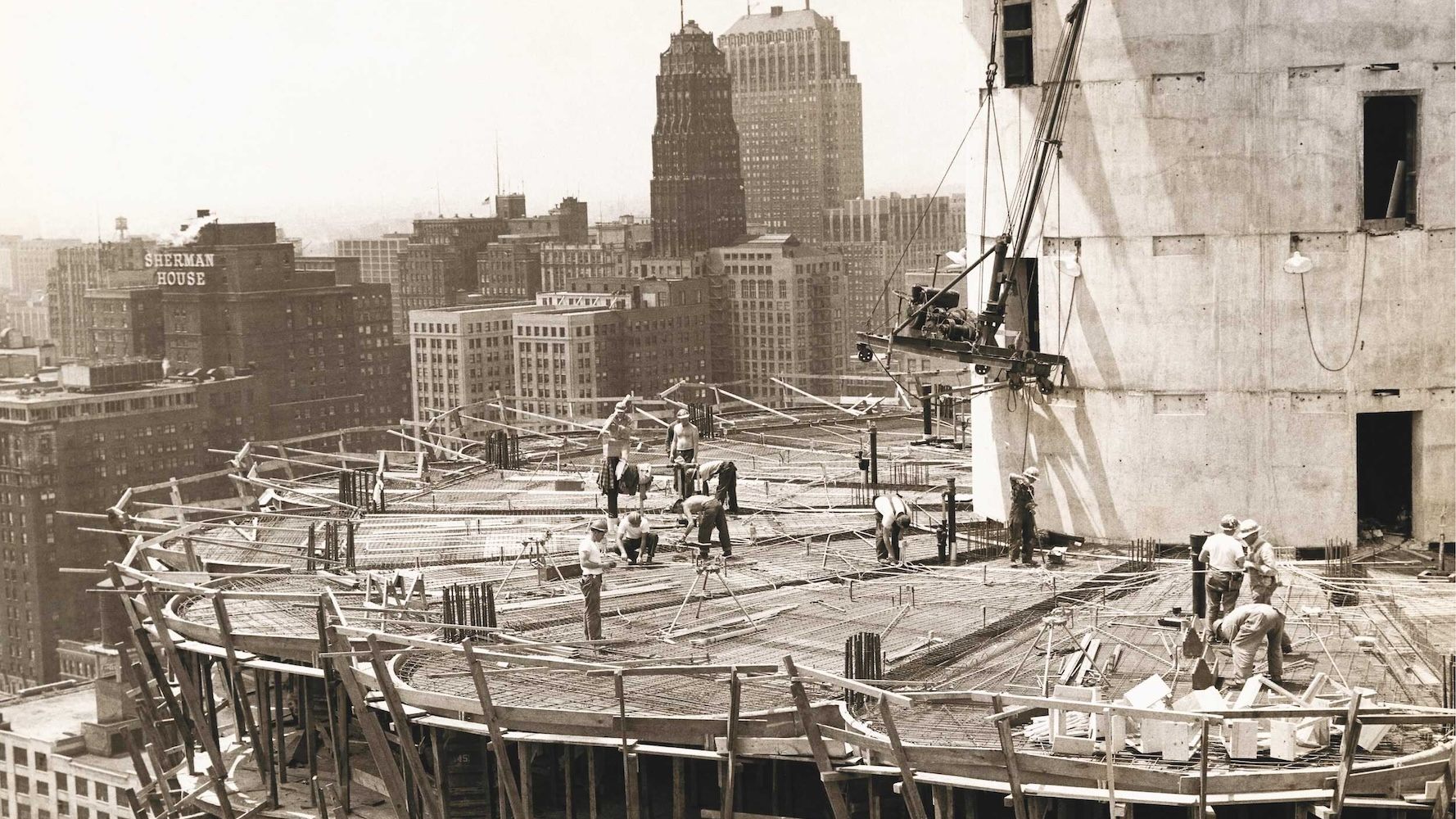
The focus of the exhibition is, however, the second half of the 20th century to the present. It outlines key figures and projects, including architect Bertrand Goldberg and his corn cob-like Marina City towers in Chicago—at 588 feet, the tallest concrete buildings in the world at time of completion in 1962—and engineer Fazlur Kahn, known for his innovations in “framed tubes.” The system concentrates the structure on a tower’s perimeter, “turning the building, in effect, into a giant hollow column that can resist gravity and wind loads,” explains the exhibition wall text. Kahn frequently collaborated with Bruce Graham and Myron Goldsmith from Skidmore, Owings & Merrill (SOM) on buildings such as the Brunswick Building (1965) and the Dewitt-Chestnut apartments (1966), also both in Chicago.
As part of their curatorial efforts, the exhibition team created a “world’s tallest” timeline, charting the growing height of concrete towers. The process revealed that the 1960s and ‘70s were especially fertile decades, driven by developments that included advancements in concrete mixes, composite systems, among other technical developments.
Willis points out that the concrete frames of buildings of this era are typically hidden within all-glass skins or are covered in some other material. For instance, the 52 concrete columns around the perimeter of the 38-story Black Rock, the New York headquarters for CBS completed in 1965 and designed by Eero Saarinen with engineer Paul Weidlinger, were clad in dark Canadian granite. Tall-building projects in which concrete was exploited for its expressive qualities, such as Rudolph’s 1972 housing complex, Tracy Towers, in the Bronx, were exceptions rather than the rule. “They were outliers,” says Willis.
When the competition for the world’s tallest building moved beyond the U.S. in the 1990s, concrete, or composite structures, dominated. Photo © The Skyscraper Museum
When the competition for the world’s tallest building moved beyond the United States in the 1990s, with activity concentrated in Southeast Asia, China, and the Middle East, concrete, or composite structures, dominated. In Situ showcases Petronas Towers (1998), in Kuala Lumpur, designed by César Pelli and structural engineers Thornton Tomasetti, as exemplifying this trend, with its distinctive floor plates in the shape of eight-pointed stars. At 1,483 feet, it claimed the “world’s tallest” title from Chicago’s Sears Tower.
In Situ highlights the current record-holder, SOM’s 2,717-foot-tall, Dubai’s Burj Khalifa and the tower that could one day surpass it—the under-construction Jeddah Tower, designed by Adrian Smith + Gordon Gill Architecture and Thornton Tomasetti, which is reportedly aiming to be the world’s first 1-kilometer-tall building. Both rely on a similar structural concept, with three load-bearing walls in reinforced concrete buttressing a central core, in contrast to the point-supported columns typical to steel towers, says Willis.
Concrete features prominently in another recent development—super-slender towers—or those whose width to height ratio is 1:12 or more. The ultra-skinny trend is represented here by 85-story 432 Park (2014), in New York, designed by Rafael Viñoly with the engineering firm WSP. The building’s 30-inch-thick core walls and its high-performance mix provided the needed stiffness and weight, explains the display text accompanying the project’s model. “Only concrete could make such ‘pencil’ buildings possible,” it says.
Indeed, In Situ convincingly argues that concrete has been essential to the development of the modern skyscraper and that the material has been the main protagonist in the story of the tall building for at least several decades. In the words of the curators, “The race to the skies has been won by concrete.”