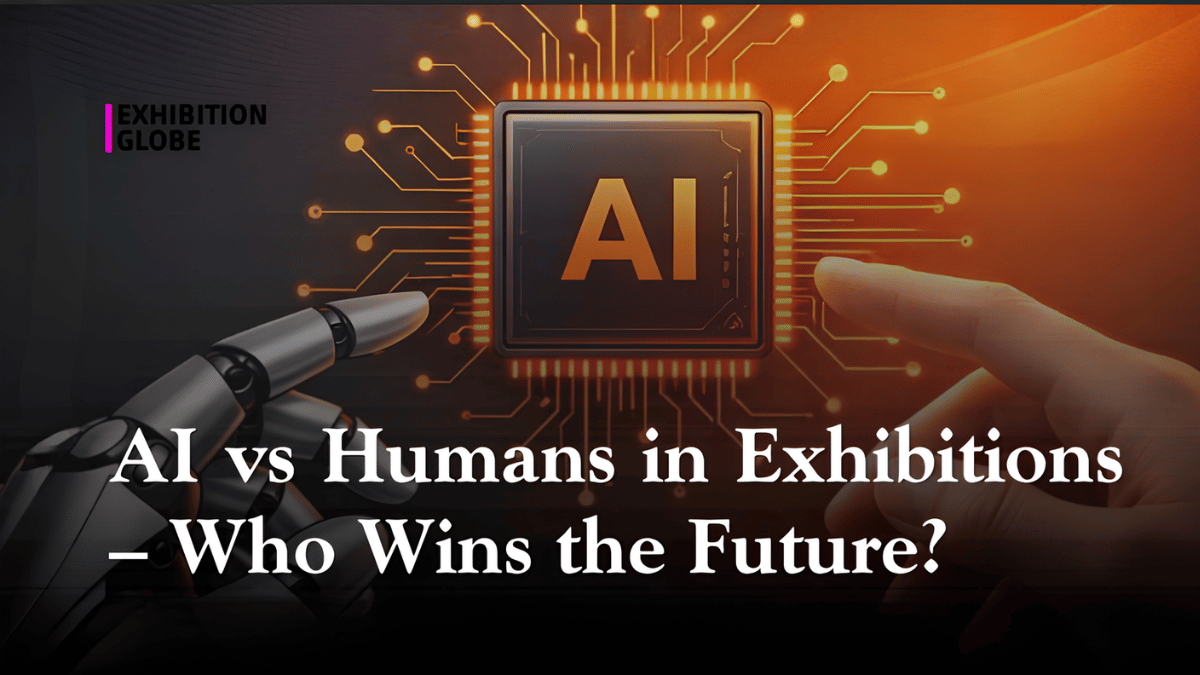
Yet, the rapid advancement of AI is beginning to challenge this foundation in meaningful ways. Today, artificial intelligence can analyze vast amounts of data to identify patterns that no human could detect. It can predict which visitors are most likely to engage, which exhibitors will generate the highest ROI, and even which conversations are worth prioritizing. It can automate scheduling, personalize recommendations, and optimize event layouts with remarkable precision. In many ways, AI is bringing a level of efficiency and intelligence that the industry has never experienced before.
This has led some to believe that the balance of power is shifting. If machines can handle matchmaking, marketing, analytics, and even elements of planning, what role remains for humans? The answer lies in understanding what AI can do—and what it cannot.

Artificial intelligence excels at processing information, identifying patterns, and making data-driven decisions. It thrives in structured environments where inputs can be measured and outcomes can be optimized. In exhibitions, this translates into better targeting, smarter engagement, and more efficient operations. AI can ensure that the right people meet, that resources are used effectively, and that performance is continuously improved.
But exhibitions are not purely structured systems. They are dynamic, unpredictable, and deeply human environments. A successful interaction at a trade show is rarely just about matching needs with solutions. It involves reading intent, understanding context, building rapport, and navigating complex interpersonal dynamics. These are areas where human intuition remains irreplaceable.
Consider the moment when a conversation shifts from formal to meaningful. When a visitor hesitates, asks an unexpected question, or reveals a hidden concern, it is not data that drives the response—it is instinct, experience, and emotional intelligence. These are qualities that cannot be easily programmed. They require presence, awareness, and the ability to adapt in real time.
The future of exhibitions, therefore, is not a competition between AI and humans. It is a collaboration. AI will handle the heavy lifting —data analysis, automation, and optimization —while humans will focus on what they do best: building relationships, creating experiences, and making decisions that go beyond logic.
This shift is already visible. Leading exhibitions are integrating AI into their systems, but not at the expense of human interaction. Instead, technology is being used to enhance it. Visitors are guided more intelligently, exhibitors are better prepared, and organizers are able to deliver more targeted experiences. The result is not a replacement of humans, but a redefinition of their role.
For professionals in the industry, this transformation brings both opportunity and responsibility. The skills that once defined success—operational efficiency, logistical management, and broad outreach—are being complemented by new requirements. Strategic thinking, creativity, and the ability to interpret and act on data are becoming increasingly important. The organizer of the future will need to be as comfortable with technology as they are with people.
There is also a broader implication. As AI becomes more embedded in exhibitions, it raises questions about control and differentiation. If every event uses similar technology, what sets one apart from another? The answer will lie in how that technology is used. Tools may be accessible to all, but the ability to create unique, meaningful experiences will remain a distinctly human advantage.
Ultimately, the debate between AI and humans is not about who wins—it is about how they coexist. The exhibition industry is not will it remain unchanged by technology. It is moving toward a hybrid model where intelligence is both artificial and human, where efficiency meets empathy, and where data supports—but does not replace—judgment.
In that future, success will not belong to those who choose one over the other.  It will belong to those who understand how to combine both.
Because in exhibitions, as in business, the real power lies not in choosing between technology and people— but in knowing how to make them work together.