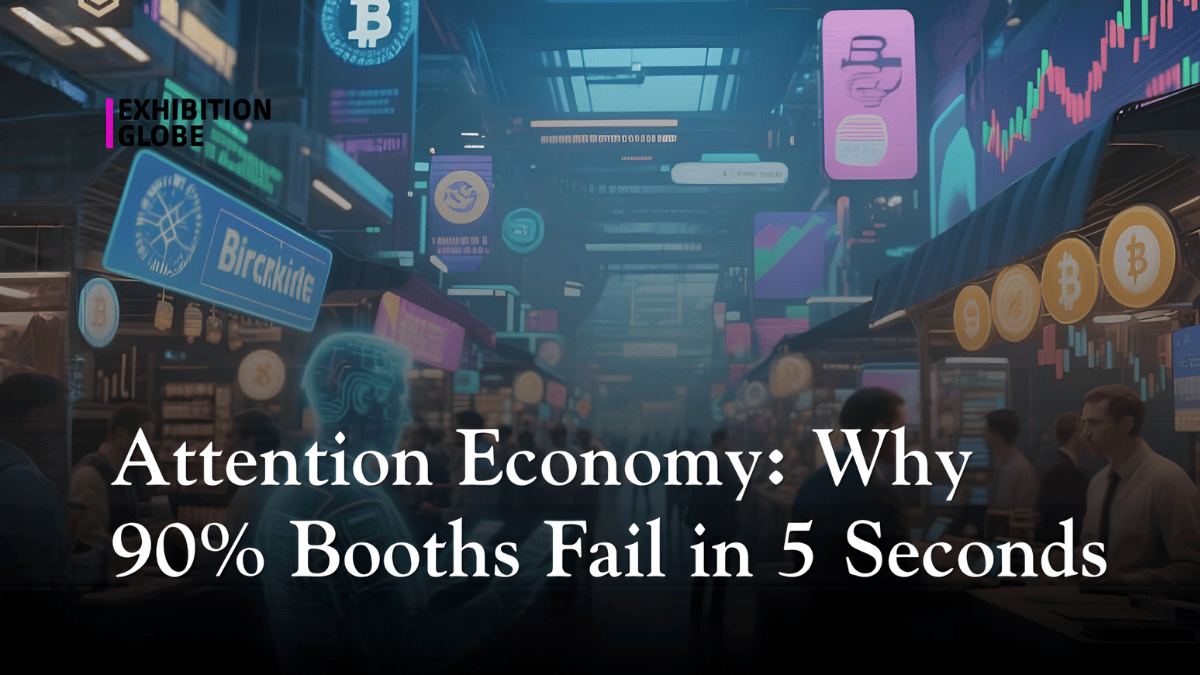
The modern exhibition floor reflects this shift clearly. Instead of uniform stalls, one increasingly encounters dynamic, open environments designed to engage multiple senses. Brands are no longer asking, “How do we display our product?” They are asking, “How do we make visitors experience our product?” This change in mindset is redefining booth design at a fundamental level.
Technology has played a major role in accelerating this transformation. Interactive screens, augmented reality, virtual demonstrations, and real-time data integration are turning booths into intelligent engagement zones. A visitor can now explore a product digitally, visualize its application, or even simulate its use without physical limitations. These tools not only enhance understanding but also create memorable interactions that extend beyond the exhibition floor.

The problem begins with a misunderstanding. Many exhibitors believe that participation itself is enough. They invest in space, design a booth, print marketing materials, and expect visitors to engage. But visitors today do not have the time or patience to explore every booth. They are filtering constantly, making rapid judgments based on what they see in an instant. If a booth does not immediately answer the question “Why should I care?”, it is ignored.
This is not a flaw in visitor behavior—it is a reflection of modern decision-making. In a world saturated with information, people rely on shortcuts. They look for signals—visual, verbal, and emotional—that help them decide quickly. Booths that fail to provide these signals are simply not processed. They are not rejected —they are overlooked.
Clarity, therefore, becomes the first and most critical factor. Many booths fail because they try to say too much. They display multiple messages, crowded visuals, and complex information. Instead of communicating value, they create confusion. And confusion leads to disengagement. Visitors do not attempt to decode—they move on.
Equally important is visual impact. In a crowded environment, design is not decoration —it is communication. A booth must stand out without being overwhelming. It must attract attention without appearing chaotic. Achieving this balance requires an understanding of contrast, spacing, and focus. Yet, many booths either blend into the background or attempt to compensate with excessive elements, both of which reduce effectiveness Beyond visuals, there is the issue of relevance. Visitors are not looking for everything—they are looking for something specific. If a booth does not clearly align with their needs or interests, it is dismissed immediately. This makes targeting essential. Exhibitors must understand who they want to attract and design their booth accordingly. A generic approach rarely works in a highly selective environment.
Another overlooked factor is engagement timing. Even when a visitor slows down or glances toward a booth, the opportunity is fleeting. If there is no immediate hook—no reason to step in—the moment is lost. This is why successful booths often use interactive elements, live demonstrations, or strong opening statements to capture attention instantly. They do not wait for engagement— they initiate it.
The human element also plays a decisive role. A well-designed booth can fail if the team inside it is passive or unprepared. Visitors often read body language before they read signage. An unapproachable or disengaged team can discourage interaction, while an active, welcoming presence can significantly increase engagement. In many cases, people—not design —make the difference.
Technology, too, is reshaping attention dynamics. Digital displays, immersive experiences, and real-time interactions are becoming more common. But technology alone is not a solution. When used without strategy, it can become a distraction rather than an attraction. The key lies in using technology to enhance clarity and engagement, not to replace them
Underlying all these factors is a simple but powerful principle: attention must be earned before it can be converted. Without attention, there is no conversation. Without conversation, there is no opportunity. And without opportunity, there is no return on investment.
The most successful exhibitors understand this deeply. They design their booths not just for presence, but for performance. They focus on the first five seconds—because that is where the decision is made. They prioritize clarity over complexity, engagement over information, and relevance over volume.
In the attention economy, visibility is no longer guaranteed. It is competed for, moment by moment, interaction by interaction. And in that competition, only those who understand how attention works can succeed.
The uncomfortable truth is that most booths do not fail because they lack potential. They fail because they fail to capture attention when it matters most.
And in a world where five seconds decide everything, that is a mistake few can afford.