A new global ranking by jwc has identified China and the United States as the world’s most attractive exhibition markets, highlighting the shifting dynamics of the global trade show industry. France secured the third position, followed by Germany, reinforcing the view that exhibition markets can no longer be evaluated solely by size.
The newly introduced country-level ranking uses a multidimensional evaluation framework to assess major exhibition markets worldwide. The analysis considers demand fundamentals, competitive dynamics, venue capacity, ecosystem readiness, and overall business conditions to determine market attractiveness.
Rounding out the top ten markets are Spain, Italy, the United Arab Emirates, India, the Netherlands, and Singapore. Together, these markets reflect a diverse mix of mature exhibition hubs and rapidly growing destinations.
India Leads in Market-Driven Segment
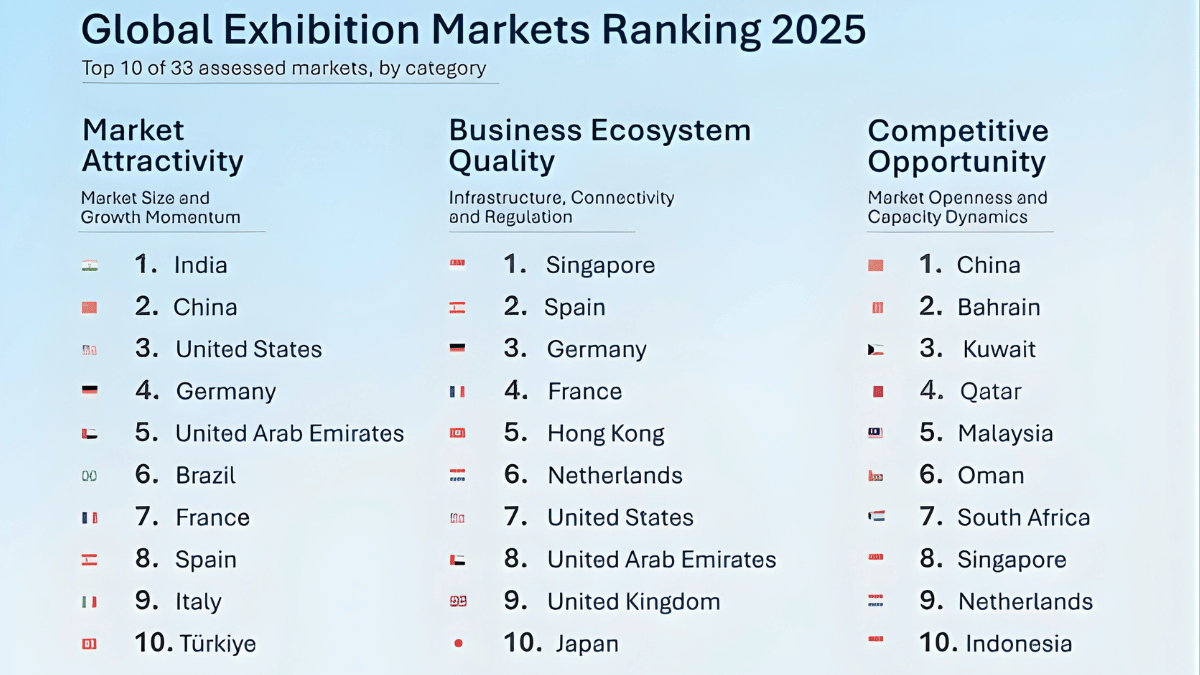
Alongside the overall ranking, the newly launched “jwc Top-10 Exhibition Markets Tables” highlight leading countries across three strategic segments. These tables form part of the organization’s regular GIPR report, offering deeper insight into the strengths of individual markets.
In the market-driven segment, which focuses on market size and growth potential, India ranks first. The country’s strong demand fundamentals and expanding exhibition infrastructure position it as one of the fastest-growing markets globally. China and the United States follow closely, demonstrating the continued importance of scale in high-volume exhibition markets.
China Tops Competition-Driven Markets
The competition-driven segment, which evaluates market openness, fragmentation, and accessibility, is led by China. It is followed by Bahrain and Kuwait, illustrating how regulatory frameworks and competitive structures can create opportunities even in smaller markets.
Singapore Leads Ecosystem-Driven Markets
In the ecosystem-driven segment, Singapore ranks first due to its highly institutionalised business environment, excellent international connectivity, and efficient administrative systems. Spain and Germany follow, highlighting the importance of strong infrastructure, logistics networks, and favorable business conditions in supporting exhibition industry growth.
Experts Highlight the Need for a Broader Evaluation Framework
According to Jochen Witt, simplified rankings can often overlook the complex factors that determine market attractiveness. He explained that exhibition markets may be appealing for very different reasons-whether due to scale, competitive openness, or ecosystem maturity-and that a multidimensional framework helps reveal these differences more clearly.
A Changing Global Exhibition Landscape
The report also emphasizes that exhibition markets operate at different stages of development. Some are large but face structural limitations, while others are smaller yet highly efficient. Meanwhile, several emerging markets are expanding rapidly due to strategic investments and supportive government policies.
Lorenzo Garbujo noted that the attractiveness of a market ultimately depends on an organizer’s strategic goals. The framework is designed to help event organizers and industry stakeholders prioritize markets that best align with their expansion plans.
Overall, the findings suggest that no single exhibition market is universally ideal. Instead, attractiveness depends on how market size, growth potential, competitive dynamics, and ecosystem conditions interact within each country.