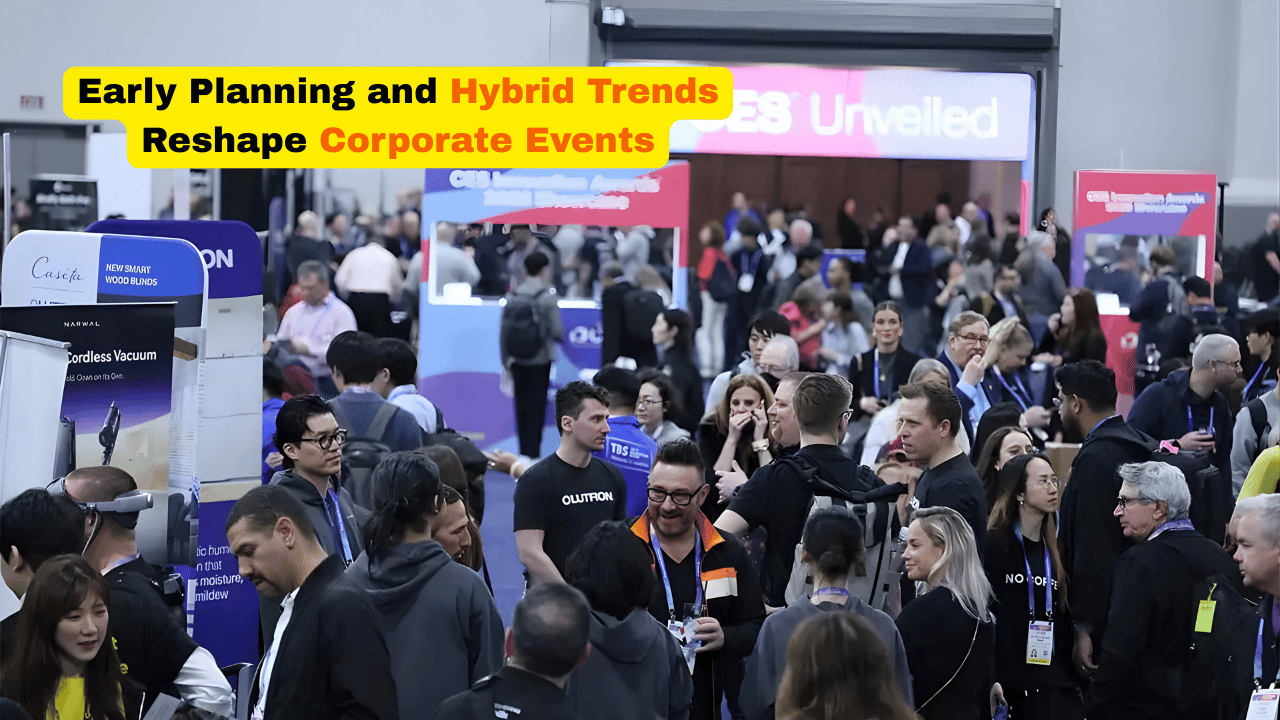
Corporate event planning cycles are extending significantly as companies increase investment in live experiences, according to a new 2026 corporate travel and events trends report.
The report highlights renewed confidence in in-person gatherings, with organizations expanding budgets while maintaining virtual access as part of the standard event format. The global corporate events market is projected to reach $595 billion by 2029, and 74 percent of Fortune 1000 companies plan to increase event budgets in 2025.
Longer Booking Lead Times Impact Event Strategy
One of the most notable shifts is the extended booking timeline for major convention venues. Lead times have now stretched to 18 to 24 months, reducing flexibility and requiring earlier decisions on budgets, destinations, and production planning.
For event organizers and exhibitors, this signals the need for proactive venue sourcing and early supplier engagement to secure preferred dates and locations.
Hybrid Events Become the New Baseline
Hybrid events are now firmly established as the core format. The report states that 80 percent of planners either host or plan hybrid events as a primary model. Additionally, 61 percent of organizers find hybrid formats more cost-effective than in-person-only programs.
By blending physical and virtual participation, companies are expanding audience reach while managing travel and accommodation costs more efficiently.
Rising Focus on Production and A/V Technology
As attendee expectations continue to grow, production quality has become a top priority. Sixty percent of planners cite advanced audiovisual (A/V) capabilities as a key investment area. Enhanced staging, streaming, lighting, and event technology are increasingly essential to delivering high-impact experiences.
Outsourcing and Specialist Partnerships Increase
Event complexity is driving greater reliance on external expertise. Sixty-six percent of planners outsource at least part of their event management, working with specialist suppliers for A/V production, event technology, sustainability compliance, and on-site execution.
This approach allows companies to manage operational demands while maintaining professional standards.
Secondary Markets Gain Popularity
Cost control is influencing destination strategy. Ninety percent of planners are considering secondary markets as alternatives to high-cost primary cities. These locations often provide competitive pricing, better venue availability, and attractive delegate experiences.
Sustainability and AI Adoption Accelerate
Sustainability remains a critical requirement, with 83 percent of planners factoring environmental impact into event planning decisions. Green venue selection, waste reduction, and carbon tracking are becoming standard considerations.
Technology adoption is also rising. Fifty-eight percent of event professionals report increased use of artificial intelligence (AI) and automation for attendee management, data analysis, personalization, and travel coordination.
Early and Strategic Planning Essential
Industry experts advise planners to book early and strategically while leveraging corporate travel management tools to coordinate logistics, control expenses, and streamline itineraries.
As corporate events grow in scale and sophistication, early planning, hybrid integration, sustainability focus, and advanced technology are shaping the future of the global events industry.