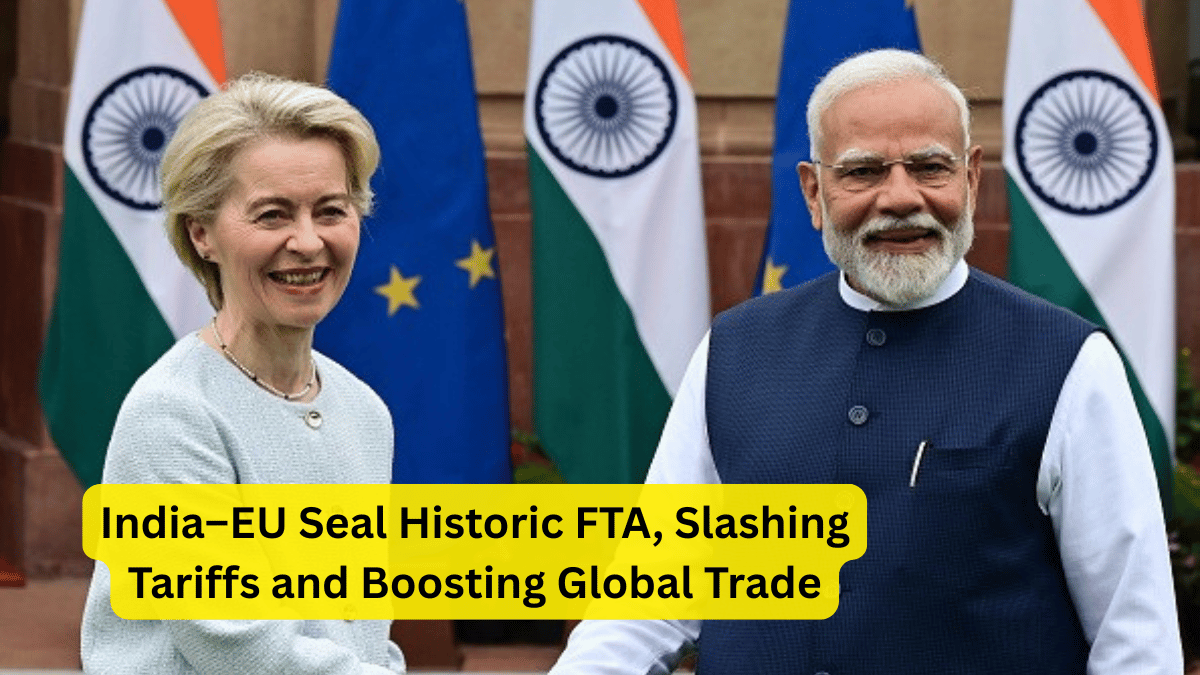
India and the European Union (EU) have officially finalised a historic Free Trade Agreement (FTA) after nearly two decades of negotiations, marking one of the most ambitious trade pacts in India’s history. Widely described as the “mother of all trade deals,” the agreement was announced at the India–EU Summit in New Delhi by Prime Minister Narendra Modi alongside senior EU leaders. Once implemented, the pact will create a vast free-trade zone covering nearly 2 billion people and accounting for around 25% of global GDP.
Under the India–EU FTA, tariffs on a broad range of goods will be significantly reduced or eliminated. Around 96–97% of EU exports to India will benefit from lower duties, potentially saving European exporters up to €4 billion annually. Key sectors such as automobiles, machinery, chemicals, processed foods, wine, and spirits will see phased tariff reductions over time, making EU products more competitive in the Indian market.
In a major move, tariffs on cars will be reduced to nearly 10%, while duties on EU aircraft and spacecraft will be fully eliminated, facilitating exports in high-value sectors. Tariffs on wine will be cut to 20–30%, spirits to 40%, and beer to 50%, while duties on fruit juices and several processed food items will be eliminated entirely.
In return, the European Union has agreed to ease market access for a wide range of Indian exports, including textiles, gems and jewellery, leather goods, pharmaceuticals, and other manufactured products. This is expected to significantly enhance India’s export competitiveness in the European market and support job creation across multiple industries.
The India–EU FTA is expected to deepen economic ties, boost bilateral trade and investment, and potentially double EU exports to India by 2032. Beyond goods, the agreement includes provisions to strengthen cooperation in services, customs facilitation, regulatory alignment, and market standards, making cross-border trade smoother and more predictable.
Trade experts see the pact as a major pillar of India’s long-term trade strategy, positioning the country as a more integrated player in global supply chains while reinforcing its strategic partnership with the EU.
Certain sensitive sectors, including parts of agriculture, steel, and automobiles, were negotiated separately or placed under cautious, phased implementation to protect domestic industries. These safeguards reflect a balanced approach aimed at liberalisation while addressing sector-specific concerns on both sides.
Before coming into force, the India–EU Free Trade Agreement must undergo legal vetting and formal ratification by the European Parliament, EU member states, and India’s Union Cabinet. Once approved, the agreement is expected to usher in a new era of economic cooperation between India and the European Union.
Overall, the India–EU FTA is being hailed as a major milestone in global trade diplomacy and a significant strengthening of strategic economic relations between India and the EU. With wide-ranging tariff cuts, expanded market access, and enhanced regulatory cooperation, the deal is set to play a transformative role in shaping future trade and investment flows between the two economies.