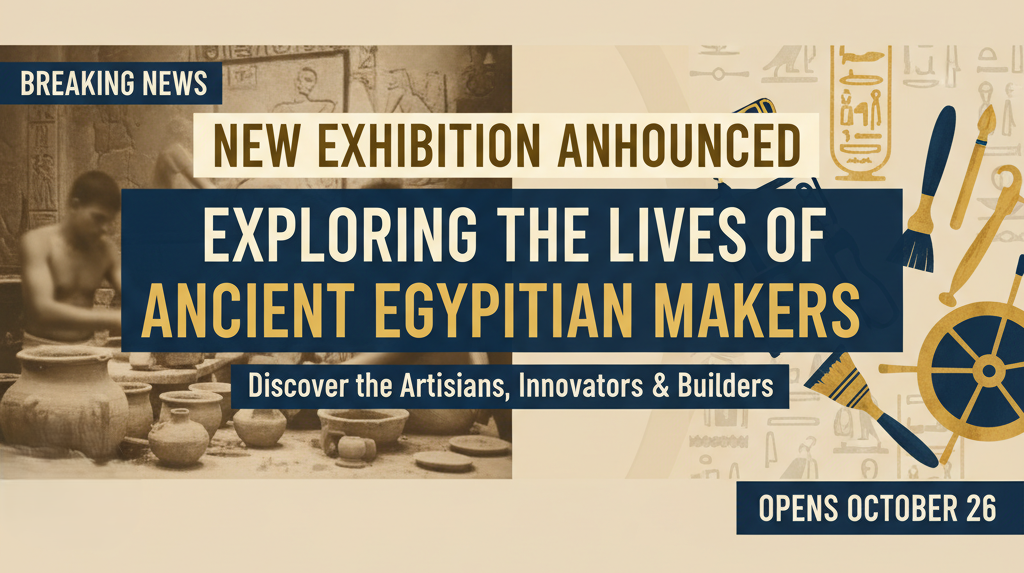
Made in Ancient Egypt exhibition offers a rare look behind Egypt’s monumental art, shining a spotlight on the Made in Ancient Egypt exhibition makers – the craftsmen and artisans whose names are usually lost in time. Held at the Fitzwilliam Museum in Cambridge, the show runs from 3 October 2025 to 12 April 2026, and aims to humanize the ancient craftsmen by bringing their work and lives into full view.
The Made in Ancient Egypt exhibition shifts focus away from pharaohs and gods, to the everyday lives of those who created jewellery, ceramics, sculpture, and architecture over millennia. This includes items seldom seen in typical displays: unfinished pieces, work orders, invoices, and even ostraca – pottery or limestone shards used by workers to write notes, doodles, instructions, or to commute messages.
What the makers left behind
Artifacts on display span roughly 4,500 to 1,800 years ago, highlighting craft traditions from ancient Egypt’s golden ages. The exhibition includes a glass vessel in the shape of a fish, tools used for jewelry, stone work, a drawing guide overlaying animals like cats and ibexes, and objects from the houses of Deir el-Medina and the recently discovered So’oud Atun.
Several particular pieces stand out: one shard bearing a hastily sent order for four windows (1295-1186 B.C.E.), another which documented how one worker named Panebu was bitten and took a day off, and even a receipt from the Louvre showing how much coffin decoration cost in terms of ancient wages. These help visitors connect with the makers as real people.
Technical process, life & worship
The Made in Ancient Egypt exhibition also reveals the technical processes and religious or spiritual dimensions of making: how materials were sourced, the labor conditions, how designs were transferred (via grids, sketches), how workshops functioned, and how the objects contributed to worship, funeral rites and daily life.
Curator Helen Strudwick emphasizes that this is more than an artifact show—it’s an invitation to “shake hands with the ancient Egyptians”, to feel their presence through fingerprints left on labor-worn tools, to sense urgency in orders, and through mundane but universal concerns like illness, rest, artistic standards, deadlines.
Why it matters
By presenting these overlooked pieces—notes, receipts, incomplete artworks—the Made in Ancient Egypt exhibition alters how we see ancient cultures. Rather than distant, legendary societies, we see people with jobs, families, challenges. It also reinforces that art is not just about grand monuments but about processes, individuals, and communities.
The exhibition gathers loans from major institutions (the Louvre, British Museum, Berlin State Museums, and more), bringing together objects that have rarely travelled.
For anyone interested in ancient history, craftsmanship, archaeology, or art, the Made in Ancient Egypt exhibition is a chance to explore the humanity behind the art. It encourages us to consider not just what the makers built—but how, why, and who they were.