Choosing the right table top material plays an important role in shaping modern home and office workspaces. Desks are no longer just static furniture; they now function as active work zones where planning, focus, and daily execution take place. This makes both performance and appearance equally important when selecting a surface. Among the popular engineered stone options, sintered stone and quartz stand out for their durability and refined finish. Understanding how they differ helps in selecting a surface that supports comfort, efficiency, and long-term design consistency.
Understanding Quartz as a Table Top Material
Quartz is a widely used engineered surface for desks and countertops, made by combining natural quartz crystals with resins and pigments under controlled conditions. This process creates a consistent and stable surface suitable for modern interiors. It offers a clean, polished look and is non-porous, helping resist everyday stains like coffee or ink. Quartz is also easy to maintain with simple cleaning. However, it has limited heat resistance, so caution is needed in environments where hot objects are frequently placed.
What Makes Sintered Stone Different?
Sintered stone is an advanced engineered surface designed for high-performance applications. It is made by compressing natural minerals under extreme heat and pressure, creating a dense and durable material. This structure gives it strong resistance to scratches, stains, heat, and UV exposure, helping it maintain its appearance under heavy daily use. It is also available in large slab formats, enabling seamless desk designs with minimal joints. Being non-porous, it remains hygienic and easy to maintain, suitable for shared and active workspaces.
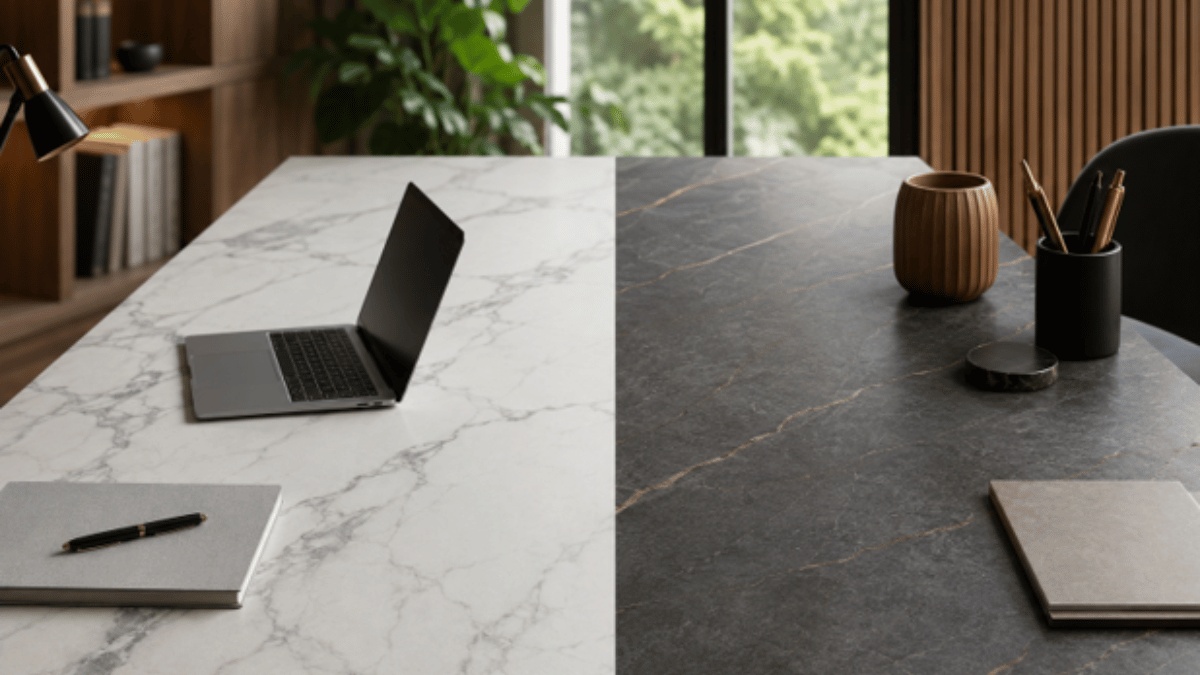
Visual Comparison of Quartz and Sintered Stone
Choosing between quartz and sintered stone is a matter of balancing surgical precision with organic artistry. While both materials are engineered for excellence, they cater to very different visual philosophies in modern interior design.
| Feature | Quartz | Sintered Stone |
| Consistency | Uniform and predictable across slabs. | Natural variation with high-definition detail. |
| Texture | Primarily smooth, polished, or honed. | Tactile, embossed, or stone-like. |
| Patterning | Symmetrical and controlled. | Replicates random natural veining. |
| Visual Scale | Best for standard, structured layouts. | Ideal for seamless, large-format impact. |
In modern desk design, quartz offers a dependable and clean foundation that fits well within a minimalist workspace. Sintered stone, on the other hand, expands design possibilities with its seamless, single-slab appearance, making it better suited to more expressive, visually bold environments.
Performance in Daily Work Use
Quartz performs well in everyday work environments, offering good stain resistance and maintaining a consistent finish under regular use, making it suitable for moderate-activity workspaces. It works best where usage is steady but not extreme, with care taken around heat and heavy impact. Sintered stone is designed for more demanding conditions, handling higher heat, pressure, and impact with ease. This makes it ideal for busy offices and shared desks, offering stronger long-term resistance to wear and environmental stress.
Maintenance and Ease of Use
Maintenance plays a key role in selecting a table top material for daily workspace use, where convenience, hygiene, and long-term appearance are important.
Quartz
Quartz requires little maintenance, as it does not need sealing and can be cleaned easily with standard cleaning agents, making it suitable for everyday residential and office use.
- Easy Cleaning: Quartz is simple to clean with everyday cleaning products and does not require sealing or specialized maintenance routines.
- Routine Care: It is designed for easy daily upkeep, making it suitable for moderate-use workspaces with consistent usage patterns.
Sintered Stone
Sintered stone offers very low maintenance with a non-porous surface that resists stains and performs well in high-usage environments while retaining its appearance over time.
- Stain Resistance: Its dense, non-porous structure prevents stains and liquid penetration, helping maintain a clean surface over time.
- Durability Care: It requires minimal upkeep, even in demanding conditions, making it suitable for busy, high-traffic workspaces.
Quartz and sintered stone both offer low-maintenance solutions for workspace tabletops, ensuring ease of cleaning, hygiene, and consistent visual appeal over time. Quartz works well for routine daily use with minimal upkeep, while sintered stone is better suited for heavier-use environments where greater resistance to stains and wear is required.
Role of Engineered Stone in Modern Interiors
Quartz and sintered stone are types of engineered stone surfaces designed to deliver greater consistency, durability, and usability than natural materials. These surfaces offer a controlled appearance, improved strength, and easier maintenance, making them suitable for modern homes and workspaces with daily use demands. They are widely preferred for their uniform finish and reliable performance over time. Solutions like Neotra Advanced Surfaces enhance this category with large-format slabs and NSF-certified hygiene standards, ensuring consistent quality, durability, and safe, modern interior applications.
Choosing Based on Workspace Needs
The choice between quartz and sintered stone depends on individual workspace requirements and usage preferences. Both materials offer reliable performance, and the selection should be guided by how the surface will be used on a daily basis.
- Quartz: Suitable for moderate-use spaces, home offices, and settings that prioritize easy maintenance and a clean, consistent look.
- Sintered Stone: Suitable for high-usage areas, shared workstations, and environments needing higher resistance to heat, scratches, and impact.
Both options are dependable, and the final choice should align with personal preference, design needs, and functional expectations of the workspace.
Conclusion
The selection of a table top material plays an important role in shaping modern work environments. Both quartz and sintered stone offer engineered solutions designed to improve usability, consistency, and long-term performance in desk applications. Each material supports different workspace requirements based on usage patterns, design needs, and maintenance expectations. Choosing the right surface helps create a workspace that remains functional, visually consistent, and reliable over time, supporting everyday work activities in both home and office settings.