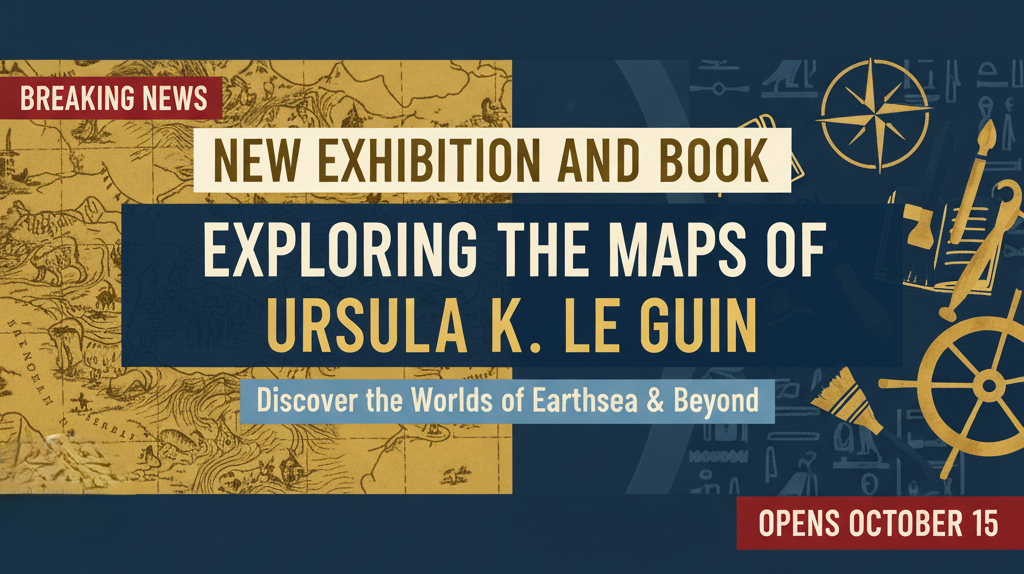
The Word for World maps exhibition opens a portal into the imagined universes of Ursula K. Le Guin, presenting her The Word for World maps exhibition pieces—original maps drawn by Le Guin to build worlds like Earthsea, Always Coming Home, and others. Hosted at the Architectural Association’s AA Gallery in London, this show runs from 10 October to 6 December 2025, and features many works that have never been publicly exhibited before.
The maps in this The Word for World maps exhibition function as both foundational blueprints for Le Guin’s stories and as reflections of her philosophy. For Le Guin, drawing a map wasn’t merely about geography—it was a way to explore identity, culture, memory, myth, and the relationship between people and place. The exhibition includes sketches, ink on paper drawings, archipelagos, valleys, and “talismanic” maps that evoke deeper symbolic meaning.
Many of the works have never been displayed before, giving audiences a rare glimpse into Le Guin’s process. Alongside maps of Earthsea and Always Coming Home, the exhibition showcases maps as early drafts, revealing how worlds evolved from rough lines to detailed landscapes, how boundaries and landforms were shaped by story not by cartography alone.
There’s also an accompanying book, The Word for World, edited by So Mayer and Sarah Shin, co-published by Spiral House and AA Publications. It collects Le Guin’s maps together with poems, essays, interviews, stories, and recipes—various voices responding to Le Guin’s cartographic imagination. The publication and exhibition together ask: how do we represent the world, how do we imagine it, and what are the maps we carry within us?
The design of The Word for World maps exhibition is immersive and poetic. Curators interpret Le Guin’s landscape metaphors—not just land and seas, but forests, valleys, islands, and celestial places—into physical space using installations and print works. Cyanotype prints, symbolic talismanic maps, and natural forms (leaves, stones) echo the organic, non-linear structure of Le Guin’s storytelling.
Why this matters: through The Word for World maps exhibition, Le Guin’s maps cease being just supplementary to her novels. They become central to understanding her worldview. The show invites fans and newcomers alike to rediscover how place, myth and narrative intertwine, to see maps not simply as directions, but as stories, as reflections, as ways of knowing.
If you plan to visit, it’s at 36 Bedford Square, WC1B 3ES, AA Gallery. Admission is free, but booking ahead is advised. The opening event (10 October 2025) also marks the book launch, making for a multi-layered celebration of Le Guin’s creative legacy.