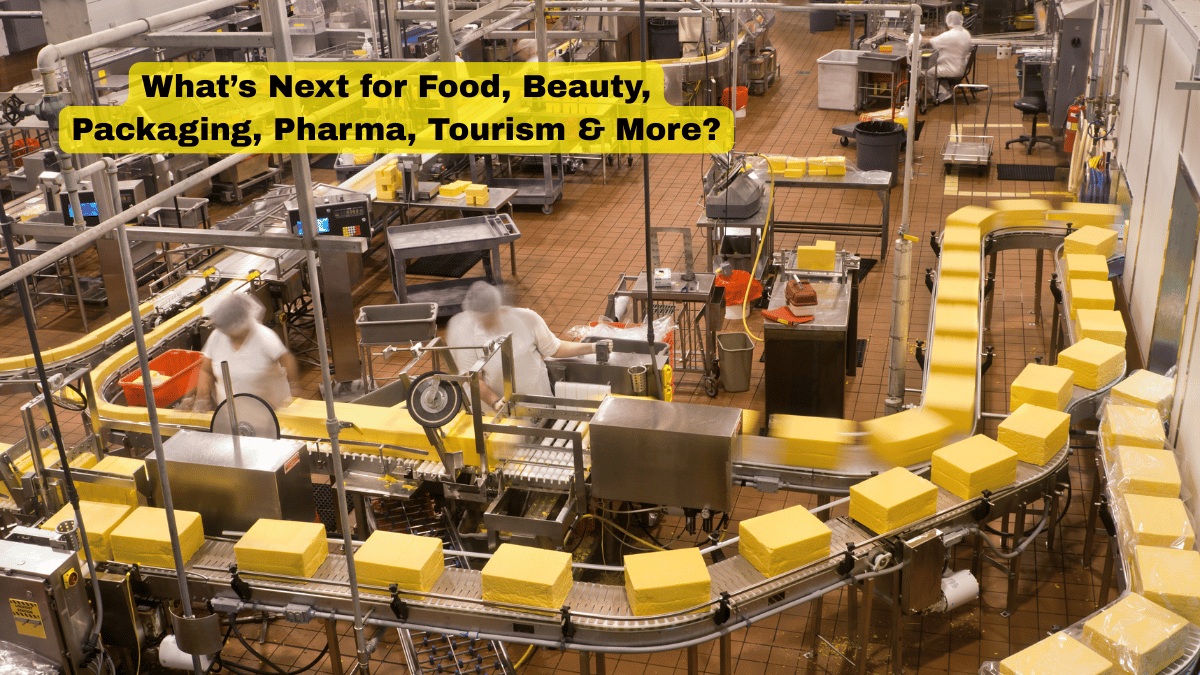
WHAT’S NEXT FOR FOOD, BEAUTY, PACKAGING, MACHINERY, PHARMA, TOURISM & MORE ?
INTRODUCTION: 2026 WILL BE A DEFINING YEAR FOR GLOBAL INDUSTRIES
Across the world, major industries are entering a phase of rapid transformation. Technology, sustainability, logistics reconfiguration, consumer behaviour, and regional economic shifts are reshaping how products are made, marketed, and consumed. Exhibitions—often the first place where these macro trends become visible—are acting as strategic windows into the future of global sectors. Based on insights from global expos like Gulfood, CES, CPhI, Interpack, Cosmoprof, ITB Berlin, and Hannover Messe, we present the most authoritative and comprehensive industry outlook for 2026.
1. FOOD & BEVERAGE: HEALTH, CONVENIENCE & GLOBAL FLAVOURS DRIVE THE FUTURE
The global F&B industry is undergoing its largest evolution in decades, driven by rising demand for health-conscious products, cleanlabel ingredients, and ready-to-cook convenience foods. In 2026, the health-food industry is expected to grow at 8–12%, led by plant-based proteins, dairy alternatives, functional beverages, gluten-free and allergenfree categories, and sugar-reduction technologies. Consumers want food that supports immunity, digestion, mental clarity, and energy—making nutraceutical-infused products one of the fastest-growing segments. Convenience continues to dominate urban markets, with ready meals and meal kits expected to expand further. International flavours—Korean, Middle Eastern, Indian, Mexican—are gaining strong demand worldwide. Sustainability pressures will push manufacturers toward recyclable packaging, waste reduction, and ethical sourcing.
2. BEAUTY & PERSONAL CARE: CLEAN BEAUTY, MEN’S GROOMING & DERMA COSMETICS LEAD 2026
Beauty remains one of the world’s most resilient sectors, expected to grow at 7–9%, with derma cosmetics, haircare actives, anti-aging formulations, and premium skincare taking centre stage. Consumers are shifting from cosmetic beauty to science-backed dermatologyinspired products, driving demand for serums, acids, retinol combinations, peptide-infused creams, and microbiome-balancing skincare. Clean beauty—free from harmful chemicals— continues to expand globally, especially in Europe, UAE, and Southeast Asia. Men’s grooming evolves into a major standalone category as younger demographics embrace skincare routines. Beauty-tech tools such as skin analysers, AI shade-matching systems, and AR try-on technology will elevate brand engagement across retail and exhibitions.
3. PACKAGING: SUSTAINABLE MATERIALS & AUTOMATION ARE REDEFINING THE INDUSTRY
Packaging is undergoing a major transformation due to global sustainability pressures. In 2026, recyclable materials, compostable films, monolayer plastics, and biodegradable solutions will dominate innovation. Regulations in Europe, UAE, and parts of Asia are forcing manufacturers to adopt eco-friendly packaging systems while maintaining performance. Automation is reshaping factories as demand rises for faster production, precision filling systems, robotics-assisted packaging lines, and smart inspection tools. Digital printing, QRenabled packaging, and track-and-trace technologies are becoming essential as brands prioritise transparency. Exhibitions such as Interpack, ProPak, and PackExpo report massive demand for machines that reduce energy consumption and improve efficiency.
4. MACHINERY & INDUSTRIAL AUTOMATION: ROBOTICS, AI & SMART MANUFACTURING RULE 2026
Industrial machinery sectors are experiencing a rapid shift toward smart manufacturing, robotics, and AI integration. Industry 5.0— combining human intelligence with machine precision—is becoming the new global standard. Demand for CNC machines, automation systems, robotic arms, and semiconductor-based controllers is rising across Europe, India, China, and Southeast Asia. Manufacturers aim to reduce labour dependency while increasing output efficiency. AI-driven predictive maintenance, digital twins, cloud-integrated machinery, and MR-based factory visualisations are transforming industrial workflows. Machinery exhibitions report that buyers increasingly demand energyefficient machines and modular lines adaptable to multiple product formats.
5. PHARMACEUTICALS & HEALTHCARE: GLOBAL GROWTH LED BY INNOVATION & ACCESSIBILITY
The global pharmaceutical industry is projected to reach USD 2 trillion by 2026, driven by biotech innovation, AI-supported research, and rising demand for generics and biosimilars. India, the U.S., Germany, Switzerland, and South Korea remain key hubs for pharma R&D and manufacturing. Healthcare is experiencing rapid digitalisation with telemedicine, wearable diagnostics, remote monitoring technologies, and AI-led imaging systems. Exhibitions like CPhI Worldwide and Arab Health report rising demand for medical devices, surgical robotics, diagnostic kits, and hospital automation tools. Accessibility and affordability remain global priorities, opening opportunities for exporters of generic drugs, medical consumables, and essential equipment.
6. TOURISM & HOSPITALITY: PREMIUM TRAVEL, SUSTAINABILITY & DIGITALLYENABLED EXPERIENCES
Tourism is rebounding strongly worldwide, expected to surpass pre-pandemic levels by 2026. The Middle East, South Asia, and Southeast Asia are witnessing massive tourism expansion due to global events, investments, and major infrastructure development. The future of tourism is premium experiential travel —culinary tourism, adventure travel, wellness retreats, and cultural experiences. Hospitality brands are adopting sustainabilityled operations, energy-efficient systems, and contactless service technologies. Digital guest experiences—including AI concierges, mobilefirst bookings, biometric check-ins, and automated service delivery—are becoming fundamental. Events like ITB Berlin and ATM Dubai show rising demand for tourism tech and travel solutions.
7. ELECTRONICS & CONSUMER APPLIANCES: AI-NATIVE PRODUCTS DOMINATE THE MARKET
The electronics sector is transitioning into an AI-native era, with smart-home systems, IoTintegrated devices, and voice-enabled appliances leading global demand. In 2026, consumer electronics will expand by 5–8%, driven by smart TVs, wearables, AR/VR devices, home automation kits, and connected kitchen appliances. Asia (especially China, South Korea, and India) remains the world’s manufacturing backbone, while the U.S. and Europe lead in premium electronics consumption. Exhibitions such as CES and IFA highlight a future where every device will be intelligent, customisable, and interconnected.
8. AUTOMOTIVE & EV: THE ELECTRIC REVOLUTION ACCELERATES
The global EV market is expected to grow over 20% in 2026, powered by battery innovation, government incentives, infrastructure expansion, and rising consumer awareness. China remains the world’s EV powerhouse, followed by Europe and the U.S. India is emerging rapidly due to favourable policies and local manufacturing expansion. Hydrogen fuel cell technology and autonomous driving are also gaining momentum. Exhibitions like Auto Expo, IAA Mobility, and EV Japan show an explosion of new component suppliers, software solutions, charging tech, and sustainability-driven mobility innovations.
9. TEXTILES, FASHION & APPAREL: COMFORT, FUNCTIONALITY & FAST FASHION REINVENTION
The textile and apparel sector is moving toward functional fabrics, recycled materials, sustainable dyes, and comfort-driven fashion. Athleisure continues to dominate global trends, while luxury fashion houses invest in digital runway experiences and custom production models. Countries like India, Bangladesh, Vietnam, and Turkey remain manufacturing hubs, while Europe and the U.S. drive premium consumption. Textile exhibitions highlight increasing demand for advanced machinery, printing technology, and AI-driven production forecasting tools.
CONCLUSION: 2026 WILL BE THE YEAR OF INNOVATION, PERSONALISATION & GLOBAL INTEGRATION
Across all major sectors—F&B, beauty, packaging, machinery, pharma, tourism, electronics, automotive, and textiles—the common threads shaping 2026 are technology, sustainability, customisation, digital intelligence, and global trade diversification. Exhibitions will remain the world’s most powerful platforms for showcasing innovation, connecting industries, and driving economic growth. Companies that embrace smart technology, anticipate new consumer behaviours, and expand across diverse global markets will lead their sectors into a decade defined by opportunity and transformation.