The exhibition industry has always evolved alongside business itself. From traditional trade fairs and industry gatherings to highly sophisticated global business platforms, exhibitions have continuously adapted to changing market dynamics, technological advancements, and customer expectations. However, the pace of change being witnessed today is unlike anything the industry has experienced before.
The years between 2026 and 2030 are expected to redefine how exhibitions are organized, experienced, and measured. Artificial intelligence, sustainability, data analytics, business communities, global trade shifts, and changing buyer behavior are creating new realities for organizers, exhibitors, and visitors alike.
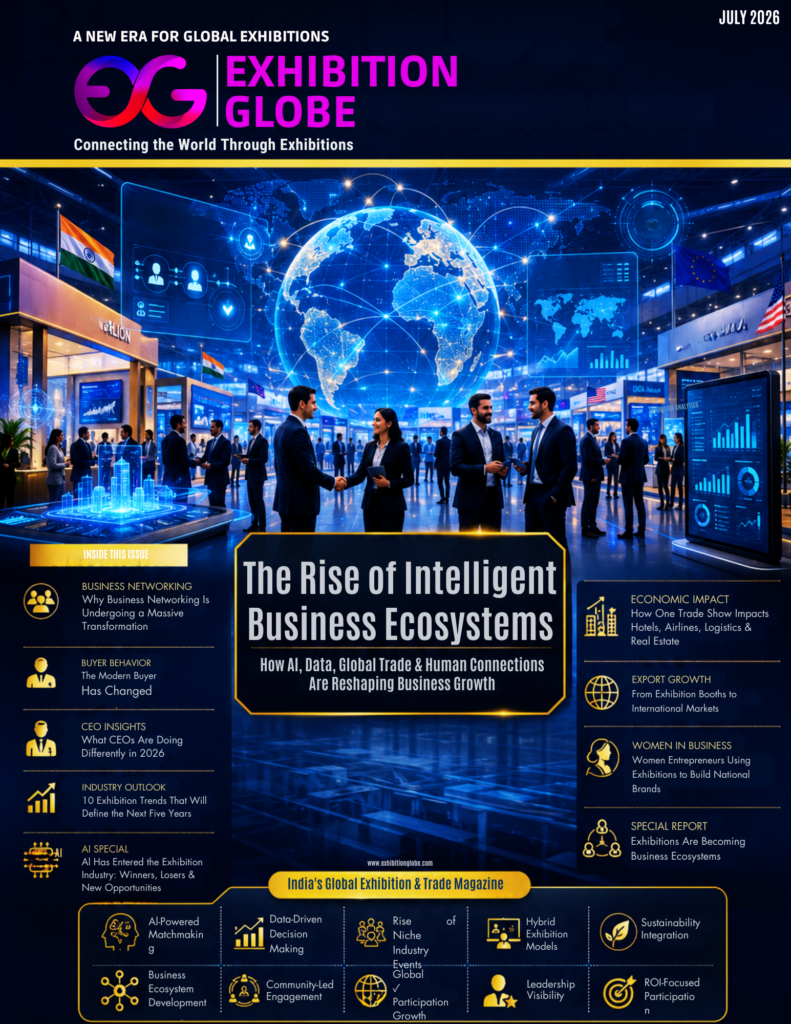
The future of exhibitions will not simply be bigger events. It will be smarter, more targeted, more measurable, and more integrated into the broader business ecosystem. The organizations that understand these emerging trends today will be best positioned to capitalize on the opportunities of tomorrow.
Trend 2: Data Will Become the New Currency of Exhibitions
For decades, exhibition success was measured through basic metrics such as footfall, booth traffic, and attendee registrations. While these indicators remain important, they are no longer sufficient. The future exhibition industry will be driven by data.
Organizers will increasingly provide detailed analytics covering visitor behavior, engagement levels, dwell times, meeting outcomes, lead quality, and conversion potential. Exhibitors will demand measurable evidence of return on investment rather than relying on assumptions.
Data will influence every aspect of decisionmaking, from booth placement and event design to marketing strategies and follow-up activities.
As analytics capabilities continue to improve, exhibitions will become one of the most measurable business development platforms available. Organizations that learn to leverage data effectively will gain significant competitive advantages.
Trend 3: Niche Exhibitions Will Outperform General Trade Shows
The era of large generic exhibitions is gradually giving way to highly specialized industry events. Businesses are increasingly seeking targeted audiences rather than mass exposure. As a result, niche exhibitions focusing on specific industries, technologies, or business communities are attracting growing interest.
Events dedicated to sectors such as artificial intelligence, electric vehicles, agritech, cybersecurity, sustainable manufacturing, and smart infrastructure are generating stronger engagement and better outcomes than broad multi-industry events.
Visitors appreciate the relevance, while exhibitors benefit from higher-quality interactions. Over the next five years, specialization will become one of the most important factors determining exhibition success.
The future belongs to focused communities rather than broad audiences.
Trend 4: Hybrid Experiences Will Become Standard
The debate over physical versus virtual events is largely over. The future is hybrid.
Physical exhibitions will remain the foundation of business networking because face-to-face engagement remains irreplaceable. However, digital components will increasingly extend the reach and lifespan of events.
This hybrid approach enables exhibitions to serve both physical attendees and remote participants simultaneously. Instead of lasting three or four days, exhibitions will evolve into year-round engagement platforms supported by digital communities and content ecosystems.
The exhibition of the future will exist both onsite and online.
Trend 5: Sustainability Will Move from Marketing to Necessity
Sustainability is no longer a corporate buzzword. It is becoming a business requirement.
Exhibition organizers, exhibitors, venues, and service providers are facing increasing pressure from customers, governments, and stakeholders to reduce environmental impact. Over the next five years, sustainable practices will become standard operating procedures rather than optional initiatives.
Reusable booth materials, digital brochures, energy-efficient venues, carbon footprint reporting, waste reduction programs, and sustainable logistics solutions will become increasingly common. Businesses that fail to align with sustainability expectations may face reputational risks and reduced participation opportunities.
The future exhibition industry will be measured not only by economic impact but also by environmental responsibility.
Trend 6: Exhibitions Will Become Business Ecosystems
The traditional exhibition model focused primarily on product displays and visitor interactions.
The future model is far broader. Modern exhibitions are evolving into complete business ecosystems that combine exhibitions, conferences, networking events, startup showcases, investor forums, training programs, and industry communities.
Participants increasingly expect more than product displays. They seek knowledge, partnerships, mentorship, investment opportunities, and strategic insights. As a result, exhibitions are becoming platforms where entire industries connect, collaborate, and evolve. The most successful organizers will be those who create comprehensive ecosystems rather than isolated events.
Business development will become the central objective.
Trend 7: Community Building Will Outperform Event Marketing
Traditionally, exhibitions focused heavily on promoting attendance. Future-focused organizers are shifting attention toward community building.
Instead of engaging attendees only during event periods, organizers are creating year-round communities through webinars, newsletters, networking groups, online forums, and industry content. These communities strengthen relationships, increase engagement, and improve retention rates.
Participants increasingly value belonging to professional ecosystems that provide continuous opportunities for learning and collaboration. The strongest exhibition brands of the future will be those that successfully transition from event organizers to community builders. The event may last a few days, but the community operates throughout the year.
Trend 8: International Participation Will Increase Rapidly
Globalization is entering a new phase. While geopolitical shifts continue to influence trade patterns, businesses remain eager to explore international markets and diversify growth opportunities. Exhibitions provide one of the most efficient mechanisms for facilitating crossborder business development.
India, in particular, is emerging as an attractive destination for international exhibitions due to its growing economy, expanding infrastructure, and strategic position within global supply chains.
Over the next five years, more exhibitions are expected to feature international pavilions, hosted buyer programs, trade delegations, and cross-border business matchmaking initiatives. The distinction between domestic and international exhibitions will become increasingly blurred.
Business opportunities will become more global than ever before.
Trend 9: Leadership Visibility Will Become a Competitive Advantage
The role of leadership within exhibitions is evolving significantly.
Previously, senior executives often delegated exhibition participation to sales and marketing teams. Today, CEOs, founders, and business leaders are becoming increasingly visible at industry events. Their presence attracts attention, builds credibility, strengthens relationships, and creates strategic opportunities.
Thought leadership sessions, keynote presentations, panel discussions, and executive networking activities are becoming important components of modern exhibitions. Businesses increasingly recognize that people connect with people, not just brands.
Over the next five years, leadership visibility will become an important competitive differentiator for organizations seeking growth and influence.
The Future Is Already Beginning
While these trends may appear futuristic, many are already reshaping the exhibition landscape today.
Artificial intelligence is improving networking. Data analytics are enhancing decision-making. Sustainability is influencing operations. Communities are extending engagement. Hybrid models are expanding reach.
The next five years will not introduce a completely new exhibition industry. They will accelerate transformations that have already begun. For organizers, exhibitors, investors, and business leaders, the challenge is not predicting the future.
It is preparing for it.
Over the next five years, leadership visibility will become an important competitive differentiator for organizations seeking growth and influence.
Trend 10: ROI Will Become the Ultimate Success Metric
The next five years will not introduce a completely new exhibition industry. They will accelerate transformations that have already begun. For organizers, exhibitors, investors, and business leaders, the challenge is not predicting the future.
Final Thought
The exhibition industry is entering one of the most exciting periods in its history.
Technology is making events smarter. Communities are making them stronger. Data is making them measurable. And business needs are making them more important than ever before. The winners of the next five years will not simply be those who organize bigger exhibitions.
They will be those who create more meaningful connections, deliver measurable value, and build ecosystems that continue long after the exhibition doors close. The future of exhibitions is not about events. It is about creating opportunities at scale.