The best business event management companies are the ones whose specialty matches your event. Hire a full-service corporate planner for a launch, retreat or client dinner. Hire a conference management firm for a multi-day program with speakers and sponsors. Hire a trade show management company to run your own exhibition. Hire a destination management company when the event is in a city you do not know. Production and experiential agencies cover the stage and the attendee experience.
Most buyers get stuck because every company calls itself full-service. Websites make the same promises, and a search for a planner in your area returns wedding planners, venues, ticketing platforms and software vendors in the same results. You cannot compare firms fairly until you know which category you are shopping in.
This guide sorts the field into six types and explains what each handles, who it suits and how it charges. It then shows how to find firms near you and compare them side by side. Exhibition Globe has covered the exhibition and events industry since 2017, so the advice here reflects how organizers, exhibitors and suppliers work together in practice.
1. Full-service corporate event planners
Full-service corporate event planner companies are the default choice when you want one team to own an event from goal-setting to teardown. They suit most one-off company events, such as product launches, sales kickoffs, leadership retreats and client dinners.
One accountable team beats five vendors you have to coordinate yourself.
What they handle
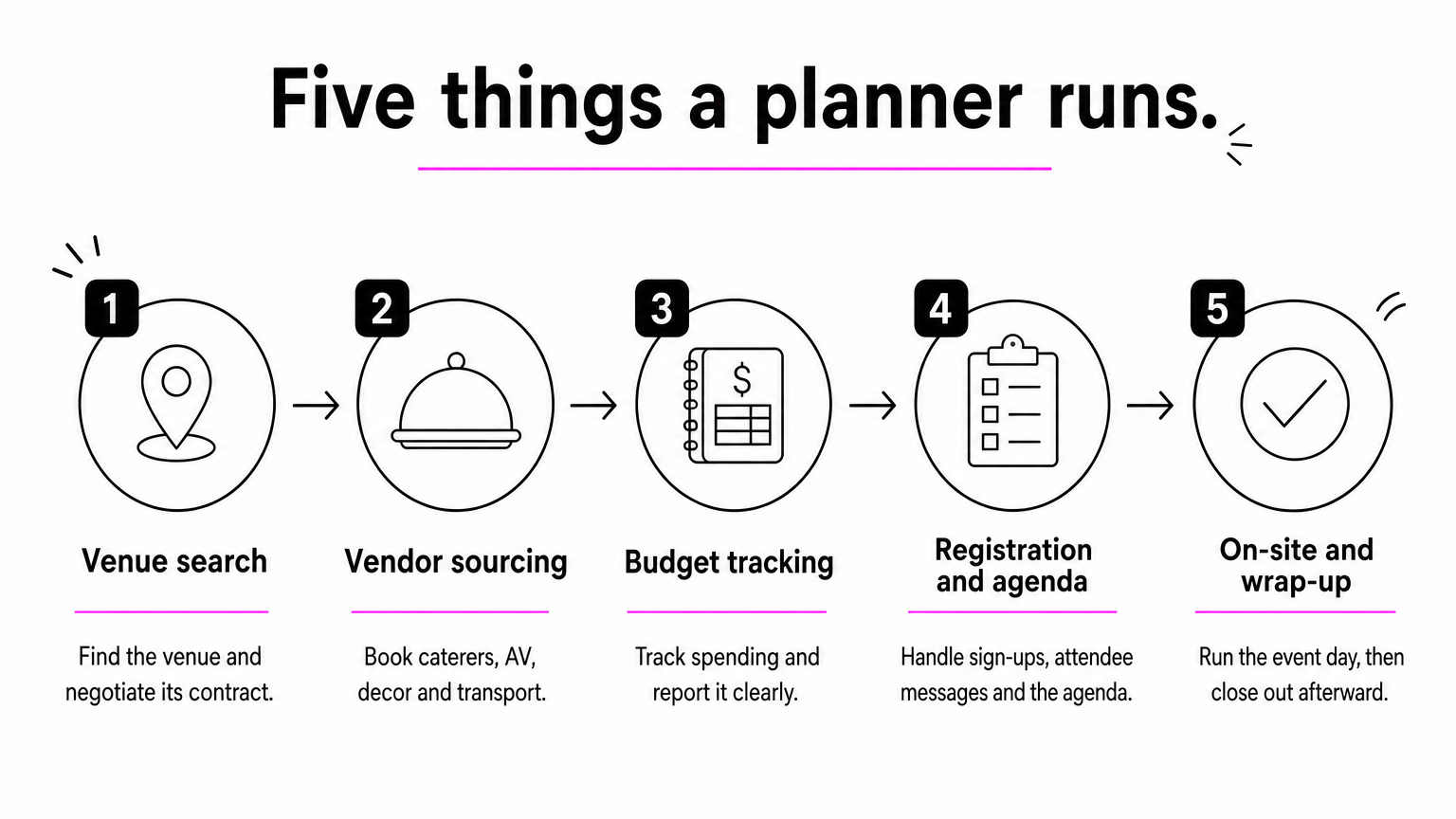
A full-service firm turns your goal into a plan, a budget and a run of show, then executes it. The scope usually includes:
- Venue search and contract negotiation
- Sourcing of caterers, AV, décor and transport
- Budget tracking and reporting
- Registration, attendee communications and agenda
- On-site management and a post-event wrap-up
Who it suits
This type fits companies that host an event once or twice a year and have no in-house events team. You get senior planning experience without a full-time hire, and the firm absorbs the vendor relationships you do not have.
Small business event management companies deserve a look here too. Boutique firms with a handful of planners often take events of 50 to 150 guests and put a senior planner on your account. Larger agencies may set minimum budgets, so ask early.
Pricing and what to ask
Full-service planners charge a flat project fee, an hourly rate, or a percentage of total event spend. Ask each firm:
- How many events of my size and type did you run in the last two years?
- Who is my day-to-day contact, and who is on site?
- Do you mark up vendor costs or pass them through at net?
2. Conference and meeting management companies
Conference management companies being business event management companies run multi-day programs where content, speakers and registration matter as much as the venue. Pick one when your event is built around sessions rather than a single dinner or launch.
A conference lives or dies on its program and registration, so hire for those skills first.
What they handle
These firms manage the parts of a conference that a general planner often treats lightly. Typical scope:
- Call for speakers, agenda building and speaker coordination
- Registration, badges and hotel room blocks
- Sponsor and exhibitor packages
- Hybrid streaming and session recording
- Attendee surveys and post-event data
Who it suits
This is the right type for companies with an annual customer or user conference, and for associations and professional bodies. If sponsorship revenue pays for the event, choose a firm that actually sells sponsorships, not one that only places logos.
Events under about 100 people rarely need this level of specialization from business event management companies. A full-service planner covers a one-day seminar well, and a conference firm’s minimums may cost more than the extra skill is worth.
Pricing and what to ask
Expect a management fee, often billed monthly across the planning cycle, plus per-attendee charges for registration. Some firms also take a commission on sponsor sales. Ask:
- Which registration platform do you use, and who owns the attendee data?
- Can I speak to a client whose conference had similar attendance?
- How do you handle speaker cancellations and agenda changes?
3. Trade show and exhibition management companies
Trade show management companies organize the exhibition itself: the floor plan, exhibitor sales and visitor marketing. Hire one when you are launching or running a show where other companies pay to exhibit.
A show works when exhibitors meet the buyers they paid to see.
What they handle
The work is closer to running a marketplace than to throwing a party. It usually covers:
- Floor plan design and booth allocation
- Exhibitor sales, contracts and the exhibitor manual
- Coordination with show service contractors for power, freight and rigging
- Visitor marketing and buyer registration
- Permits, safety rules and venue compliance
Who it suits
This type serves trade associations, companies starting a new show, and organizers who want to outsource operations. It is a choice for the organizer, not the exhibitor. If you only plan to take a booth at someone else’s show, you need an exhibit builder or the show’s official contractor, not a show manager.
If you are building an exhibition from scratch, ask whether the firm has launched a show before. Running an established show and launching a new one are different jobs.
Pricing and what to ask
Fees vary widely. Some firms charge a fixed management fee. Others take a share of booth revenue, or combine a smaller fixed fee with a bonus tied to net revenue. Ask:
- What is the exhibitor retention rate on the shows you run?
- How do you attract buyers, not just visitors?
- Who signs the venue contract, and who carries the cancellation risk?
4. Destination management companies
Destination management companies (DMCs) are local specialists who run the on-the-ground side of an event in a place that is not your home turf. Hire one for incentive trips, international meetings and any group event where local knowledge decides the outcome.

A DMC is your local team in a place where you have none.
What they handle
A DMC knows which hotels, venues and suppliers are reliable in its city, and it has the relationships to get them. Typical scope:
- Hotel and venue sourcing
- Ground transport and airport transfers
- Excursions, dinners and gala logistics
- Local permits and staffing
- Backup plans for weather, strikes or supplier failures
Who it suits
DMCs suit corporate groups traveling to an unfamiliar city or country, and planners who need a local partner. Many full-service planners subcontract a DMC for exactly this reason, so you may be paying for one even if you never hire one directly.
If your event is in your own city, you probably do not need a DMC. Searching for business event management companies near you will serve you better in types 1, 2 and 3. Skip the DMC when you already know the local suppliers.
Pricing and what to ask
DMCs typically quote per program or per person, with a management fee plus a markup on supplier costs. Ask:
- What licenses and insurance does this destination require, and do you hold them?
- Which suppliers do you own, and which do you simply book?
- What happens if a venue or vendor cancels two days before the event?
5. Event production companies
Event production companies supply the technical show: stage, sound, lighting, video, streaming and scenic builds. Hire one when you have the venue and the agenda, and you need the event to look and sound right.

Production is where small mistakes become visible to every attendee.
What they handle
Production firms turn an agenda into a working technical plan. Typical scope:
- Audio, staging, lighting and LED walls
- Show calling and stage management
- Livestream and hybrid broadcast setups
- Technical rehearsals
- Load-in and load-out
Who it suits
This type fits keynote-driven events, product launches, award nights and hybrid conferences. It also fits teams that already have a planner and need a technical partner who can run the stage without constant supervision.
Check the venue first, because it decides which business event management companies can quote. Many venues have in-house AV with exclusivity or fees for outside crews, so confirm the rules before you collect quotes. A good production company will also ask for the venue’s technical specifications, such as ceiling height and power, before it quotes.
Pricing and what to ask
Production is priced as an itemized quote of equipment, crew and day rates, plus travel and setup days. Ask:
- Can you do a site visit before you quote?
- Can I see the quote itemized by equipment and labor?
- What backup gear is on site, and who is the lead technician?
6. Experiential and brand activation agencies
Experiential agencies design the part of the event attendees talk about afterward. Hire one when the goal is brand impact, product trial or lead generation more than pure logistics.
Experiential agencies sell ideas first, so ask how they will prove those ideas worked.
What they handle
These agencies start with a creative concept, then build it. Typical scope:
- Concept and creative direction
- Interactive installations, demos and pop-ups
- Branded content capture for social and sales follow-up
- Sponsor and partner activations
- Measurement of attendance, engagement and leads
Who it suits
Marketing teams launching a product or hosting customer events get the most from this type. So do exhibitors who want a booth people stop at rather than walk past. For a standard internal conference, the creative premium rarely pays back.
Treat the agency as the idea and design partner. If it does not manage logistics and production itself, pair it with a planner or production firm, and name one party as accountable for the final result.
Pricing and what to ask
Costs usually combine a creative fee, a production budget and a management fee. Ask:
- How do you measure results: leads, dwell time, survey scores?
- Who owns the designs and content after the event?
- Is production done in-house or subcontracted?
How to find and compare companies near you
Start with referrals and local venue contacts, then send three to five firms the same written brief. A like-for-like brief is the fastest way to compare business event management companies in your own area.
Send every firm the same brief, and the differences in their answers show you who to hire.
Where to find local firms
Ask the event managers at venues you like. They see which planners run clean events and which ones create problems. Then ask peers at companies in your industry and the trade associations you belong to. When you search online, include your city and the specific type, for example "conference management company" plus the city name, instead of a generic term.
A business directory can fill in the gaps. The EG Business Listing on Exhibition Globe lists service providers, venues, services and jobs from the events industry. Treat any directory as a starting list, then check each firm’s own portfolio and ask for references from events in your city.
Compare shortlisted firms side by side
Use the same criteria for every firm: relevant experience, who staffs your event, how they price and what they exclude. This table summarizes how the six types differ.
| Type | Best for | Typical pricing | Hire when |
|---|---|---|---|
| Full-service planner | Launches, retreats, dinners | Flat fee, hourly, or % of spend | You want one team to own the event |
| Conference manager | Multi-day, session-based programs | Management fee plus per-attendee fees | Content and registration drive the event |
| Trade show manager | Exhibitions with paid booths | Fixed fee or share of booth revenue | Exhibitors pay to take part |
| DMC | Groups in an unfamiliar city | Per-program quote with fee and markup | The event is away from home |
| Production company | Stage, sound, video | Itemized equipment and crew | Venue and agenda are set |
| Experiential agency | Brand moments, launches | Creative fee plus production | Impact matters more than logistics |
Check the money before you sign
Compare total cost, not headline fees. Take an event with $80,000 in vendor and venue spend. A planner charging a 15 percent management fee adds $12,000, for a total of $92,000. A rival quoting a flat $10,000 fee brings the total to $90,000, but only if the flat fee includes on-site staff and travel. This example is illustrative, so use your own quotes.
Watch for these red flags:
- No written scope of work
- Reluctance to share references
- Vague answers about vendor markups
- Pressure to sign before a site visit
- A pitch team that differs from the team that would run your event
Choosing your event partner
Match the type of B2B event management companies to the job first, then compare firms on one written brief. A planner suits a launch or retreat, a conference manager suits a session-based program, a trade show manager suits an exhibition, a DMC suits events away from home, a production company suits the stage, and an experiential agency suits brand impact. Compare total cost, check references from events like yours, and make sure one party is accountable for the result.
If you want to build your shortlist, browse service providers and venues on Exhibition Globe and start with the type that matches your event.