Event marketing jobs are roles where you plan, promote, run and measure live or virtual events, such as trade shows, conferences, product launches and brand activations, so a company earns leads, sales or awareness. In the United States, posted pay runs from about $42,000 a year for entry-level assistants to well over $100,000 for corporate specialists and managers. ZipRecruiter’s national average, which counts every listing, sits near $43,000. You can find openings near you, hybrid or remote, on every major job board. The skill is knowing which titles to search and which listings to skip.
This guide covers why the work is worth considering, the job titles and what each one does, what each level pays, how to find and apply for roles locally and remotely, and how to stand out. The pay figures come from current postings rather than guesses, and the guide explains where the averages mislead.
Exhibition Globe covers the exhibition, trade show and conference industry. Alongside its news, interviews and business directory, it runs a jobs section for events industry roles.
Why event marketing jobs are worth pursuing
Event marketing jobs are worth pursuing if you want work tied directly to revenue, openings across many industries and a clear promotion path. You also need to be able to handle weekends, travel and long event days. Both sides are covered below.
Where the demand comes from
Hiring is spread across sectors instead of sitting in one. Current listings come from medical technology, software, live entertainment, hotels, universities, senior living and consumer brands. The major job boards each show thousands of matching openings in the United States, although many are loosely related marketing roles. Any company that sells through face-to-face contact needs someone to run its events, so your skills carry over if one industry slows.
- Medical technology and healthcare: congress and tradeshow operations, often with compliance rules
- B2B software and services: trade shows, field events, invitations and post-event follow-up
- Live entertainment and sports: regional marketing and sponsorship activations
- Hotels and venues: combined events and marketing coordinators
- Education: enrollment and campus events
- Consumer and retail: brand ambassadors and promotional representatives
The career ladder is clear. Most people move from assistant to coordinator, then specialist, then manager, with side routes into field marketing, sponsorships and brand marketing. Results are also easy to prove, because events produce meetings booked, leads captured, pipeline and revenue that you can put straight on a resume.
Event marketing is one of the few marketing careers where you can point to a room full of people and a lead count as proof of your work.
What the work costs you
The trade-off is the schedule. Postings ask for weekends, evenings and holidays, extended hours on event days and travel, sometimes international. Setup and teardown are physical, and some events run outdoors in all weather or in spaces without air conditioning.
Decide whether that suits you before you apply. People who like variety, deadlines and meeting strangers tend to thrive. People who need a predictable nine to five often find it wearing. Hybrid roles exist, but one corporate posting required three days a week in the office on top of event travel.
Event marketing job titles and what each one does
Event marketing job titles run from assistant to director, and the duties matter more than the title, because identical words describe very different jobs. Start with what the work involves, then match it to a level.
What an event marketer does
An event marketer owns the commercial result of an event, not only the logistics. The work falls into three phases.

- Before the event: set goals with sales (engagement, meetings, leads, pipeline, revenue, ROI), choose events, build the budget, and write invitations, landing pages and emails.
- During the event: run the booth or activation, manage vendors, shipping, setup and teardown, brief staff, and capture leads with scanners or forms.
- After the event: hand leads to sales quickly, send follow-up sequences, report on spend and results, and run a debrief for the next show.
That ownership of outcomes is the role of event marketing inside a business. It turns a costly day or week of face time into a measurable source of leads.
Titles, experience and focus
Experience asks in current postings climb in clear steps. Use this table to place yourself.
| Title | Typical experience asked | Main focus |
|---|---|---|
| Event marketing assistant or associate | None to 2 years, paid training common | Supporting events, promotions, outreach and setup |
| Events and marketing coordinator | 1 to 3 years | Calendars, vendor orders, logistics, email and social support |
| Event marketing specialist | 2 to 3+ years | Running events end to end, including trade shows, budgets and vendors |
| Field marketing specialist | 2+ years | Regional events, sales alignment, lead follow-up |
| Event marketing manager | 5 to 8+ years | Strategy, team leadership, budget and ROI |
| Brand ambassador or representative | Often none | Face-to-face promotion, sampling or retail lead generation |
Event marketing versus event coordination
In theory, marketing promotes the event and drives attendance and leads, while a coordinator handles logistics such as venues, schedules and vendors. In practice the lines blur. One posted "Event Marketing Specialist" job was described as the operational lead for congresses and tradeshows, covering exhibit management, freight, housing, compliance and budgets.
Read the duties list to see which side a job leans toward. Shipping, housing and vendor contracts mean a logistics-heavy role. Messaging, invitations, lead handoff and reporting mean a marketing-heavy one. Pick the mix you want before you apply.
Judge an event marketing job by its duties list, not its title.
What event marketing jobs pay
Event marketing jobs pay about $43,000 a year on average nationally, but corporate postings reach $75,000 to $140,000 or more. Your level and industry matter far more than the average.
The national average and why it misleads
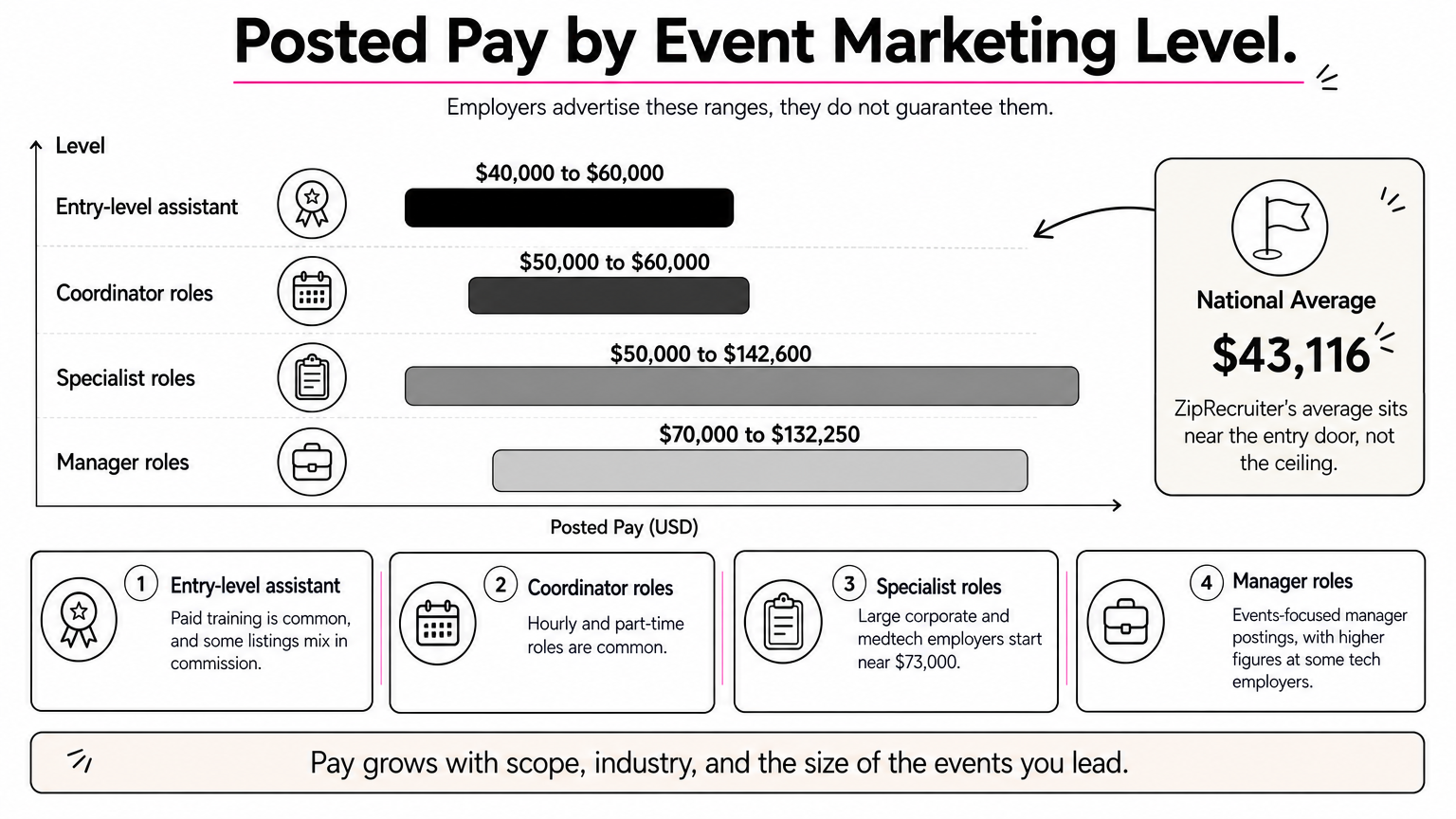
ZipRecruiter reports an average yearly pay for event marketing in the United States of $43,116 as of late October 2026. Most workers in its data earn $40,000 to $47,000, the median is about $43,500, and the 75th percentile is $46,800. Those figures are accurate for the data set, but the data set leans heavily toward entry-level assistants, promotions representatives and part-time coordinators.
Corporate specialist and manager postings sit far above that band. Some "representative" listings also quote ranges as wide as $40,000 to $90,000, which usually means commission is mixed in. When you compare offers, compare them against the posted range for your level, not the national average.
The national average describes the entry door, not the ceiling.
Posted pay ranges by level
These ranges come from current postings. They show what employers advertise, not what they guarantee.
| Level | Posted pay range | What to know |
|---|---|---|
| Entry-level assistant or associate | $40,000 to $60,000 a year | Paid training is common, and some listings mix salary with commission |
| Coordinator | $50,000 to $60,000 a year, or about $19 to $29 an hour | Hourly and part-time roles are common |
| Specialist | $50,000 to $142,600 a year | Small employers sit near the bottom, while large corporate and medtech employers start near $73,000 |
| Manager | $70,000 to $132,250 a year | Events-focused manager postings, with higher figures at some tech employers |
Hourly roles need a quick conversion. A posted $25 an hour full-time coordinator job comes to 25 × 2,080 hours, or $52,000 a year. The same rate at 28 hours a week comes to 25 × 28 × 52, or $36,400. Check the weekly hours before you compare an hourly offer with a salary.
What pushes pay higher
Industry and scope move pay the most. The top ranges go to medical technology and enterprise tech employers, where events carry large budgets and compliance duties. One field marketing posting at a fast-growing tech company listed $130,000 to $180,000, which is among the highest figures in event-related roles. Director-level roles are posted less often and frequently without a range.
Experience and credentials help too. Corporate postings ask for three or more years of event logistics or tradeshow experience, and they name the Certified Meeting Professional and Certified Trade Show Marketer credentials as preferred. Employers also adjust pay by location, so the same title can pay noticeably more in a higher-cost metro area.
How to find and apply for event marketing jobs
Find event marketing jobs by searching several titles on two or three boards, setting alerts, and applying early. Then add organizer and venue career pages for the sectors you like.
Search by title, not only by keyword
Employers rarely use one label. Search the full family of titles, or you will miss most openings. Most large boards accept quotation marks and OR, so one string can cover several titles.
"event marketing" OR "field marketing" OR "experiential marketing" OR "trade show" OR "events coordinator"
Also try regional marketing coordinator, sponsorship marketing associate, event producer and events and marketing coordinator. Sort by date so you see fresh posts first.
The best event marketing jobs often sit under titles that do not contain the words "event marketing."
Find roles near you and beyond the big boards
For event marketing jobs near you, set your city and then widen the radius, because smaller metro areas post fewer roles. Hotels, convention centers, universities, hospitals, medical device makers, live music venues and real estate groups all hire event staff. Career pages of local venues and show organizers often list roles before the big boards do.

Trade media is another source. Exhibition Globe runs a jobs section for the events industry, and its EG Business Listing directory lets visitors find service providers, jobs, services and venues. Its coverage leans toward India and Asia, so it suits you best if you want to work for international organizers or learn which companies run the shows in your sector.
Remote and entry-level event marketing jobs
Remote event marketing jobs exist, but they are fewer and come with conditions. They cluster in B2B tech, education and healthcare, usually as field marketing or events manager roles. Many still expect travel to events, and one remote posting required candidates to live in specific metro areas. Filter for remote, then read the residency line before you apply.
For entry-level roles, search assistant, associate, coordinator and intern. Hospitality, banquet, catering and campus event work counts as relevant experience, and one posting asked for just a year of special event, catering, hotel or restaurant experience. Volunteering at conferences and student events fills the gap if you have none.
A five-step routine for applying
- Set alerts on two boards for four or five of the titles above.
- Check new listings every day and apply within the first few days.
- Rewrite the top third of your resume to mirror the duties, using terms such as budget management, vendor coordination and lead capture.
- Attach a one-page summary of two or three events you worked on, with attendance, budget and outcome.
- Send a short follow-up email after a week, restating one relevant result.
How to stand out and avoid weak listings
You stand out by showing results in numbers, matching the tools in the posting, and spotting weak listings before they cost you time.
Skills and credentials employers ask for
Postings repeat the same core skills: project management, vendor management, budget tracking and clear communication across sales, marketing and procurement. Corporate roles often list a bachelor’s degree. Tool names that recur include Cvent, Salesforce and other CRM platforms, lead retrieval systems and email tools.
Healthcare and medtech roles add compliance knowledge, such as the Sunshine Act and Open Payments rules, to their preferred lists. If you are early in your career, learn one event platform and one CRM well enough to describe a real task you completed in each.
Resume bullets that show results
Hiring managers scan for scale and outcome. Each bullet should name the event, the size, the budget and the result. Use this pattern and replace the placeholders with your own figures.
Ran [event type] for [number] attendees on a $[budget] budget, producing [number] qualified leads and [number] sales meetings.
A filled-in example with placeholder numbers: "Managed booth logistics for three trade shows, kept spend within a $60,000 budget, and delivered 400 scanned leads to sales within 48 hours." Without a budget or lead figure, a bullet reads like a duty. With one, it reads like proof.
Warning signs in a listing
Many "event marketing" listings are really commission sales jobs, such as staffing a retail kiosk to book appointments. Some are legitimate entry points, but you should know what you are accepting. Watch for these signs:
- A very wide pay range for a representative role, such as $40,000 to $90,000
- "No experience needed, immediate hire" paired with weekly pay quotes
- A marketing title where the duties are door-to-door or kiosk sales
- No named employer, or a vague company description
- Any request that you pay for training or materials
Ask directly whether the pay is salary, hourly or commission, how many hours a week to expect, and whether travel is reimbursed.
A wide pay range on a "representative" job often means a small base and commission filling the rest.
Where to go from here
Event marketing jobs reward people who match the title to the duties, compare pay against their own level, and apply early. Search the full family of titles, treat the $43,000 national average as an entry-level figure, and read every posting for commission, travel and residency conditions. Back your resume with budget and lead numbers.
If you want to learn how the industry works while you search, browse the events industry jobs and listings on Exhibition Globe. Combine that with alerts on the major boards and a short list of local venues and organizers, and you will see most of the openings worth your time.