The best event organizer companies for you are the ones that specialize in your kind of event, show you comparable work, and put their fees in writing. A wedding planner suits a wedding, a corporate agency suits a conference, and a day-of coordinator suits a small party where the venue is already booked. Match the type first, then compare individual firms.
Most searches for event organizers return a long list of names that tells you little. You cannot tell a firm that runs 300-person galas from one that coordinates backyard parties. This article sorts event organizer companies into seven types instead, so you know who to call, what to ask, and what a fair quote looks like.
We publish Exhibition Globe, a media platform and business directory for the events and trade show industry, active since 2017. We spend our days with organizers, service providers and venues, so the questions below come from how the industry actually works. Company names change, but the types stay stable, and the last section shows you how to find firms near you.
1. Full-service event planning firms
What they do
Full-service firms run an event from the first brief to the final pickup. They own the whole project, so you approve decisions instead of chasing suppliers. A typical scope covers:
- Venue search and contract negotiation
- Hiring and managing caterers, florists, rentals and entertainment
- Design, floor plans and a minute-by-minute run of show
- A team on site during the event
A full-service firm earns its fee only when one team is accountable for the entire event.
Who they suit
Large weddings, milestone birthdays, anniversaries and galas suit this model. Once your guest list passes about 100 people, or you are coordinating several vendors and venues, a single accountable lead saves dozens of hours.
Skip this type when you only need help on the day. You would pay for design and sourcing work you already did yourself, and a day-of coordinator costs far less.
Pricing and what to ask
Fees usually come as a flat project fee or a percentage of the total budget, and percentages around 10 to 20 percent are commonly quoted. Before you sign, ask:
- Who is my daily contact, the owner or a junior planner?
- Do you earn commissions from vendors you recommend?
- Can I speak to two clients with events like mine?
2. Wedding planners and coordinators
What they do
Wedding planners work on one kind of event, so they know the vendor circuit and the pacing of a ceremony and reception. Their services come in three tiers:
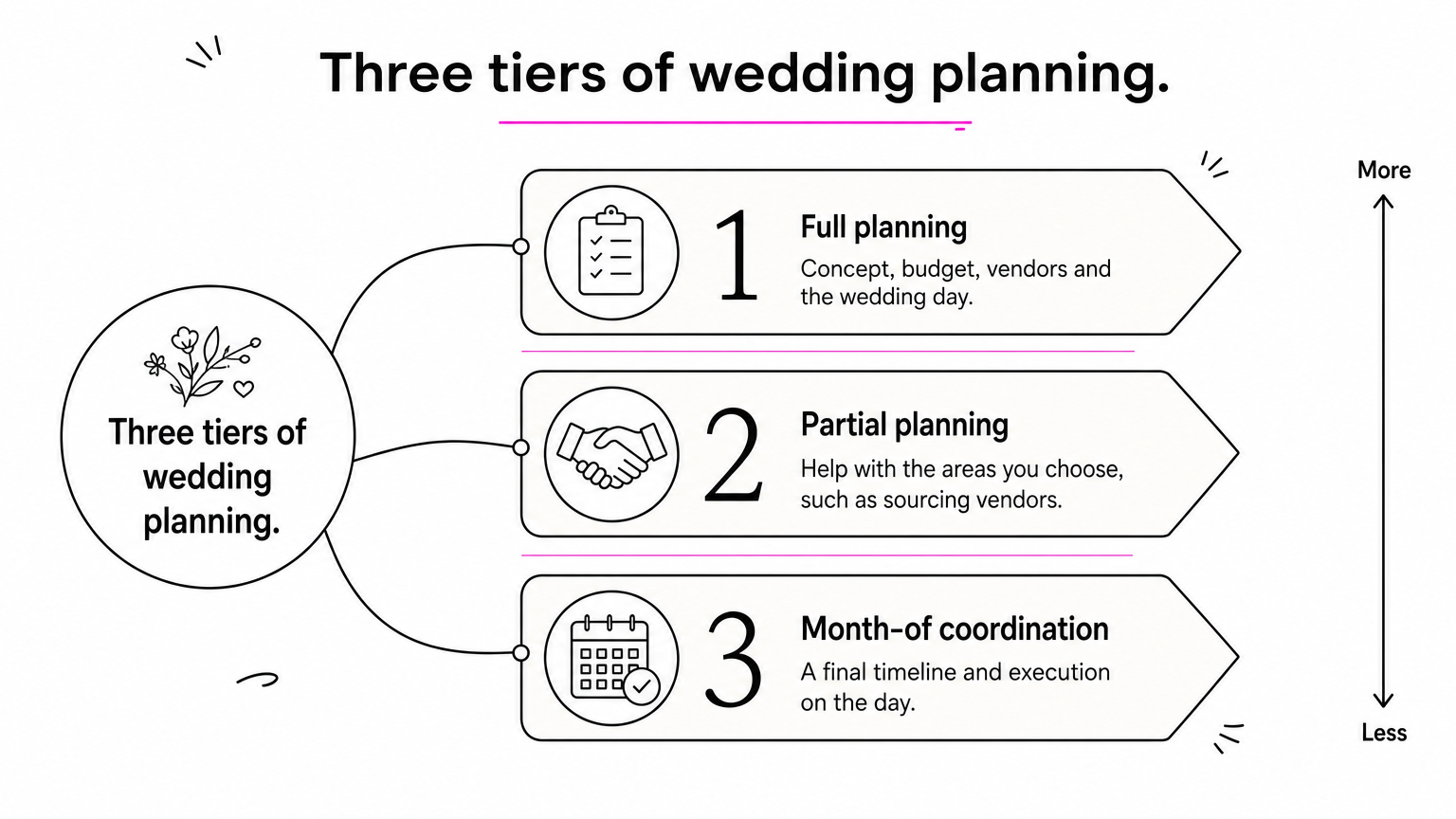
- Full planning: concept, budget, vendors and the wedding day
- Partial planning: help in the areas you choose, such as sourcing vendors
- Month-of coordination: a final timeline and execution on the day
Choose the planning tier before you choose the planner, because the tier sets both the price and your workload.
Who they suit
Couples with moving parts benefit most, such as religious services, multi-day celebrations or destination weddings. Ask every candidate whether they have run traditions like yours. Referrals from family, venues and community groups are often the fastest route to a planner who already understands your customs, including Black-owned, women-owned and other specialist firms.
Couples planning a simple one-day event with organized friends and family can often save money with coordination only.
Pricing and what to ask
Planners typically sell flat packages by tier, and coordination-only packages cost the least. Compare what each package includes, not just the headline number. Useful questions:
- How many weddings do you take on the same weekend?
- Will you review vendor contracts before I sign them?
- What is your backup plan if you are sick on the day?
3. Corporate event agencies
What they do
Corporate agencies plan events that serve a business goal, such as a conference, product launch, offsite, awards dinner or holiday party. They start from the objective, then build the program, registration and budget reporting around it. Many also handle speakers, sponsors and attendee data, which in-house teams often lack time to manage.
A good corporate agency can tell you in one sentence what the event is supposed to achieve for your company.
Who they suit
Marketing, HR and sales teams that run events a few times a year suit this model. Your team sets the goal and approves the budget, and the agency carries the logistics.
If you run events every week, an in-house planner may cost less over a year. If you hold one large event annually, an agency is easier than hiring someone permanent.
Pricing and what to ask
Agencies charge a project fee or a monthly retainer, and some add a markup on vendor costs. Ask for the markup in writing and for a budget that shows vendor costs separately from the agency fee. Also ask:
- Which companies in our industry have you worked with?
- How do you measure results after the event?
- What insurance do you carry for corporate events?
4. Trade show and exhibition organizers
What they do
Trade show organizers create and run B2B exhibitions. They sell booth space, market the show to buyers, manage the venue and often program conference sessions alongside the floor. Associations and industry bodies also hire exhibition management firms to run their annual expos. We cover these organizers every day at Exhibition Globe, from packaging and cargo shows to dental and facade expos.

A trade show organizer is judged by the quality of the visitors it brings, not the size of the hall.
Who they suit
Two readers need this type. Exhibitors choose an organizer by choosing the show they join. Associations and companies launching their own expo hire a management firm to run it.
Exhibitors also need a stand contractor or booth designer, which is a separate service from the organizer. Book that supplier early, because the best ones fill up before major show dates.
Pricing and what to ask
Exhibitors usually pay per square foot or square meter of booth space, with extras for power, furniture and sponsorship. Firms hired to run a show quote a management fee or a revenue share. Ask:
- Can you share visitor numbers and a buyer profile for last year’s edition?
- What share of exhibitors rebook?
- Which venues have you managed shows in?
5. Event production companies
What they do
Production companies deliver the technical side of an event: sound, lighting, staging, LED screens, projection, livestreaming and hybrid broadcasts. Some organizers subcontract this work, while others expect you to book it directly. If your event depends on a stage, a presentation or a stream, hire production early and treat it as its own contract.

- Audio, lighting and video equipment with technicians
- Stage design, rigging and set builds
- Livestream and recording crews for hybrid events
Technical failures ruin more events than weak decor, so book production with the same care as the venue.
Who they suit
Conferences, product launches, concerts, fundraisers and hybrid meetings suit this type. You bring the concept and the venue, and the production team makes it work technically.
For a casual party in a restaurant, a speaker and a playlist are enough. Hiring a production company there is overkill.
Pricing and what to ask
Expect itemized quotes with equipment, crew and day rates, plus load-in and load-out time. Check that rehearsal time is included. Ask:
- Do you carry backup equipment for critical gear?
- Have you worked in my venue before?
- What insurance and crew certifications do you hold?
6. Destination management companies
What they do
A destination management company, or DMC, is a local specialist that organizes events for groups traveling to its city. They handle ground logistics: hotels, transfers, venues, activities and local permits. This is the one type where hiring a firm near you is the wrong move. You want a firm based where the event happens, with local supplier relationships you cannot replicate from a distance.
If your event is out of town, hire the local expert in the destination, not a planner near your home.
Who they suit
Companies running incentive trips, retreats and multi-day conferences in unfamiliar cities suit this model. Groups of 30 or more travelers gain most, because the logistics multiply fast.
Destination weddings are a gray area. Many couples hire a local wedding planner at the destination, and some DMCs also take private groups.
Pricing and what to ask
DMCs generally quote per-person pricing or cost-plus with a management fee. Insist on a breakdown that separates supplier costs from their fee. Ask:
- Do you offer emergency support during the event?
- Which transport and activity suppliers are licensed and insured?
- Can you provide references from groups like mine?
7. Day-of coordinators and boutique planners
What they do
Day-of coordinators execute a plan you have already made. They confirm vendors, run the timeline and solve problems so you can enjoy the event. Small boutique planners work the same way for lighter packages. Many venues also include a coordinator, so check what that person does and does not cover.
A coordinator rescues a self-planned event only when they receive the full plan weeks ahead.
Who they suit
Budget-conscious hosts of small events under about 75 guests suit this type, as do people who enjoy planning but do not want to run the day. This is usually the most affordable way to bring in a professional.
Larger or more complex events outgrow a coordinator. When you find yourself managing five or more vendors, step up to partial or full planning.
Pricing and what to ask
Coordinators usually charge a flat fee well below full planning, and small firms often negotiate on scope. Confirm when they start working and how many meetings are included. Ask:
- Will you contact my vendors before the event?
- How many hours will you be on site?
- Who steps in if you cannot attend?
How to find and shortlist event organizer companies
Match your event to a type
Start by matching your event to one of the seven types above, because that narrows your search to a few firms instead of dozens. The table shows the usual pairings.
| Your event | Best-fit type |
|---|---|
| 120-guest wedding | Wedding planner, full or partial |
| 50th birthday with a venue booked | Day-of coordinator |
| Annual company conference | Corporate event agency, plus production if staged |
| Industry expo or association show | Trade show organizer or exhibition management firm |
| Retreat in another city | Destination management company |
| Hybrid product launch | Corporate agency plus production company |
Where to find companies in your area
Venues and caterers are your best source, because they watch planners work and know who is reliable. Next, check portfolios and review pages, and look at local chapters of event industry associations. A business directory can also help, and the EG Business Listing on Exhibition Globe is a directory page where visitors find local businesses, service providers, jobs, services and venues. Check whether a directory covers your area before relying on it.
Aim for three to five candidates, then request the same brief and quote format from each.
Compare quotes and contracts
Compare quotes on scope, not price alone. Take a $40,000 event budget. Firm A charges 15 percent, which is $6,000. Firm B quotes a flat $5,200 but excludes on-site staff, which adds $1,000 and brings it to $6,200. The cheaper headline cost more. Before you sign, confirm:
- The written scope and what is excluded
- The deposit, payment schedule and cancellation terms
- Proof of insurance and a backup plan
- Disclosure of any vendor commissions
The cheapest quote is only cheaper if it covers the same work as the others.
Pick the type first, then the firm
Event organizer companies differ less by quality than by specialty. A full-service firm, a wedding planner, a corporate agency, a trade show organizer, a production company, a destination management company and a day-of coordinator each solve a different problem. Choose the one that matches your event, then compare three to five firms on the same brief, the same scope and the same contract terms.
Ask for comparable work, written fees and a named contact before you pay a deposit. If you are building a shortlist of venues, service providers and organizers, you can browse service providers and venues in the EG Business Listing on Exhibition Globe and use the questions in this guide to vet each one.