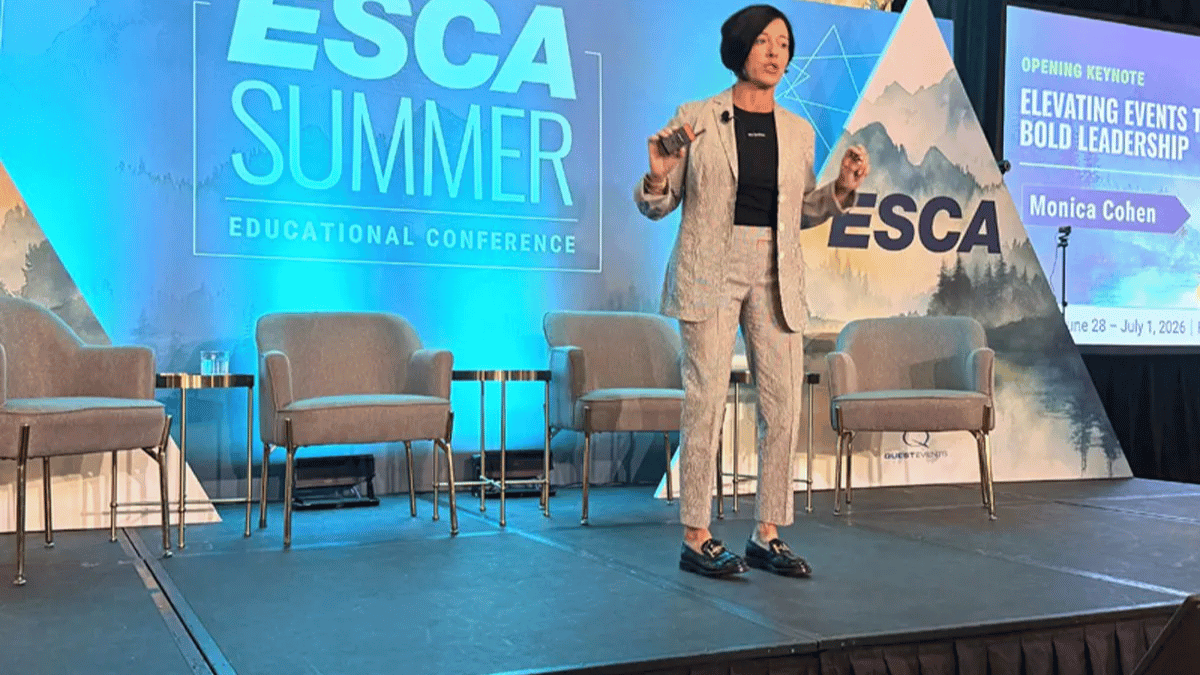
The Exhibition Services & Contractors Association (ESCA) Summer Educational Conference 2026 continued its first full day of educational sessions on June 29 at the Fairmont Banff Springs in Banff, Canada. Running from June 28 to July 1, the conference brought together exhibition industry leaders to discuss leadership, operational challenges, safety, technology, artificial intelligence (AI), and the future of live events.
The day’s sessions emphasized the importance of innovation, collaboration and strategic planning as the exhibitions and events industry adapts to changing business environments and evolving customer expectations.
Monica Cohen Urges Leaders to Embrace Strategic Thinking
The conference’s keynote session was delivered by Monica Cohen, Chief Executive Officer of the American Cider Association, who encouraged event industry professionals to move beyond day-to-day operations and focus on long-term leadership.
Cohen described exhibitions as the “Super Bowl of business,” highlighting that successful events rely on months of planning, teamwork and countless decisions made well before attendees arrive.
She challenged business leaders to evaluate whether long-established policies, workflows and management practices continue to support growth or have become barriers to innovation.
According to Cohen, organizations should create space for experimentation, encourage fresh ideas and empower employees at every level to contribute to better decision-making. She also urged companies to identify what they should stop doing, start implementing, continue learning and actively share across their teams.
Artificial intelligence, mentorship, knowledge transfer and employee ownership were among the key themes discussed as organizations prepare for the future of work.
Rather than viewing disruption as a threat, Cohen encouraged attendees to embrace change as an essential part of effective leadership in a rapidly evolving industry.
Convention Center Leaders Discuss Industry Transformation
A panel featuring senior executives from leading convention centres explored how venues are adapting to meet the changing needs of event organizers and exhibitors.
The discussion was moderated by Chris Schimek, Chief Operating Officer of Freeman, and included Larita Clark, Chief Executive Officer of the Metropolitan Pier and Exposition Authority; Mark Tester, Executive Director of the Orange County Convention Center; and Freddie Peterson, General Manager of the Miami Beach Convention Center.
The panel examined how modern convention centres are evolving beyond simply providing exhibition space. Today’s venues are increasingly expected to deliver enhanced visitor experiences through advanced technology, flexible meeting spaces, improved food and beverage services, sustainability initiatives and stronger collaboration with organizers and service providers.
Rising Costs Increase Need for Collaboration
One of the major topics discussed during the panel was the growing financial pressure facing convention centres.
Panelists noted that venues continue to manage rising labour costs, operational expenses, capital investment requirements and increasing customer expectations while maintaining competitive pricing for event organizers.
They agreed that early planning and stronger partnerships between venues, contractors, organizers and local stakeholders have become essential for delivering successful events.
Larita Clark emphasized the importance of adopting an industry-wide perspective when addressing operational challenges, encouraging greater collaboration between convention centres, exhibition organizers, contractors and labour partners.
Local Advocacy Supports Convention Center Growth
Mark Tester highlighted the role of public advocacy in supporting the long-term success of convention centres.
He noted that decisions regarding public funding can significantly influence convention centre operations, destination marketing, tourism development and regional economic growth. Building strong relationships with government agencies and local communities remains an important part of sustaining the exhibitions industry.
Freddie Peterson added that open communication between venues and event organizers is becoming increasingly important as convention centres invest in technology upgrades, campus expansion projects and new ways to activate surrounding public spaces.
Industry Encouraged to Adapt Before Change Is Forced
A consistent message throughout Monday’s programme was the need for proactive adaptation.
Speakers agreed that the exhibition and live events industry cannot rely solely on traditional operating models as attendee expectations, technology and market conditions continue to evolve.
Instead, organizations are encouraged to embrace innovation, invest in leadership development and strengthen collaboration across the entire events ecosystem before external pressures require more disruptive change.
ESCA Conference Focuses on Future of Live Events
The ESCA Summer Educational Conference continues through July 1, offering sessions focused on safety, workforce development, operational excellence, emerging technologies and business resilience.
By bringing together contractors, venue executives, organizers and industry suppliers, the conference provides a platform for sharing best practices and exploring solutions that will help shape the future of exhibitions and live events.
As the industry continues to evolve, discussions at ESCA 2026 reinforce the importance of leadership, strategic planning and collaboration in building a more innovative, resilient and sustainable exhibitions sector.