The best event and production companies are the ones whose core skill matches your event’s biggest technical risk. Hire a full-service production company if you want one contract for lighting, audio, video and staging. Pick an AV specialist for conferences, a lighting and staging firm for galas and launches, a streaming crew for hybrid shows, and a festival producer for outdoor multi-stage events. For trade shows, look at exhibition specialists. If you also need venue and vendor management, add a planner.
The trouble is that nearly every company in a search result calls itself full-service. Phrases like "concept to curtain call" do not tell you who owns the gear, who runs the lighting desk, or who is responsible when a rig fails. This guide sorts providers into seven types. For each one you get what it handles, who it suits, how it charges, and what to ask before you sign.
Exhibition Globe has covered the exhibitions and events industry as a B2B publication and directory since 2017. That industry view shapes the advice below. Because the right crew knows your venue, your loading dock and your local permit office, shortlist providers in your own area first, then use this list to decide which type you need.
1. Full-service event production companies
What they do and who they suit
A full-service production company supplies lighting, audio, video and staging under one contract, with a production manager who coordinates every department. They design the stage, bring or rent the equipment, staff the technicians and run the show on site. This type suits galas, product launches and multi-day conferences, where problems usually come from vendors who never talked to each other. Small meetings rarely need this level of service.
Typical scope includes:
- Production design and technical drawings
- Sound, lighting and video equipment with crew
- Load-in, show calling and load-out
- Special effects such as confetti or haze, and sometimes pyrotechnics, which need permits and a licensed operator
One contract and one production manager remove the finger-pointing between your lighting, audio and video vendors.
How they charge and what to ask
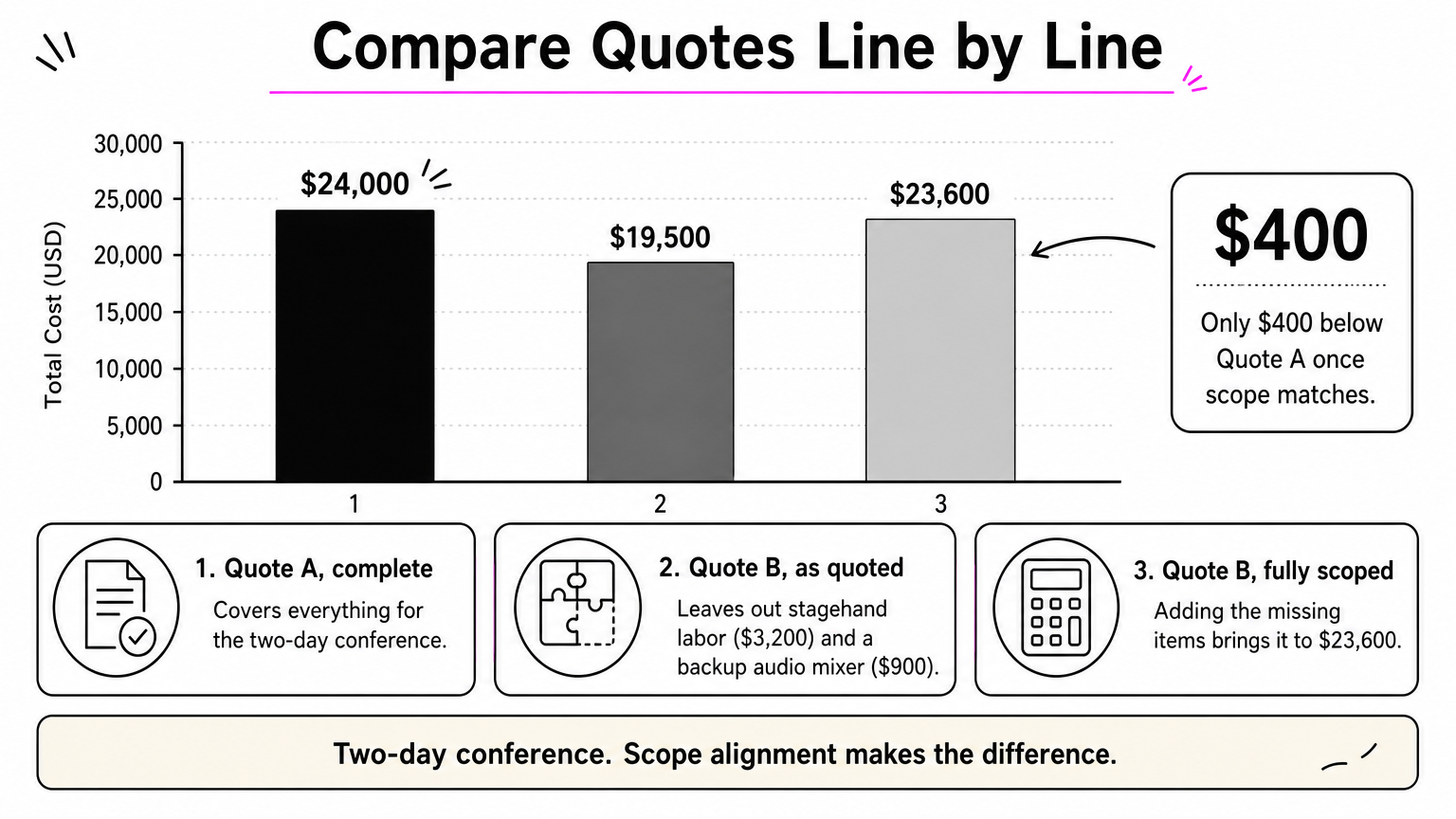
Quotes are either a single project fee or an itemized list of equipment, crew labor, transport and a management fee. Always compare quotes line by line, because scope hides in the gaps. Take a hypothetical two-day conference. Quote A is $24,000 and complete. Quote B is $19,500 but leaves out stagehand labor ($3,200) and a backup audio mixer ($900). Add those and B costs $23,600, only $400 below A.
Ask each company these questions before you decide:
- Have you worked at my venue before?
- Who is my on-site lead, and will that person be there all days?
- Which gear do you own, and which do you subrent?
- Can I see your insurance certificate?
- What happens if a console or projector fails mid-show?
Shortlist three companies near your venue. Local crews cut freight, travel and lodging costs.
2. Audio-visual specialists
What they do and who they suit
An audio-visual (AV) specialist handles sound and display: microphones, mixers, speakers, projectors, screens, LED walls and the technicians who run them. They suit conferences, corporate meetings and breakout-heavy agendas where clear speech and readable slides matter more than dramatic lighting. If your event is mostly speakers and presentations, an AV firm is usually cheaper than a full-service company.
Check the venue contract first. Some venues require or strongly push their in-house AV supplier, which can limit who you can hire. Get this answered in writing before you collect outside quotes.
How they charge and what to ask
Most AV firms charge per-day equipment rental plus technician labor, often with a minimum call time. Delivery, setup and teardown can appear as separate lines. Ask for a room-by-room equipment list so you can see what each space gets.
Clear audio matters more to attendees than any screen, so never trade a dedicated audio engineer for a cheaper package.
Key questions:
- Is there a dedicated audio engineer, or does one person run everything?
- Do you bring backup microphones and batteries?
- Will you attend a tech rehearsal with the speakers?
- Can you handle remote speakers or recorded video playback?
3. Lighting, staging and rigging companies
What they do and who they suit
These companies build the physical look of the event: stage decks, truss, drape, moving lights, uplighting and the rigging that holds equipment overhead. They suit galas, fashion shows, product launches and concerts, where the room’s appearance is part of the product. Many offer lighting design drawings, called plots, so you can approve the look before load-in.
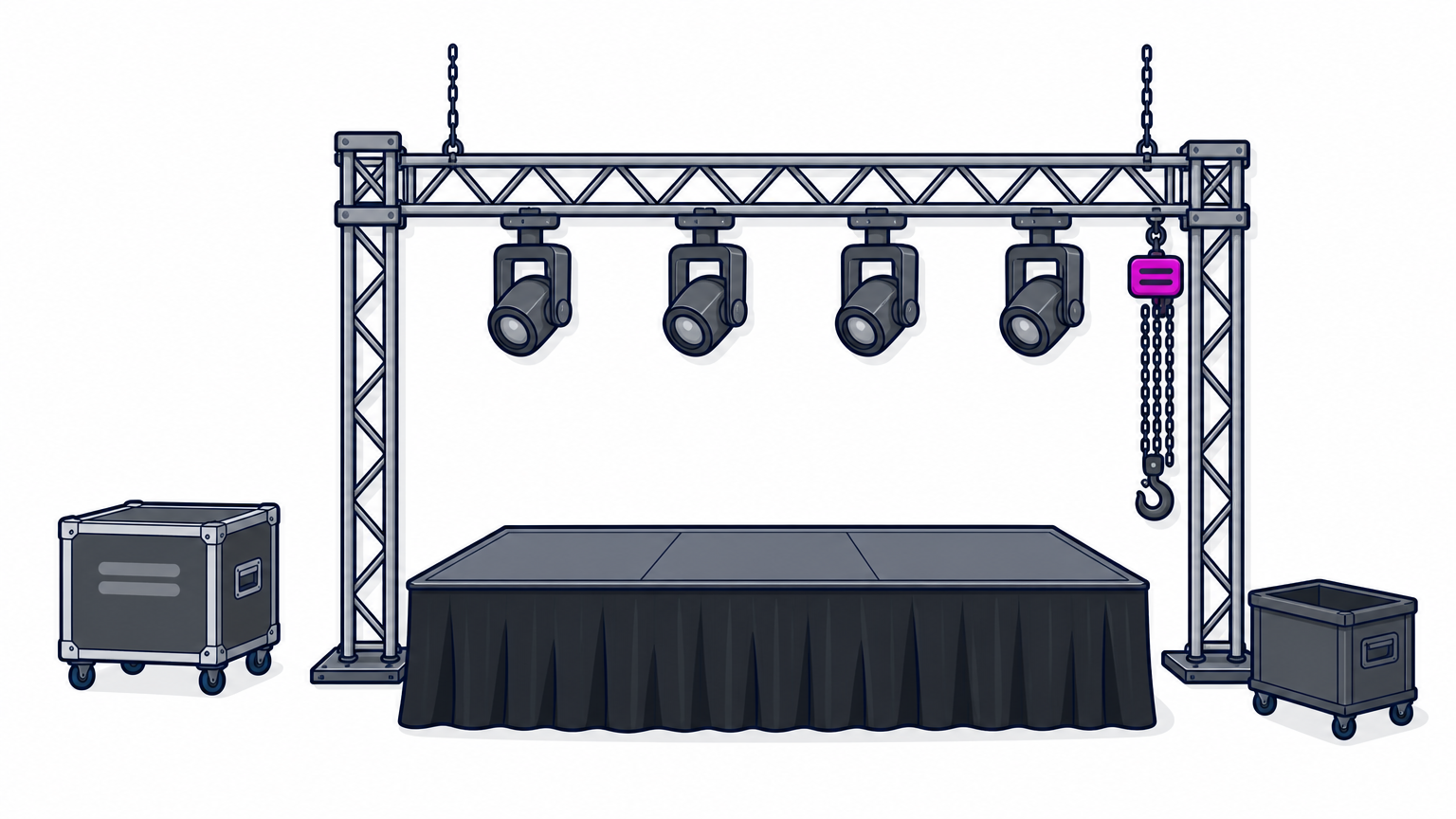
Rigging is the safety-critical part. Hanging weight from a venue’s ceiling needs approved rigging points and known load limits. Pick a firm that treats this as routine and asks you for venue specifications on the first call.
How they charge and what to ask
Pricing usually combines per-fixture or per-package rental, labor for load-in and load-out, and design time. Overnight crews or tight turnarounds raise the labor line. Compare the number of lights and truss sections quoted, not just the total.
Ask who is responsible for rigging safety before you ask about price.
Ask these before hiring:
- Who certifies and signs off the rigging?
- Will you provide a lighting plot or render for approval?
- Do you carry liability insurance and can you share the certificate?
- What is the load-in time, and does it fit my venue access window?
4. Live video and streaming production companies
What they do and who they suit
A live video company runs cameras, switches between them, puts speakers on screens in the room and streams the show online. It suits hybrid conferences, keynotes and events with a remote audience. Many also record sessions for later editing, add lower-third graphics and bring in remote speakers by video link.
You do not need a separate video vendor if your event has no remote audience and no on-screen camera feed. A basic AV package that includes recording may be enough.
How they charge and what to ask
Expect charges for crew by the day, camera and switching equipment, and streaming setup. Editing and post-production are usually quoted separately. Internet is the usual failure point, so treat connectivity as a budget line, not an assumption.
A livestream is only as reliable as its internet connection, so ask about a backup before you ask about cameras.
Questions to ask:
- Do you bring a second internet connection or bonded cellular backup?
- Which streaming platform do you use, and who owns the recording?
- Can we run a test stream before doors open?
- Is editing included, or priced after the event?
5. Festival and concert production companies
What they do and who they suit
These firms build temporary venues: stages, sound reinforcement, lighting, power distribution, site layout and the schedules that keep several stages running. They suit outdoor festivals, large concerts and community events where weather, crowd flow and power supply matter as much as the equipment itself. Look for a team that has run multiple stages and has dealt with your local authorities.
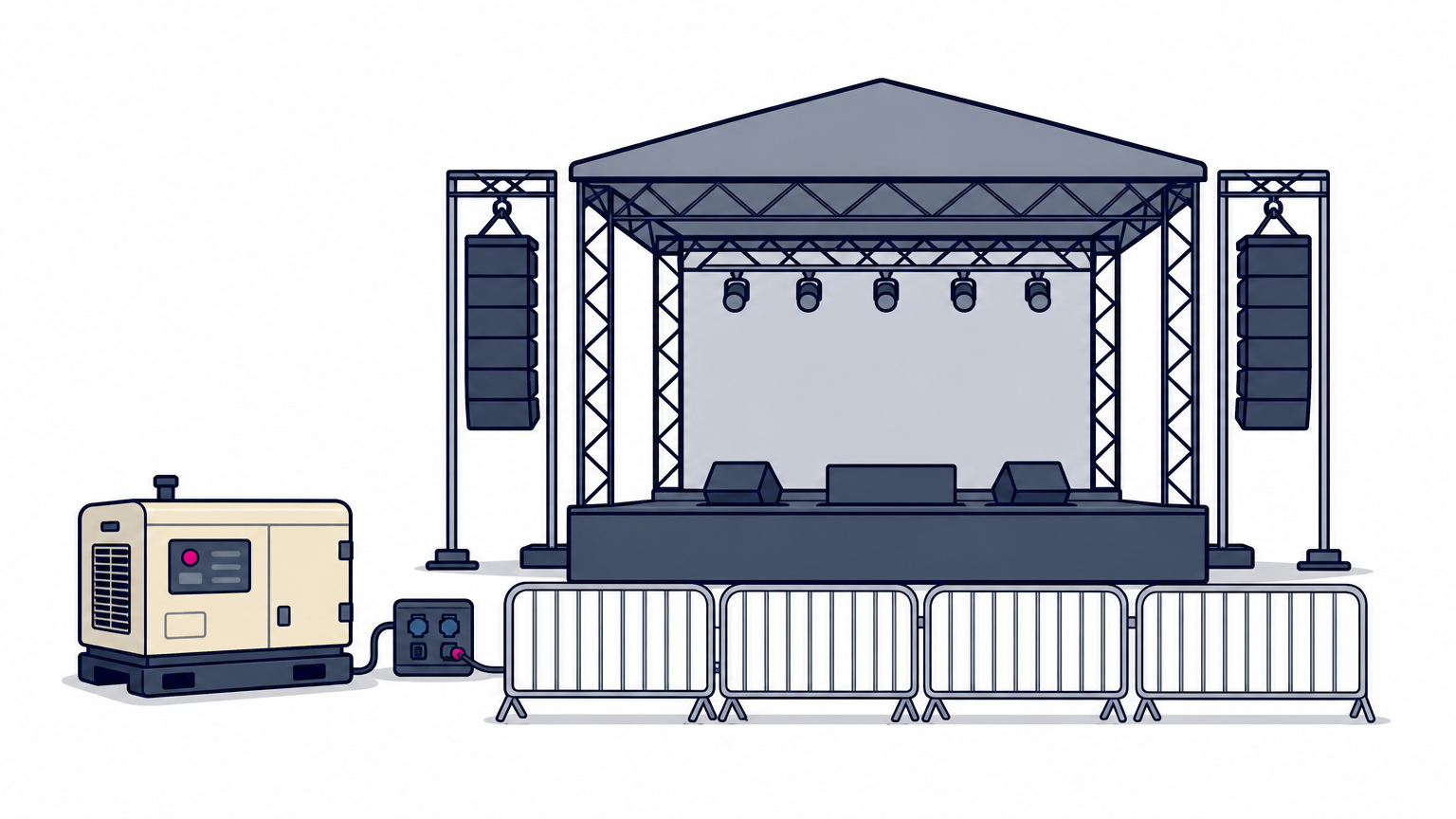
A conference firm may own the same speakers but lack outdoor experience. Weather plans, generator sizing and crowd safety separate festival crews from indoor specialists.
How they charge and what to ask
Pricing is scope-based and often paid in stages, with a deposit to reserve dates and further payments as the event approaches. Power, generators, fencing and permits can add large lines, so ask what is included. Request a written site plan before you commit.
For outdoor events, the weather plan and the power plan are the two documents that should convince you.
Ask:
- What wind and rain limits apply to your stage and roof?
- Who calculates the power load and supplies generators?
- Have you handled permits with the local fire and safety offices?
- Who coordinates with security and emergency services?
6. Exhibition and conference production specialists
What they do and who they suit
Exhibition specialists work inside trade shows, expos and conventions. They build stands, run drape and pipe, supply show-floor lighting and AV, set up registration areas and follow the show organizer’s rules for move-in and move-out. They suit organizers running an expo, and exhibitors who need a stand built and lit to the venue’s technical manual.
If you are searching for providers in your own area, a directory helps. The EG Business Listing on Exhibition Globe lists service providers, services and venues, so you can compare options before you contact anyone. Always verify any listed company’s references yourself.
How they charge and what to ask
Stand builders often quote by booth size and design complexity, while show-floor services are priced per item and per day. Organizer-appointed contractors can be mandatory for some services, such as electrical hookups. Read the exhibitor manual before you sign.
Check the show manual first, because the organizer may already require certain contractors.
Questions to ask:
- Have you worked at this venue or with this organizer?
- Which services does the organizer require me to buy from its contractor?
- What are the move-in and move-out deadlines?
- Who handles storage and shipping of stand materials?
7. Event planning and management firms
What they do and who they suit
An event planning or management firm handles the strategy around the show: concept, budget, venue, schedule, registration and vendor coordination. Many subcontract the lighting, audio and video to a production company. They suit first-time organizers, corporate programs with many moving parts and teams with no in-house event staff.
If your event is technically simple, a planner alone may be enough. If it is technically complex, pair a planner with a production company you trust, or ask the planner which production partner it uses and why.
How they charge and what to ask
Planners typically charge a flat fee, an hourly rate or a percentage of the event budget. The percentage model can reward higher spending, so agree on a cap. Ask how subcontracted production is billed.
Make the planner show you the production vendor’s actual quote, not just a marked-up line item.
Ask:
- Do you mark up vendor costs, and by how much?
- Can I see the production vendor’s quote and contract?
- Who will be on site, and for how many hours?
- Which production companies do you use, and for what kind of events?
Picking your shortlist
Start with your biggest technical risk. A speaker-led conference needs strong AV. A stage show needs lighting and rigging. A festival needs weather and power planning. A trade show needs people who know show-floor rules. Choose the type first, then compare three local providers on the same itemized scope, insurance and references.
Whichever type you hire, ask for a written quote that lists equipment, crew, transport and fees, and confirm who is accountable on show day. Most hiring mistakes come from vague scope, not high prices.
If you want to compare service providers and venues in one place, browse the EG Business Listing on Exhibition Globe, or list your own company if you supply the events industry.