A strong event marketing career starts with choosing the role that matches how you like to work, then finding openings that fit your city and experience level. If you like logistics, aim for event manager or trade show manager. If you like campaigns and data, start as an event marketing specialist. Creative people should look at experiential marketing, and people who like travel and face-to-face work should try field marketing. Almost everyone can enter through the coordinator role.
The problem is that job boards return hundreds of postings with overlapping titles, and salary figures change from city to city. This article lists seven roles, explains what each one involves, shows what it typically pays, and says who it suits. It then covers the skills employers screen for and how to find openings near you, including routes in if you have no experience.
Exhibition Globe is a media platform for the exhibitions, trade shows and conference industry, and it runs a jobs section for the sector, so the roles below lean toward the event world. The salary figures come from published career guides, so read them as ranges and confirm them against current postings in your area.
1. Event marketing coordinator
The event marketing coordinator is the most common entry point into an event marketing career. You support the team that plans and promotes events, so you learn every moving part before you own any of them.

Coordinator roles trade glamour for a fast education in how events actually run.
What the role involves
Coordinators handle the operational support around an event: vendor communication, promotional materials, registration lists, and budget tracking. You also schedule social posts and send attendee emails. Expect to be on site on event days, often early and late.
- Booking and confirming vendors
- Building email and social promotion that drives registrations
- Tracking spend against budget and counting attendance
Pay, entry route, and who it suits
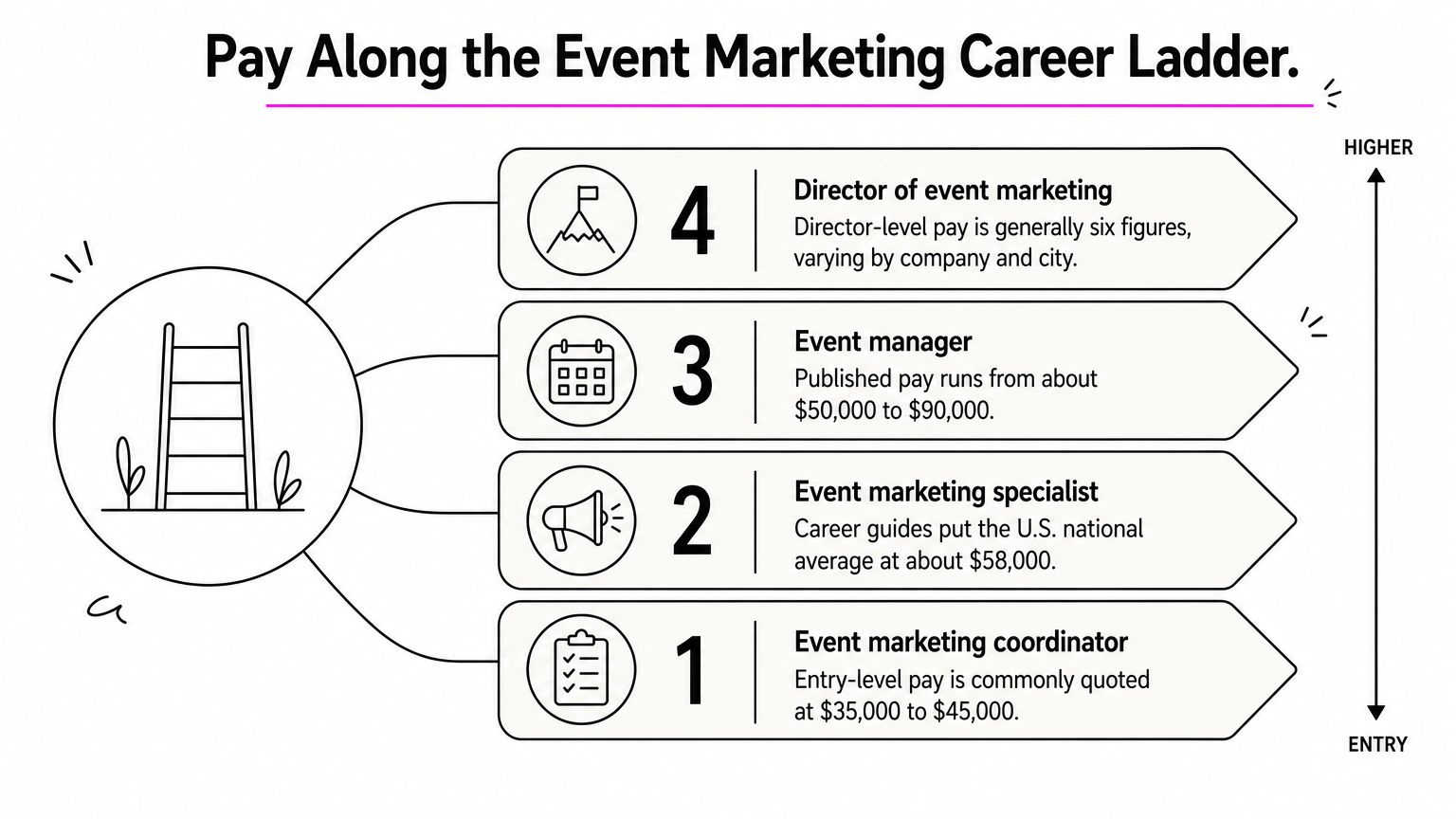
Entry-level pay is commonly quoted between $35,000 and $45,000 in career guides, and it rises in expensive cities. A bachelor’s degree in marketing, communications, or hospitality helps. Without one, internships, volunteering at local events, and freelance projects carry real weight.
This role suits you if you like detail, tolerate long event days, and want to learn before you specialize. Notice which task you enjoy most, because that tells you which of the next roles to pursue.
2. Event marketing specialist
An event marketing specialist drives interest in an event before, during, and after it happens. Career guides put the national average salary in the U.S. at about $58,000.
A specialist is judged on one thing: how many of the right people show up.
What the role involves
Specialists brainstorm campaigns, plan promotion across email, social, and paid channels, and build awareness around each event. Some work in-house for one brand. Others work at agencies and market events for many clients, which means more variety and more deadlines.
- Planning the promotion calendar for each event
- Writing copy and briefing designers
- Reporting registrations, leads, and cost per attendee
Pay, entry route, and who it suits
The $58,000 national average is a midpoint, so expect lower pay early and higher pay at large brands. Most specialists hold a bachelor’s degree in marketing or communications, though strong event planning experience can substitute for the degree.
Pick this role if you prefer writing, persuasion, and numbers over on-site logistics. It also gives you the cleanest route toward a brand or digital marketing career if you leave events later.
3. Event manager
The event manager owns delivery. You keep every team and vendor on target from the first planning meeting to the last load-out, and published pay runs from about $50,000 to $90,000.
If the event runs smoothly, nobody notices the manager, and that is the job.
What the role involves
Event managers apply project management skills to ideation, planning, and execution. Events range from small meetings to conferences and multi-day festivals or conventions. For a branded fashion show, for example, the manager plans the format, security, staffing, and photography, then becomes the main point of contact on event day.
- Setting the schedule, budget, and run of show
- Contracting venues, security, and suppliers
- Leading the on-site team and solving problems live
Pay, entry route, and who it suits
Managers are hired mainly on proven event experience, and a related degree is optional. Moving from a coordinator job to manager commonly takes a few years. Teal’s career guide puts the full path to event marketing manager at three to five years.
You will fit this role if you stay calm under pressure and like owning outcomes. Plan for evening, weekend, and holiday work, because events do not follow office hours.
4. Experiential marketing manager
An experiential marketing manager designs events that let people try a brand through a product or an immersive experience. Reported pay starts around $35,000 to $45,000 and tops out above $109,000.

Experiential work sells by letting people touch the brand, not by telling them about it.
What the role involves
You build pop-ups, activations, and branded experiences, then engage directly with customers and attendees. The work is creative, but it still needs a budget, a timeline, and a way to prove results. Sensory design and storytelling matter here more than in other event roles.
- Developing the concept and attendee journey
- Managing production partners and brand ambassadors
- Measuring engagement, sampling, and leads
Pay, entry route, and who it suits
Employers typically ask for a bachelor’s degree, creative thinking, and event marketing experience. Experience leading remote teams across far-flung projects is a plus. The wide pay range reflects the gap between small agencies and national brands, so check which one is hiring.
This path suits people who enjoy concept work and are comfortable being judged on audience reaction. Keep photos, attendance counts, and engagement numbers from every activation, since a portfolio decides who gets the senior jobs.
5. Field marketing manager
A field marketing manager runs face-to-face programs outside the office, such as in-store sampling, road shows, and trade show presence. Pay is commonly quoted between $50,000 and $100,000.
Field marketing is the event career for people who would rather be on the floor than at a desk.
What the role involves
This is the more traditional side of marketing: distributing, sampling, or selling product in the field. You often work autonomously, away from the main office. That makes it one of the more remote-friendly roles in event marketing, although the field work itself happens in person.
- Planning sampling and road show schedules
- Coordinating local staff and promoters
- Reporting sales, leads, and customer feedback
Pay, entry route, and who it suits
Employers look for strong people skills and usually a degree in marketing, public relations, or communications. The wide salary band depends on how many markets you cover and how much revenue the work drives.
You will like it if you enjoy talking to strangers, travel, and self-directed work. It is a poor fit if you want a fixed desk and a predictable week.
6. Trade show manager
A trade show manager runs a company’s presence at exhibitions, or runs the show itself for an organizer. The job focuses on booth design, lead generation, and return on investment.
Trade show managers are paid to turn a booth and a few days into measurable pipeline.
What the role involves
On the exhibitor side, you pick which shows to attend, design the booth, brief the staff, and follow up every lead after the show. On the organizer side, you sell space, manage exhibitors, and deliver the event. The same skills transfer between both sides, and Exhibition Globe’s audience includes both.
- Choosing shows and negotiating space and sponsorships
- Managing booth design, shipping, and staffing
- Scoring and passing leads to sales after the show
Pay, entry route, and who it suits
Sources rarely break trade show pay out separately, so use the event manager band of $50,000 to $90,000 as a starting benchmark and check live postings. Most managers come up through coordinator or event manager roles. Knowing the exhibition cycle in your industry helps.
This role suits sales-minded planners who like deadlines tied to fixed show dates. Because it connects directly to revenue, it also makes a strong stepping stone toward director roles.
7. Director of event marketing
A director of event marketing leads the team and the strategy, making sure events support business goals. Director-level pay is generally six figures, though it varies by company and city.
Directors are promoted for business impact, not for how many events they ran.
What the role involves
Directors own the event budget and the team, decide which events the company runs or sponsors, and report results to executives. Teal’s career guide describes the work as setting strategic direction and tying events to brand values and business objectives. You spend more time on planning, hiring, and numbers than on site.
- Setting the annual event strategy and budget
- Hiring, coaching, and promoting the team
- Reporting ROI to senior leadership
Pay, entry route, and who it suits
Take a rough worked example. You start as a coordinator at about $40,000, move to specialist at the $58,000 average, which is a 45% raise, then step into manager and director roles. Six-figure pay usually arrives only after you can show budgets managed and results delivered.
This fits people who like leading others and care about strategy. If you prefer hands-on execution, a senior event manager role may keep you happier than a director title.
Skills and credentials that move your career forward
Employers screen for project management, marketing strategy, and data skills, and the mix shifts as you rise. A degree in marketing, communications, or hospitality is common but not required.
Learn to run the work first, then to measure it, then to lead the people doing it.
Skills by career stage
Project management matters at every level. Digital marketing carries the most weight early on, while leadership and budget ownership take over later. The table below shows how priorities shift, based on Teal’s skills matrix.
| Skill | Entry level | Mid level | Senior level |
|---|---|---|---|
| Project management | High | High | High |
| Digital marketing | High | High | Medium |
| Analytics | Medium | High | High |
| Budget management | Medium | High | High |
| Leadership | Low | Medium | High |
Read the table as a plan. At entry level, master organization and promotion. In the middle years, add analytics and budgeting so you can prove results and justify spend.
Tools, degrees, and certifications
Learn the event platforms employers name in postings, such as Cvent, Eventbrite, and Bizzabo, plus an email tool like Mailchimp and a CRM like HubSpot. Free trials let you practice before an interview. A degree is not strictly required, but it helps in competitive markets.
Certifications add credibility on top of experience. The Events Industry Council offers the Certified Meeting Professional credential, and the American Marketing Association and Meeting Professionals International offer training and networking. Treat them as differentiators, not substitutes for a portfolio of real events.
How to find event marketing openings near you
Search by role title and your metro area, then widen to event-industry sources and employers’ own career pages. Filter by work mode, because many roles are on site around event dates.
Search by role title and metro first, then go where event employers advertise.
Search by title, metro, and work mode
General job boards such as LinkedIn and Indeed work well when you use the right titles. Set your search radius to your commuting distance and check nearby cities too, since event employers cluster in conference and convention hubs. Run each of these titles as a separate search:
- Event marketing coordinator
- Event marketing specialist
- Field marketing manager
- Experiential marketing manager
- Trade show manager
- Event sponsorship coordinator
Save each search and turn on alerts. Remote-only listings are rare for on-site event work, but digital promotion and some field roles offer hybrid arrangements, so filter for them separately.
Use event-industry sources
Many openings never reach the big boards. Check the careers pages of exhibition organizers, venues, and agencies in your area, and join associations such as the American Marketing Association and Meeting Professionals International, where members hear about roles early. Teal notes that networking often leads to jobs that are not advertised publicly.
Exhibition Globe has a jobs section for the events industry, and its EG Business Listing directory lets you find local service providers, venues, and companies that may be hiring. Together they show you who operates in your market, even when no posting exists yet.
Break in without experience
If you have no experience, build proof. Volunteer at community or nonprofit events, take an internship, or freelance on one small event project. Each gives you a real event to describe in an interview.
Keep a simple portfolio with the event name, your role, and one number, such as attendance, registrations, or leads. Numbers separate you from other applicants, and a coordinator or assistant title is the realistic first target.
Your next move in event marketing
An event marketing career rewards people who match a role to their strengths. Coordinators learn the work, specialists and field marketers run campaigns, managers deliver events, and directors own strategy and budgets. Pay climbs with proof of results, from entry salaries in the $35,000 to $45,000 range to six figures at director level.
Start with one title from this list, run the saved searches in your own metro, and build a small portfolio with a number attached to every event. Then add analytics and budgeting skills as you move up. If you want to explore the events industry itself, you can browse trade show news and event industry jobs on Exhibition Globe and see which organizers and exhibitors are active near you.