An experiential marketing event is a live or digital event where people use, try, play with or step inside a brand instead of just looking at an ad. The audience does something, and that participation is what makes the message stick. A pop-up shop, a branded installation, a sampling station and an interactive trade show booth all qualify. A billboard does not, because the viewer only watches.
This guide covers why these events work, how to plan one step by step, the main formats, real brand examples, and ideas you can adapt on a smaller budget. It closes with how to measure results, so you can tell whether the event paid for itself.
Exhibition Globe has reported on exhibitions, trade shows and conferences since 2017.
Why experiential marketing events matter
Experiential marketing events matter because they turn attention into memory, and memory into action. Most advertising asks people to notice you. An event asks them to do something, which is much harder to forget.
What sets event experiential marketing apart
Event experiential marketing is defined by active participation, not by location. A campaign in a physical space is not automatically experiential, and one on a screen can be. What counts is whether the person takes part.
| Tactic | How the audience takes part | Experiential? |
|---|---|---|
| Billboard or banner ad | Watches or clicks | No |
| Magazine ad with a coupon QR code | Scans once, no brand experience | No |
| Trade show booth with brochures only | Mostly passive | Usually not |
| Pop-up where visitors build, test or play | Hands-on | Yes |
| Online AR try-on or branded game | Interactive, on screen | Yes |
Format also matters less than intent. A booth with a product demo that visitors operate themselves is experiential. The same booth with a rep reading a script is not.
If the audience only watches, it is advertising. If the audience does something, it is experiential.
What you gain from running one
A well-built event gives you several things that ads rarely deliver together. Visitors try the product first-hand, which answers objections faster than copy can. They also create shareable moments, so photos and videos spread your brand beyond the people in the room.
Other gains include stronger brand recall, press coverage when the idea is distinctive, and contact data from people who chose to engage. For B2B brands, the event doubles as a live conversation with qualified buyers.
The trade-off is cost. These events usually take more money, staff and lead time than a digital campaign. They pay off when the experience is tightly tied to a clear goal, which the next section covers.
How to plan an experiential marketing event
Plan an experiential marketing event by choosing one goal, designing the experience around one feeling, and building a budget that covers staff and data capture, not just the spectacle.
Set one goal and know your audience
Pick a single primary goal before you brainstorm. The common options are brand awareness, a product launch, lead generation, customer loyalty, and entry into a new market. Each one leads to a different design. A launch needs demos. A lead goal needs a clear way to capture contact details.
Then define who you want in the room, where they already spend time, and what would make them stop. A campaign for young shoppers belongs near campuses and festivals. A campaign for procurement managers belongs at the trade show they already attend.
Decide the one number you will judge the event by before you design anything.
Design the experience around one feeling
Choose the emotion you want people to leave with, such as excitement, trust, nostalgia or curiosity. Then let every element serve it: the venue and location, the layout, the music, the staff behavior and the hashtag.
Keep the concept simple enough to explain in one sentence. Fit with your brand matters more than scale. A playful snack brand and a precision-engineering firm should not run the same kind of event.
Staff are part of the design. Brief them on the goal, the product and the tone, and give them a short script for the first ten seconds of each conversation. A great setup run by bored people reads as a bad experience.
Budget and logistics
Budget for the whole event, not just the build. This split for a hypothetical $50,000 event is a reasonable starting point, and you should adjust it to your goal.
| Cost area | Share | Amount |
|---|---|---|
| Concept, design and build | 35% | $17,500 |
| Staffing and training | 20% | $10,000 |
| Technology and data capture | 15% | $7,500 |
| Venue, permits, transport | 15% | $7,500 |
| Promotion | 10% | $5,000 |
| Contingency | 5% | $2,500 |
| Total | 100% | $50,000 |
Work backward from the event date. Book the location and permits first, since they have the longest lead times. Confirm vendors next, rehearse with staff, and plan a weather or crowd fallback. Then build the follow-up plan before launch, not after it.
Types of experiential marketing events
Most experiential marketing events fall into a handful of formats. The right one depends on your audience, your budget and how long you want the experience to last.
Seven formats compared
| Format | What it is | Best for | Effort |
|---|---|---|---|
| Pop-up shop | Temporary store with demos or limited products | Launches, local buzz | High |
| Installation | Branded structure or transformed space | Awareness, social content | High |
| Brand-hosted event | Festival, party, fashion show or tour | Loyalty, brand image | Very high |
| Guerrilla stunt | Unannounced surprise in a public place | Viral reach, low budget | Medium |
| Sampling or demo | Product trial at a booth or street stand | Conversion, first trial | Low to medium |
| Trade show activation | Interactive stand or challenge at an expo | B2B leads | Medium |
| Digital or hybrid | AR, VR, livestream, online game | Wide reach, remote audiences | Medium |
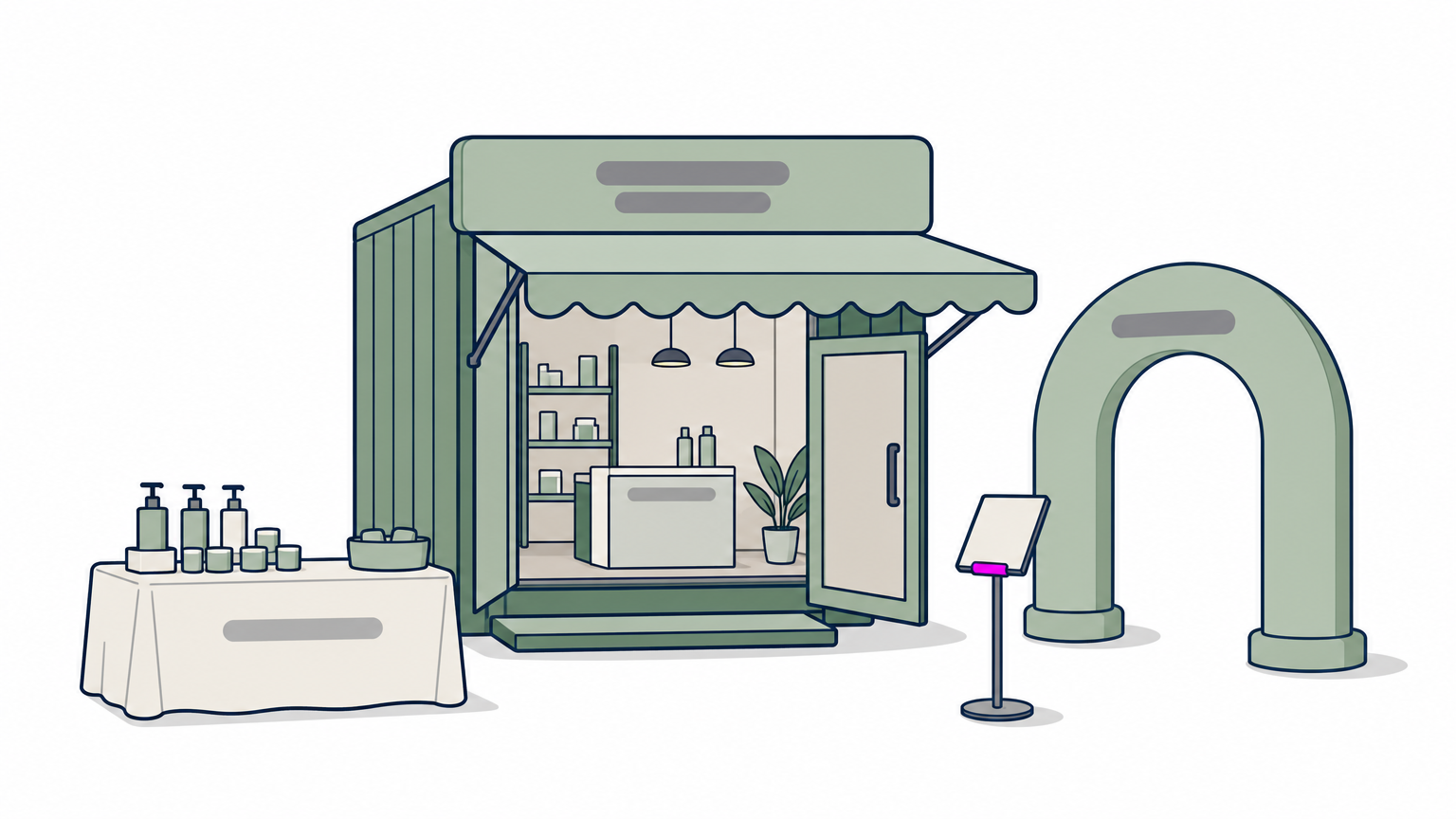
Many strong campaigns combine two formats, such as a pop-up with a livestream so people who cannot attend still take part.
Choosing the right format
Start with where your audience already gathers. If your buyers attend industry exhibitions, a trade show activation gets you in front of them with the least friction. If you want public attention, an installation or stunt in a busy place does more.
Budget and repeatability also matter. A sampling stand is cheap enough to run in many cities. A brand-hosted festival is a one-off statement. If you are testing experiential marketing for the first time, start with a small, measurable format and learn from it before you scale.
Pick the format your audience will walk into without being asked, not the one that looks best in a pitch deck.
Experiential marketing event examples and ideas
Strong examples share one trait: the brand turned a message into something people could walk through, play with or taste. These real campaigns show the range of what brands run, and the ideas below show how to scale the same thinking down.
Brand examples worth studying
- Revolve Festival at Coachella: a fashion brand hosted its own festival experience, so its identity became a place people visited and posted from.
- Cheetos “House of Flamin’ Haute”: a snack brand staged a fashion show, which made an unexpected cultural move and earned media attention.
- Wendy’s Halloween drive-thru: the restaurant transformed an everyday drive-thru into a spooky experience, using a space customers already used.
- Netflix, “The Irishman”: the streaming service took over part of Manhattan’s Little Italy to tie the film to a real neighborhood.
- Dove’s recycling vending machine: a personal care brand used a vending machine to make its sustainability message something people could act on.
- IKEA and Snapchat “Escape the Clutter”: a digital escape room that carried the brand’s home-organization theme to people on their phones.
- Sabrina Carpenter’s “Short n’ Sweet” cafe pop-ups: an artist brought an album’s mood into a physical cafe built for her fans.
New York Fashion Week works the same way at larger scale. Runway shows become immersive worlds with custom sets, music and guests, and attendees spread the content for the brand.
The pattern is consistent. Each campaign fit the brand’s identity, gave people a reason to participate, and produced content worth sharing. None relied on spectacle alone.
Ideas you can adapt on a smaller budget
You do not need a festival budget. These ideas suit exhibitors and B2B brands.
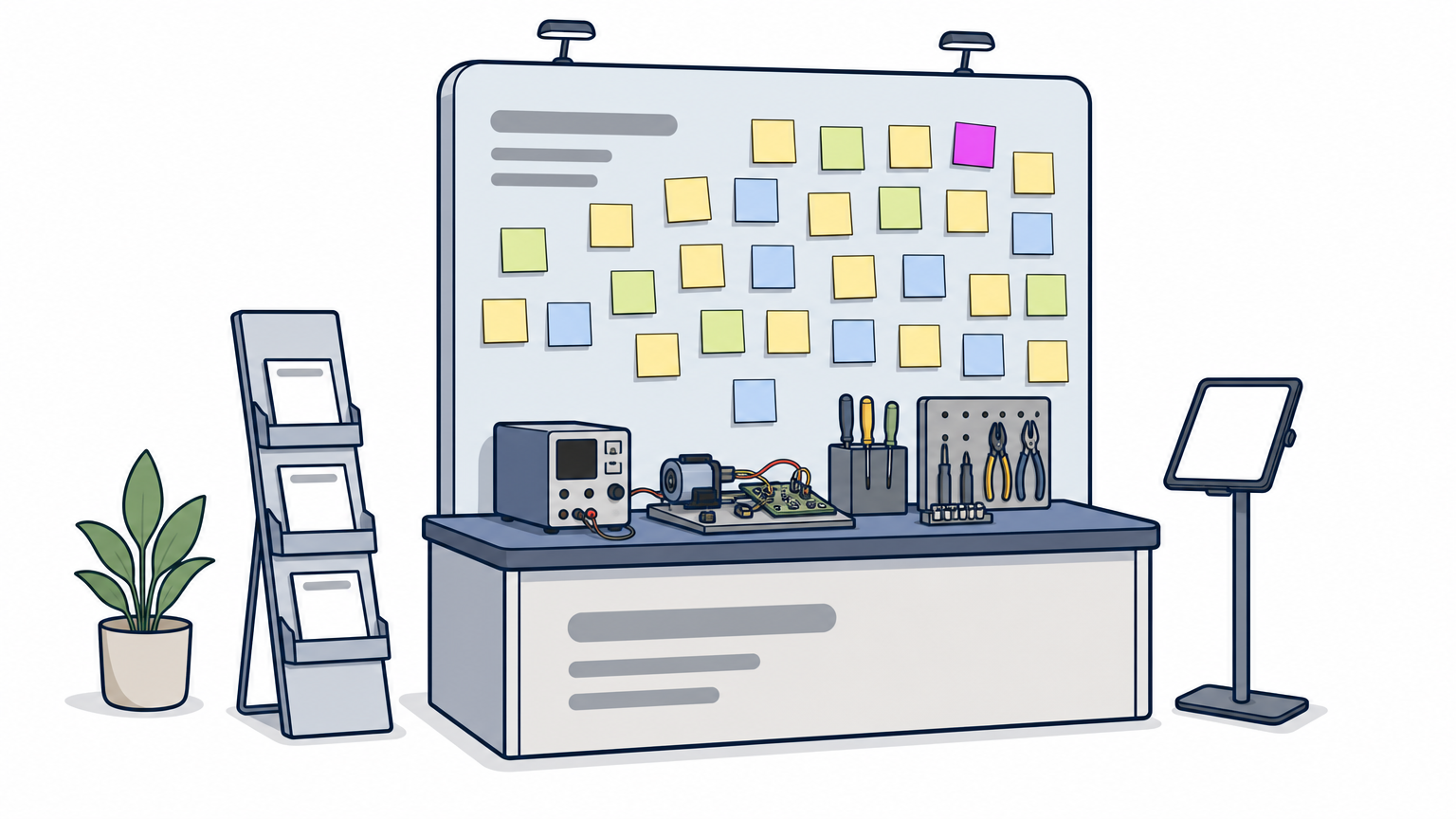
- Live build or test station: let visitors assemble, configure or stress-test your product themselves.
- Problem wall: ask visitors to post their biggest challenge, then show how your product answers it.
- Tasting or sensory bar: let people compare options blind, then reveal the results.
- Show-floor challenge: a scavenger hunt across several exhibitor stands, with a prize that requires a lead scan.
- Mini workshop: a 15-minute hands-on session that teaches a useful skill.
- AR product tour: a tablet or phone demo for products too large to ship to the venue.
- Community moment: a fundraiser or local sports event linked to your brand’s values.
Copy the mechanism, not the budget: a reason to participate, a link to your brand, and something worth sharing.
Measuring results and avoiding mistakes
Measure an experiential marketing event against the single goal you set at the start, and plan data capture into the experience itself. Most failures come from skipping that step, not from weak creativity.
Metrics to track
Match the metric to the goal. These are the most useful pairings.
| Goal | Metrics to track |
|---|---|
| Awareness | Attendance, social posts and tags, press mentions, website traffic spikes |
| Launch | Demos given, product trials, early orders |
| Leads | Contacts captured, qualified leads, meetings booked |
| Loyalty | Repeat visits, sign-ups, referral volume |
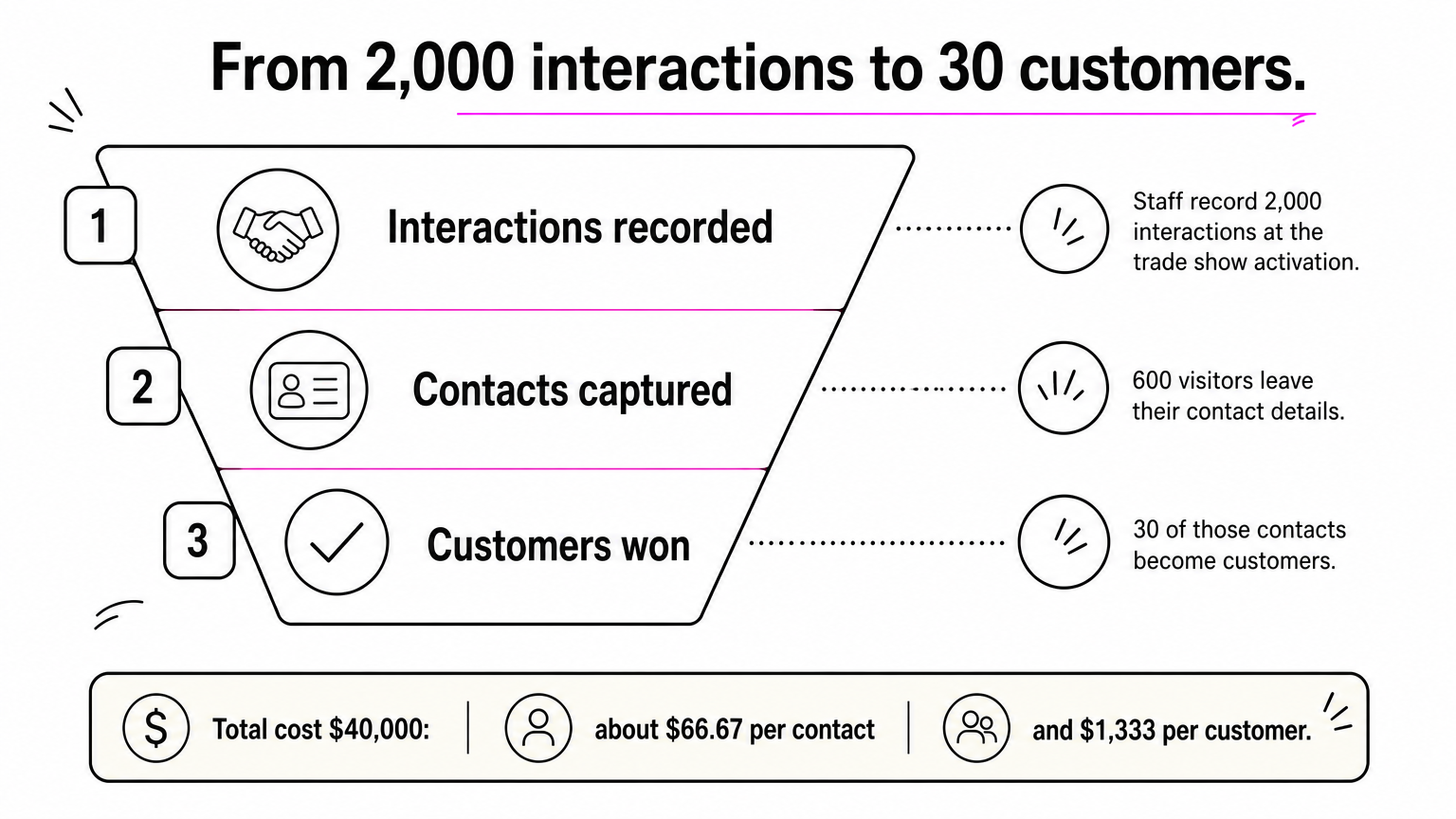
Here is a worked example. Say a trade show activation costs $40,000 in total and staff record 2,000 interactions. Of those, 600 visitors leave contact details, so you paid about $66.67 per contact ($40,000 divided by 600). If 30 of those contacts become customers, you paid about $1,333 per customer ($40,000 divided by 30). Compare that figure with your cost per customer from other channels.
An event that cannot be measured cannot be repeated, defended or improved.
Common mistakes to avoid
The first mistake is spectacle without substance. A giant installation draws crowds, but if visitors cannot say what your brand stands for afterward, the budget is wasted. Check every element against the one feeling and the one goal.
The second is skipping data capture. Use forms, scans, short surveys or check-in apps that feel natural to participants. The third is ignoring follow-up. Visitors are most engaged right after the event, so send photos, a thank-you and a clear next step within days. A post-event press release also helps, since earned coverage extends the event’s reach.
Other recurring problems are thin staffing, a mismatch between the experience and the brand, and a location where the target audience never goes.
Plan the experience, then measure it
An experiential marketing event works because people remember what they do far more than what they see. Pick one goal, design around one feeling, choose the format your audience will actually step into, and build measurement and follow-up in from the start.
You can begin small. A single interactive station at a trade show teaches you more than a lavish event with no clear goal. If you organize or exhibit at events and want your activation seen by the industry, get your event or story featured on Exhibition Globe.