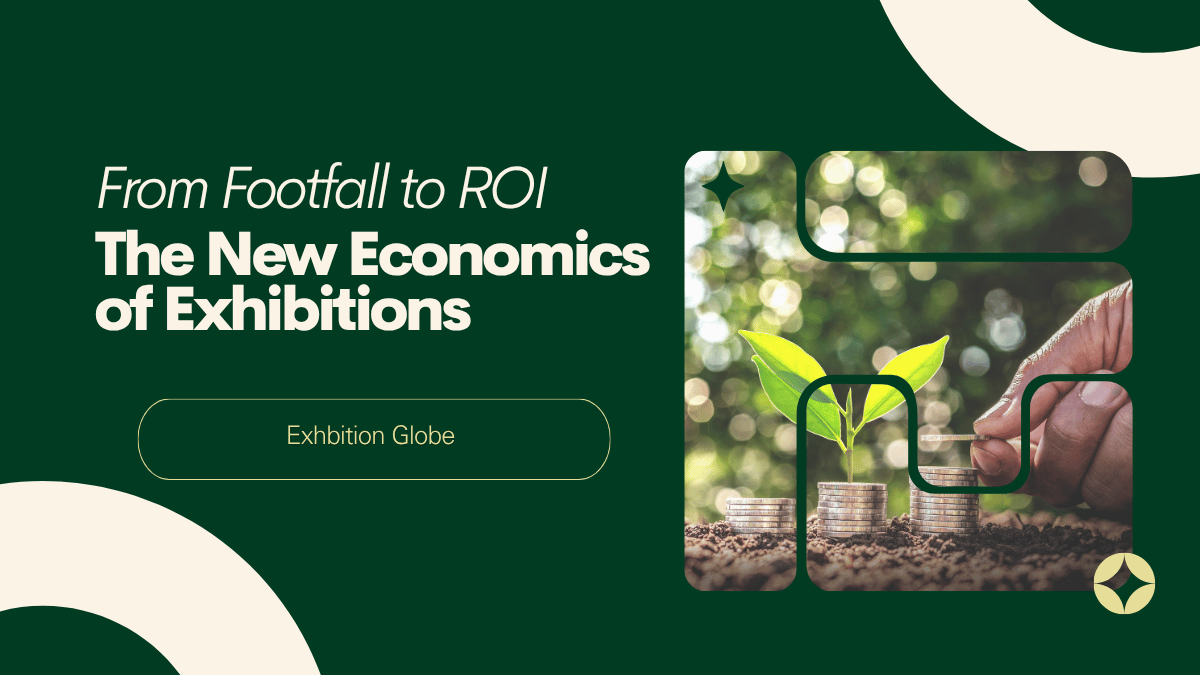

The exhibition industry is entering a new era in which success is no longer measured solely by visitor numbers, booth traffic or the size of an exhibition stand. Businesses participating in trade shows and exhibitions are increasingly focused on measurable outcomes, including qualified leads, sales opportunities, customer acquisition, brand visibility and return on investment (ROI).
The shift from footfall to ROI is transforming how exhibitors plan their participation, allocate marketing budgets and evaluate event performance.
Companies are looking beyond crowded exhibition halls to understand whether their investment generates meaningful business relationships and long-term commercial value.
As competition increases and exhibition costs continue to rise, exhibitors must adopt a more strategic approach. From pre-event marketing and audience targeting to lead qualification and post-event follow-ups, every stage of exhibition participation can influence the final return.
The Economics of Exhibitions Are Becoming More Complicated
Exhibitions remain valuable platforms for networking, product demonstrations, industry knowledge and business development. However, participating in a trade show involves more than booking a booth and displaying products.
Exhibitors must consider venue charges, booth design and construction, logistics, travel, accommodation, staffing, promotional materials, digital marketing and technology expenses. These costs can quickly increase, particularly for businesses participating in major international exhibitions.
The challenge is that higher expenditure does not automatically translate into stronger business results. An exhibition stand may attract hundreds of visitors without generating enough qualified prospects to justify the investment.
This is why modern exhibitors are increasingly evaluating the relationship between exhibition spending and commercial performance. Understanding the cost of every lead, the quality of business conversations and the conversion rate of prospective customers is becoming essential to exhibition planning.
The Real Cost of Exhibiting: Why Budget Management Matters
The actual cost of exhibiting extends well beyond the price of renting exhibition space. Businesses must account for the complete investment required to prepare, execute and follow up on their participation.
Booth design and fabrication can represent a significant expense, especially when exhibitors require custom structures, premium materials, interactive displays or complex installations. Additional spending may include transportation, installation, dismantling, electricity, internet connectivity, audiovisual equipment and on-site services.
Marketing and staffing costs also influence the final budget. Exhibitors may invest in advertising campaigns, printed materials, promotional merchandise, sales teams and hospitality to improve their presence at an event.
A clear exhibition budget should therefore distinguish between fixed costs, variable costs and expenses associated with generating and converting leads. This approach helps businesses identify unnecessary spending and allocate resources to activities that contribute directly to their objectives.
For example, a company may discover that a simpler modular exhibition stand combined with targeted digital marketing generates better commercial results than an expensive design focused primarily on visual impact.
The objective is not always to spend less. It is to ensure that every investment serves a measurable business purpose.
ROI Does Not Always Mean Immediate Sales
One of the most important considerations in exhibition measurement is understanding that not every valuable outcome produces an immediate sale.
Some visitors may be ready to purchase, while others may be researching suppliers, comparing solutions or planning future projects. A meaningful exhibition conversation can develop into a commercial opportunity weeks or months after the event.
Businesses should therefore evaluate exhibition ROI through multiple indicators, including qualified leads, sales meetings, product demonstrations, partnership enquiries, distributor relationships, customer retention and brand awareness.
A basic financial ROI calculation compares the net return attributable to an exhibition with the total investment.
Exhibition ROI = (Attributable Revenue − Total Exhibition Cost) ÷ Total Exhibition Cost × 100
For example, if a company invests ₹5 lakh in an exhibition and generates ₹8 lakh in attributable gross profit, its ROI would be 60%, assuming the gross profit figure is used as the return measure and all relevant costs are included.
It is important to distinguish revenue from profit when calculating ROI. A company generating ₹8 lakh in sales has not necessarily earned ₹8 lakh in profit. Accurate measurement requires a consistent financial methodology and realistic attribution of results to the exhibition.
The Business Case Begins Before the Show
Successful exhibition participation starts long before the exhibition doors open. Businesses that define their objectives early are better positioned to measure performance and use their budgets effectively.
Before booking a booth, exhibitors should identify their primary goals. These may include generating sales-qualified leads, launching a new product, entering a new market, meeting distributors, strengthening customer relationships or building industry visibility.
Once the objectives are established, companies can define measurable targets. These might include the number of qualified meetings, target-account conversations, product demonstrations, sales opportunities or post-event appointments required to justify participation.
Audience research is equally important. Understanding who attends an exhibition helps businesses determine whether the event attracts the buyers, decision-makers, procurement professionals or channel partners they want to reach.
Exhibitors should also evaluate the event’s previous editions, industry relevance, visitor profile, exhibitor mix, location and competing events. These factors help establish whether the exhibition aligns with the company’s commercial strategy.
A carefully prepared business case turns exhibition participation from a routine marketing expense into a planned investment with specific performance expectations.
Qualified Leads Matter More Than Visitor Volume
Footfall remains an important indicator of an exhibition’s reach, but it does not reveal the full value of the audience. A high number of visitors may create visibility without producing meaningful sales opportunities.
Lead quality depends on factors such as purchasing authority, business requirements, budget, project timelines and compatibility with the exhibitor’s products or services.
A qualified lead is a prospect who meets defined criteria and has a realistic potential to become a customer. Depending on the industry, this could be a procurement manager seeking suppliers, a distributor exploring a partnership or a business owner planning a new project.
Exhibitors can improve lead quality by using targeted invitations, appointment scheduling, product-specific demonstrations and structured qualification questions. Digital registration systems and customer relationship management platforms can also help teams capture relevant information consistently.
Rather than measuring performance only by the total number of contacts collected, companies should examine how many leads meet their qualification criteria and progress into genuine sales opportunities.
This approach allows businesses to understand whether their exhibition strategy is attracting the right audience.
Building a Measurable Exhibition Lead Funnel
An effective exhibition lead funnel connects marketing activities with commercial outcomes. It tracks the journey from initial awareness to meaningful engagement and, eventually, a potential sale.
The process begins with audience targeting and pre-event promotion. Businesses can use email campaigns, professional networking platforms, digital advertising and direct invitations to attract relevant visitors.
During the exhibition, trained teams can capture lead details, identify business requirements and record the next steps for each prospect. Lead scoring can help prioritise visitors according to their commercial potential.
After the event, sales and marketing teams should categorise contacts, assign responsibilities and schedule appropriate follow-ups. High-priority prospects may require immediate sales calls, while early-stage contacts may benefit from product information, educational content or future meeting invitations.
The funnel should also track the progression of leads into meetings, proposals, negotiations and closed business.
When these stages are measured consistently, businesses can identify where opportunities are being lost and improve the performance of future exhibitions.
The Role of Digital Marketing in Exhibition ROI
Digital marketing has become an important part of exhibition strategy because it extends engagement beyond the physical exhibition floor.
Pre-event campaigns can introduce products, announce participation, promote speaking sessions and encourage potential buyers to schedule meetings. Search engine optimisation, email marketing, social media and paid advertising can help businesses reach relevant audiences before the event begins.
During an exhibition, digital channels can support live updates, product demonstrations, interviews, event coverage and visitor engagement. QR codes and digital enquiry forms can simplify information collection and direct interested prospects towards relevant resources.
Post-event campaigns provide another opportunity to convert attention into business. Exhibitors can distribute product brochures, share demonstration recordings, publish expert insights and arrange follow-up consultations.
Digital activity should be connected to clear objectives rather than measured only through impressions, clicks or follower growth. Tracking enquiries, meeting bookings, qualified leads and sales opportunities provides a stronger understanding of its commercial contribution.
A coordinated digital strategy can therefore increase the value of an exhibition investment before, during and after the event.
Measuring Performance Beyond Opening Day
An exhibition’s commercial value cannot always be assessed on the final day. Many business-to-business sales involve multiple stakeholders, technical evaluations, procurement processes and extended decision-making periods.
For this reason, exhibitors should establish a measurement timeline that continues after the event.
Initial reporting can evaluate visitor engagement, leads collected, qualified prospects, meetings completed and enquiries received. Subsequent reporting can track sales appointments, quotations, proposals, negotiations and confirmed orders.
Businesses should use their CRM systems to connect exhibition contacts with later commercial activity. Campaign tags, lead-source fields and consistent reporting procedures can improve visibility into which opportunities originated at the event.
Where possible, companies should also compare exhibition performance with other marketing channels. This can help determine whether trade shows generate more valuable leads, accelerate sales cycles or strengthen relationships in ways that other channels cannot easily replicate.
Long-term measurement is particularly important for companies selling industrial equipment, enterprise technology, specialised services and other high-value solutions.
Digital Exhibitions and Physical Experiences Can Work Together
Physical exhibitions provide direct interaction, product demonstrations and face-to-face relationship building. Digital channels offer broader reach, convenient access to information and opportunities for continued engagement.
Combining the two can create a more connected customer journey. Before the event, digital campaigns can identify interested prospects and encourage attendance. At the venue, demonstrations and meetings can help visitors evaluate solutions. After the event, online resources and personalised follow-ups can support further decision-making.
Businesses can also extend exhibition visibility through virtual product presentations, recorded interviews, digital catalogues and online business enquiries.
The most effective approach depends on the audience and industry. A manufacturer may prioritise hands-on equipment demonstrations, while a software company may combine an exhibition booth with online demonstrations and scheduled consultations.
The objective is to use each channel where it adds value and maintain a consistent experience across every stage of engagement.
How to Build a Stronger Exhibition ROI Strategy
A practical exhibition ROI strategy should begin with clearly defined objectives and a realistic budget. Businesses need to understand what they want to achieve and how success will be measured before committing to an event.
The next step is audience evaluation. Exhibitors should investigate whether the exhibition attracts the right decision-makers and whether its commercial opportunities justify the investment.
Marketing and sales teams should then coordinate their activities. Pre-event outreach, booth messaging, lead qualification and post-event follow-up should support the same business goals.
During the exhibition, staff should record interactions accurately and prioritise prospects according to their needs and commercial potential. After the event, leads should be assigned to responsible team members with clear follow-up deadlines.
Finally, management should review the results against the original business case. Comparing expenditure, qualified leads, pipeline value, attributable profit and conversion rates helps determine whether the exhibition delivered sufficient value.
This process should be repeated after every event. Over time, businesses can use historical performance data to select stronger exhibitions, refine their budgets and improve future participation.
The Future of Exhibitions: From Visibility to Business Value
The future of the exhibition industry will increasingly depend on its ability to demonstrate measurable business outcomes. Visitor numbers and stand design will remain relevant, but they will form part of a wider evaluation that includes audience quality, engagement, lead progression and commercial impact.
Data-driven planning, marketing automation, CRM integration and more structured performance reporting can help exhibitors make better decisions. At the same time, personal interaction, trust and meaningful business conversations will continue to distinguish physical exhibitions from many other marketing channels.
Event organisers can also support this shift by providing transparent visitor information, relevant networking opportunities and services that help exhibitors connect with their target audiences.
For exhibitors, the priority is to understand the complete journey from investment to business results. This means preparing before the event, engaging the right people during the exhibition and following up systematically afterwards.
The strongest exhibition strategies will combine compelling experiences with clear commercial objectives and reliable measurement.
Conclusion: Turning Exhibition Investment into Measurable Growth
The shift from footfall to ROI represents a broader change in how businesses evaluate exhibitions and trade shows. Participation is no longer simply about occupying exhibition space or attracting attention. It is about building relationships, identifying qualified prospects and creating opportunities that support long-term growth.
By managing the complete cost of exhibiting, defining measurable objectives, prioritising lead quality and integrating digital marketing with sales follow-up, businesses can make more informed decisions about their exhibition investments.
Ultimately, exhibition success should be measured not only by the number of people who walk past a stand, but also by the value of the conversations, opportunities and commercial relationships that follow.