The fastest route into event marketing careers is to start in an entry role such as event assistant, coordinator, or brand ambassador, prove you can plan, promote, and measure one event, and then search for openings by title and employer type in your own area. Hiring managers care more about evidence from a real event than about your degree. Pay starts hourly and moves to salary as you take ownership of budgets and results.
The search itself is messy. Job boards mix genuine marketing roles with security staffing, commission-only sales gigs, and unrelated posts that mention events once. Titles change from company to company, pay is often unclear, and it is hard to tell which jobs lead anywhere.
This guide fixes that in order. First you learn what the work involves and what it pays. Then you follow four steps: pick an entry role, build proof of your skills, find openings near you, and apply with confidence. Exhibition Globe is a media platform for the exhibition, trade show, and conference industry, and the advice below follows how that industry actually hires.
What event marketers do and what they earn
What the work covers
Event marketing is promoting a brand, product, or cause through events that people attend, such as a trade show booth, a conference, a product launch, a customer dinner, a webinar, or a pop-up activation. The event marketer owns the "why" of the event: who should come, what they should do there, and what result the company expects. An event coordinator owns the logistics instead, meaning venue, vendors, and schedules. On small teams one person does both jobs.
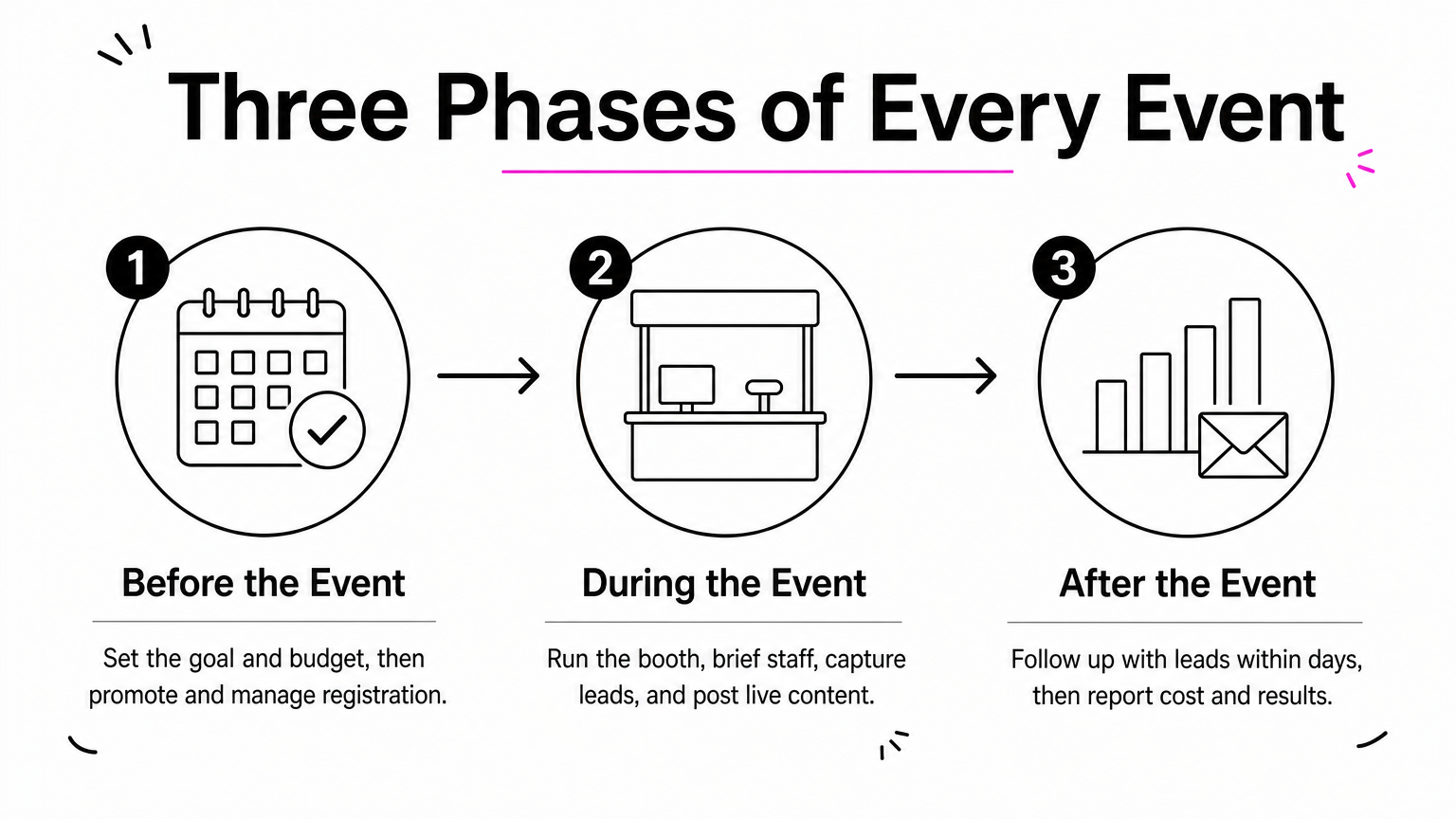
The work follows the same three phases at every level:
- Before the event: set the goal and budget, choose the audience, write invitations and promotion, and manage registration.
- During the event: run the booth or program, brief staff, capture leads, and post live content.
- After the event: follow up with leads within days, then report cost and results to the team.
Event marketing careers reward people who tie every event to a measurable result, not just a well-run day.
Roles and what each one involves
Titles overlap, so read the duties, not the name. "Field marketing," "experiential," "trade show marketing," and "brand activation" all describe similar work. The table shows the usual ladder.
| Level | Common titles | Main job | Experience usually asked |
|---|---|---|---|
| Entry | Event staff, brand ambassador, promoter, event assistant | Greet attendees, staff booths, qualify leads, set up and tear down | None, often part-time with evenings and weekends |
| Early career | Event marketing coordinator, marketing assistant | Handle registration, emails, social posts, vendor orders, attendee data | Little to about 1 year, internships count |
| Mid-level | Event marketing specialist, field marketing coordinator | Own a set of events, run promotion, report results | About 2 to 4 years |
| Senior | Event marketing manager, field marketing manager | Set the event plan and budget, manage vendors and a small team | Typically 4 or more years |
| Leadership | Director of events, head of field marketing | Decide which events the company funds and defend the spend | Years of proven results |
What event marketing careers pay
Pay depends on the city, the employer’s budget, and whether the role is hourly or salaried. Hourly roles such as event staff, promoters, and ambassadors often post somewhere between roughly $15 and $25 an hour in US listings. Salaried roles from coordinator to manager span a much wider band, and the top of that band goes to people who manage large budgets or answer for revenue. The same logic answers who earns the most. In marketing overall, directors and chief marketing officers sit at the top. Among event planners, those who run big corporate, association, or trade show programs, or who own an agency, usually out-earn those who run small local events.
Do not rely on a single national average. Build your own benchmark from postings in your area. A growing number of US states require employers to post pay ranges, so many listings now show them. Pull three postings for the role you want and average the midpoints. The figures below are illustrative, not market data.
| Posting | Posted range | Midpoint |
|---|---|---|
| A | $48,000 to $52,000 | $50,000 |
| B | $50,000 to $62,000 | $56,000 |
| C | $55,000 to $60,000 | $57,500 |
The average midpoint is ($50,000 + $56,000 + $57,500) / 3 = $54,500. Use that as your target when you negotiate. For official wage data on related occupations, such as meeting and event planners and marketing specialists, check the Bureau of Labor Statistics Occupational Outlook Handbook.
Step 1. Pick the entry role that fits you
Choose the title family that matches what you already have, then search for those titles. Entry level event marketing careers do not need one fixed background, because hospitality, sales, writing, and admin skills all transfer. Starting from your strengths gets you interviews faster than applying to everything.
Match your background to a title family
| Your background | Titles to search | Why it fits |
|---|---|---|
| No experience, student | Event staff, brand ambassador, event assistant, intern | Quick to start and builds floor experience |
| Hospitality, retail, customer service | Event coordinator, venue marketing coordinator, guest experience | Handling attendees is the same skill |
| Sales or business development | Field marketing coordinator, trade show marketing, lead generation | Lead conversion is the metric that matters |
| Writing, design, social media | Marketing communications assistant, content coordinator | Every event needs copy and visuals |
| Admin or project management | Event marketing coordinator, marketing operations assistant | Registration and vendor tracking are core tasks |
Weekend and evening work is normal in this field, so ask about the schedule early. If you cannot work those hours, lean toward the in-office coordinator and communications titles.
Screen out roles that are not what they claim
Some postings use "event marketing" to describe commission-only sales or door-to-door promotion. These are not the careers described in this guide, because they build no planning or measurement skills. Check four things before you apply:
- The pay is stated as an hourly rate or a salary, not "unlimited earning potential."
- The duties mention planning, promotion, or reporting, not just selling.
- The employer is named and has a real website and company page.
- You are never asked to pay a fee, buy stock, or recruit others.
If a posting cannot tell you what you will be paid or what you will measure, it is not an event marketing job.
Step 2. Build proof you can plan, promote, and measure
You need one real event on your resume, with numbers attached. Employers screen for a small set of skills, and you can show every one of them through a single small project. Do this step before you send many applications.
Skills hiring managers screen for
- Project management: deadlines, checklists, and juggling vendors.
- Writing: invitations, event pages, emails, and social posts that get clicks.
- Data basics: counting registrations, attendance, and leads in a spreadsheet.
- Tools: a CRM such as Salesforce or HubSpot, an event platform such as Cvent or Eventbrite, an email platform, and a design tool such as Canva.
- People skills: speaking to strangers, briefing staff, and staying calm when a shipment is late.
You do not need paid access to learn the tools. Free tiers and trial accounts of most email, design, and ticketing platforms are enough to practice. A certification such as the Certified Meeting Professional credential from the Events Industry Council is optional and mostly helps later in your career.
Run one small event and write it up
Volunteer at a conference or trade show to see how a floor operates. Then run something small yourself, such as an alumni meetup, a charity run, a local industry mixer, or a workshop for a club. Treat it like a campaign: set a goal, a budget, and a promotion plan, then measure the result. A $2,400 budget and 71 attendees works out to about $33.80 per attendee, and a number like that is exactly what interviewers want to hear.

Copy this one-page summary and fill it in after your event:
Event: [name, date, type]
Goal: [target registrations and attendees]
Budget: [total spend]
Promotion: [channels, number of emails or posts sent]
Result: [registered, attended]
Cost per attendee: [budget divided by attendees]
Follow-up: [what you sent, replies or leads]
Next time: [one change you would make]
Keep up with the industry while you build experience. The monthly Exhibition Globe E-Magazine covers exhibitions, trade shows, and MICE news, interviews, and market developments, which teaches you the vocabulary employers use. Attending a trade show as a visitor also lets you talk to exhibitors about how their teams are structured.
One documented event with a cost-per-attendee figure beats a page of vague responsibilities.
Step 3. Find openings near you and remote options
Search job boards by title, add employer types you have not thought of, and set alerts so you apply within days of a posting. Most event marketing careers are on-site, so your local employer mix matters more than the national picture.
Search by title, then by employer type
Use a Boolean search on LinkedIn or Indeed to catch every title variant in one pass:

("event marketing" OR "field marketing" OR "trade show" OR "experiential") AND (coordinator OR specialist OR assistant OR manager)
Set your location and radius, sort by date, and save the search as an alert. Then widen your list beyond obvious employers. Hiring teams for events sit in many places:
- Venues and hospitality: convention centers, hotels, arenas, and sports teams.
- Agencies: experiential, brand activation, and exhibit and stand design firms.
- Companies with trade show programs: B2B software, manufacturers, healthcare, and logistics.
- Organizers: companies that run regional trade shows and conferences.
- Institutions: universities, hospitals, and nonprofits that run fundraising events.
Exhibition Globe has an events industry jobs section, and its EG Business Listing directory lets you browse organizers, service providers, and venues. That makes it a useful way to build a target employer list before you apply. Staffing agencies are worth a call too, because they fill temporary event roles quickly and those gigs often turn into permanent offers.
What to expect from remote roles
Remote event marketing careers exist, but they are a minority. They cluster in virtual events and webinars, content and social promotion, demand generation, and event technology or marketing operations. Field marketing roles may be labeled hybrid, but expect travel to shows instead of a home-only schedule. Search "virtual events marketing," "webinar marketing," or "demand generation events," and check whether the posting means fully remote or remote with travel.
Search by every title variant and every employer type, because the best event marketing jobs rarely carry the title you typed first.
Step 4. Apply, interview, and negotiate
Lead every application with numbers from your event work, tailor the wording to each posting, and practice three stories before the interview. Event teams hire people who show they can handle pressure and report results, so show both.
Write a resume built on numbers
Replace task lists with outcomes. Compare these two bullets, which are examples only:
- Before: Helped with promotion for company events.
- After: Promoted a 150-seat product launch through 4 emails and 10 social posts, reaching 112 registrations, 30% above target.
Mirror the posting’s own words, such as "lead capture," "registration," or "vendor coordination," where they honestly describe your work. Keep the resume to one page for entry roles. Add a link to your one-page event summary from Step 2 so the interviewer can see the work.
Prepare for the interview and the offer
Expect questions like "Walk me through an event you promoted," "How do you measure success," and "What do you do when something goes wrong on event day." Answer each with the same structure: the goal, what you did, and the number that resulted. Prepare one story about a problem you fixed under pressure.
For the offer, compare the pay with your benchmark from the first section. For hourly roles, ask about shift length, weekend frequency, travel pay, and whether training is paid. For salaried roles, ask about travel expectations and how event days are compensated. Within a year or two, you move up by taking ownership of a budget and reporting your results.
Interviewers hire the candidate who can explain what an event cost and what it produced.
Your next move into event marketing
Event marketing careers open to people who can plan, promote, and measure an event. The path is simple: understand the roles and pay, pick an entry title that fits your background, build one documented event, search by title and employer type near you, and apply with numbers. Start with the pay benchmark and the small event, because both make every later step easier.
If you want to see who runs the shows in your industry, browse Exhibition Globe’s events industry jobs, directory, and trade show coverage and build your target employer list today.