The best event planner companies are the ones built for your kind of event, not the ones with the longest client list. Corporate teams with large guest counts usually need a full-service agency. Couples need a wedding planner with strong venue relationships. Exhibitors need a trade show specialist. Plan on paying roughly 10% to 20% of your event spend in planning fees, or a flat fee when the scope is small.
Most search results for this topic hand you a ranked list of firms from one city, with pricing "by proposal" and no way to tell which firm suits a 40-person birthday or a 400-person conference. That gets frustrating when you need to hire someone in your own area and the date is already set.
This guide sorts event planner companies into seven types. For each type you get what it handles, who it suits, and what it costs, with worked examples. A final section shows how to find companies near you, compare quotes fairly, and what to ask before you sign. Exhibition Globe is a B2B media platform for the events, exhibitions and trade show industry.
1. Full-service corporate event agencies
What they handle
Full-service corporate agencies run the entire program, from concept and venue sourcing to vendor contracts, production, AV, staffing and on-site management. Many keep planning, design and production under one roof, so you deal with one accountable team instead of coordinating a dozen suppliers. Typical scope includes:
- Conferences, sales kickoffs and offsites
- Product launches, galas and award dinners
- Employee events and holiday parties
- Hybrid events with a streaming component
Who they suit
Hire this type when the event has many stakeholders, a fixed date and more than about 100 guests. Marketing, HR and communications teams use these agencies because they absorb the coordination work that would otherwise eat weeks of internal time.
They are a poor fit for a small team dinner. Agency minimums can exceed what the event is worth, and you will pay for capacity you do not use.
A full-service agency earns its fee by removing coordination work, so the more vendors you would otherwise manage yourself, the better the value.
What they cost and what to check
Most corporate agencies quote a custom proposal built on a percentage of the event budget or a flat management fee. Ten to 20 percent is a common range. Say a conference has $60,000 of venue, catering and production spend. At 15% the planning fee is $9,000, and at 20% it is $12,000, which brings your total outlay to $69,000 or $72,000.
Before you accept a proposal, get clear answers on three points:
- Does the percentage apply to every vendor invoice or only to the ones the agency manages?
- Does the agency earn commissions or markups from vendors, and are they disclosed?
- What is included: design, AV management, travel, post-event reporting?
2. Wedding planners
What they handle
Wedding planners manage the timeline, vendors, design and guest experience for a ceremony and reception. They sell in tiers, so a full-planning package and a day-of package are very different purchases. Many also source venues, manage rentals and handle guest logistics such as hotel blocks and shuttles.

- Full planning: from the first venue tour to the last dance
- Partial planning: picks up after you have booked the big items
- Day-of coordination: starts a few weeks out and runs the event itself
Who they suit
Planners earn their fee for couples with demanding jobs, multi-day weekends, out-of-town guests, or venues with strict vendor rules. Look for someone who has already worked at your venue or a similar one, because they know load-in windows, noise curfews and insurance requirements.
Style fit matters as much as logistics. Some planners specialize in cultural or religious ceremonies, intimate weddings, or large black-tie events. Scroll through a full real wedding from start to finish, not just the highlight photos.
Pick the planner whose past weddings look like the one you want, not the one with the most followers.
What they cost and what to check
Full-service wedding planners typically charge a flat fee or a percentage of the wedding budget, often in the 10% to 20% range. On a $40,000 wedding, 15% comes to $6,000 and 20% comes to $8,000. Day-of coordination is a flat package and costs a fraction of full planning.
Ask how many weddings the planner takes per season, since a calendar packed with events means divided attention. Ask who steps in if your lead planner is sick on the day. For popular dates, start your search six to twelve months ahead, and earlier for peak seasons and holiday weekends.
3. Social and milestone party planners
What they handle
These planners focus on birthdays, anniversaries, baby showers, retirement parties, proposals, and bar or bat mitzvahs. They handle themes and decor, vendor booking, entertainment, rentals and the run of the evening. Because the events are personal, the best ones spend real time learning the guest of honor and the family dynamics.
Who they suit
This type works for hosts who want a distinctive event without becoming a part-time project manager. Small event planner companies often shine here, because a solo planner or a team of three can give a 60-person party hands-on attention that a large agency cannot.
Bar and bat mitzvahs deserve special care. Choose a planner who has run several, since the timeline includes ceremony logistics, a candle lighting or similar traditions, entertainment for mixed age groups, and a large guest list with many moving parts.
For a personal milestone, the person who answers your texts matters as much as the portfolio.
What they cost and what to check
Pricing is usually a flat design-and-coordination fee or a percentage of the budget, often in the same 10% to 20% band. On a $15,000 party, 15% is $2,250 and 20% is $3,000. Many planners also set a minimum fee, so the percentage math can understate the real cost of a small event.
Check these points before booking:
- Ask whether the quote covers design and decor, or only coordination.
- Confirm how many hours the planner is on site the day of the party.
- Find out if rentals, florals and entertainment are billed through the planner or directly to you.
4. Destination management companies
What they handle
A destination management company, or DMC, is a local firm that arranges everything a visiting group needs at a destination: hotels, venues, ground transport, tours, activities, meals and on-site staff. Its value is local knowledge and supplier relationships that an out-of-town planner does not have. Some DMCs also handle event production for galas and welcome dinners.

Who they suit
DMCs suit incentive trips, multi-day conferences and group travel where most attendees fly in. They also suit destination weddings and large family reunions, where nobody on the hosting side knows the area. If your event is a single evening for local guests, you do not need one.
A DMC can work alongside your own planner. Your planner owns the program and the brand, and the DMC handles the destination: permits, local vendors, drivers, and the Plan B when it rains.
A DMC sells local knowledge, so choose one based in the destination, not one that subcontracts the work.
What they cost and what to check
DMCs often quote a per-person or per-program price with a service fee or markup built in. As an illustration, a group of 80 guests at $150 per person for transfers and a welcome dinner comes to $12,000 before hotel rooms. Always ask for the quote to be itemized so you can see transport, venue, food and the management fee separately.
Ask which services the DMC delivers with its own staff and which it subcontracts. Ask for a cancellation schedule in writing, because group travel contracts often carry attrition clauses, and for proof of liability insurance.
5. Experiential and brand activation agencies
What they handle
Experiential agencies build events as part of a brand campaign. They combine live production with strategy, content capture and social amplification, and they plan around measurable audience behavior as well as guest comfort. Typical work includes pop-ups, product launches, sampling programs, roadshows and press events.
At the enterprise end, firms such as Jack Morton New York, the local office of a global experiential agency, cover trade shows, exhibits and employee experiences at scale.
Who they suit
Choose this type when the event has a marketing objective with numbers attached: sign-ups, foot traffic, press coverage, social reach, or leads. A traditional planner can run a great launch party, but an experiential agency will also design the content and measurement around it.
They are the wrong choice for private celebrations. The processes are heavier, the scoping is formal, and the minimum engagement is built for brands with campaign budgets.
If the event does not have a measurable goal, you are paying experiential rates for planner work.
What they cost and what to check
Pricing is campaign-based and custom. Expect separate lines for strategy and creative development, production and fabrication, staffing, content capture and measurement. Percentage fees can apply, but creative fees and production costs often sit apart from them, so compare totals, not rates.
Agree on success metrics before creative work starts. Ask who owns the photos, video and attendee data after the event. Ask whether the production budget is passed through at cost or marked up.
6. Exhibition and trade show specialists
What they handle
Exhibition specialists work in two roles. Organizer-side companies run the show: floor plan, exhibitor sales, ticketing, visitor marketing and venue contracts. Exhibitor-side providers support a company taking a booth, handling:
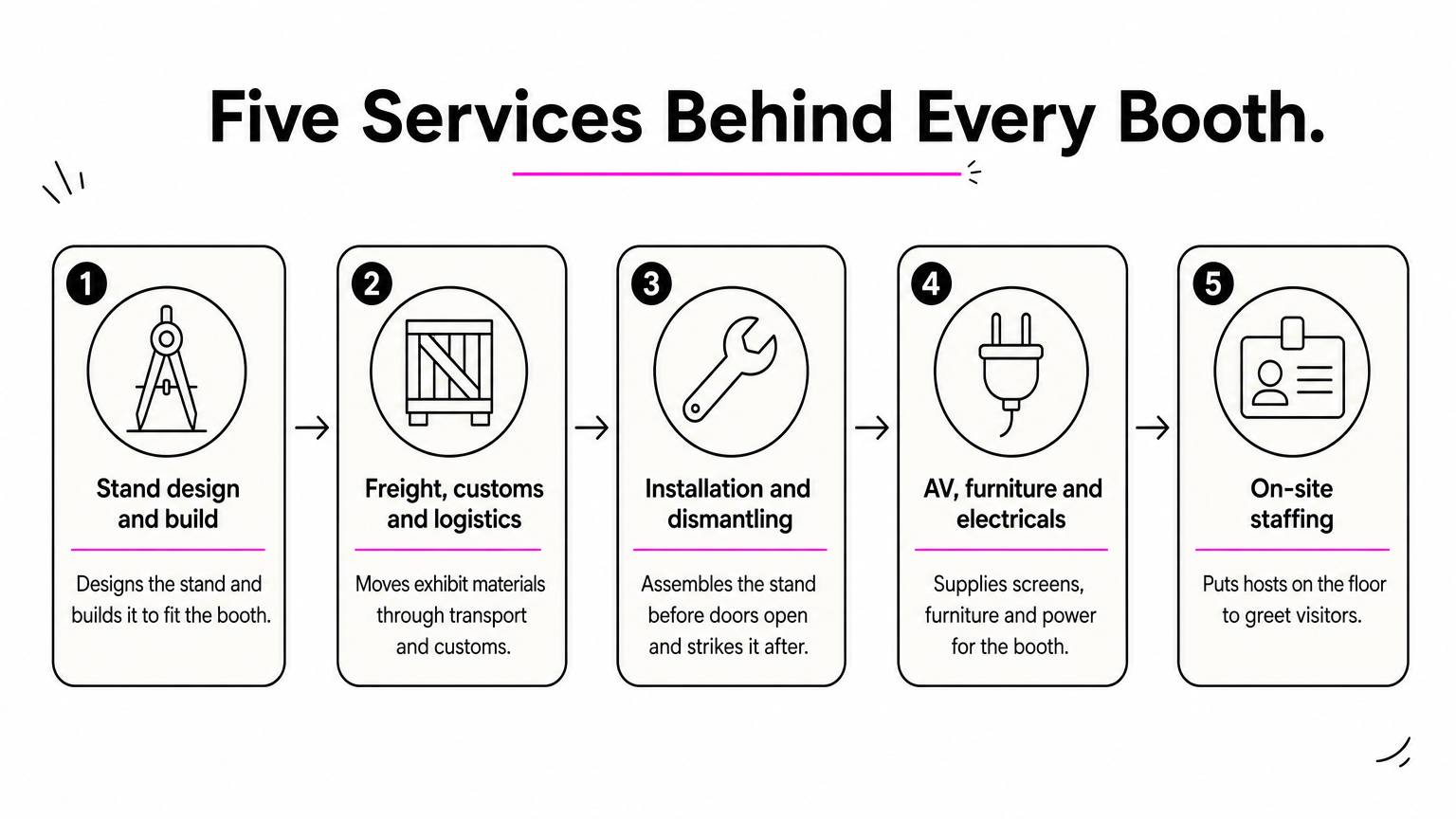
- Stand design and build
- Freight, customs and logistics
- Installation and dismantling
- AV, furniture and electricals
- On-site staffing and hostesses
Who they suit
If you are an exhibitor, you need a stand contractor and a logistics partner, not a party planner. If you are an organizer, you need contractors and venue services that understand show-day deadlines, such as move-in windows and fire regulations for exhibit structures.
A business directory is a fast way to build a longlist. The EG Business Listing on Exhibition Globe is a directory page where visitors find businesses, service providers, jobs, services and venues from the events industry. Check that a listed provider operates in your market before you call.
For trade shows, hire for exhibition experience first, because a great party planner can still miss a move-in deadline.
What they cost and what to check
Floor space is priced by area, and build and services come on top. Assume a 10 ft by 10 ft booth, which is 100 square feet. At a hypothetical $40 per square foot, space alone is $4,000. Stand build, freight, installation, electricity, furniture and staffing are all separate lines, so ask every contractor for an all-in estimate.
Ask to see photos of stands they built in the same venue. Confirm who handles show-site paperwork and who is on the floor during move-in.
7. Independent planners and day-of coordinators
What they handle
Independent planners are solo consultants or small teams who sell partial services rather than full management. That can be hourly consulting, a vendor shortlist, a timeline and run-of-show, or on-the-day coordination. They work across weddings, parties and corporate events.
Who they suit
These planners suit hosts who have done the creative work and want a professional to run the day. They also suit corporate teams with an in-house planner who needs extra hands on site. If your budget is modest, this is often the smartest first hire.
The tradeoff is capacity. A solo planner has one pair of hands, so ask what backup they have if two events fall on the same weekend.
The cheapest way to get professional help is to hire a planner for the day, not the whole project.
What they cost and what to check
Day-of coordination is usually a flat package, and consulting is often billed hourly. A day-of package normally covers a final walkthrough, a written timeline, vendor confirmations and the event itself, but the exact hours vary. Request an estimate of total hours and a cap, so an hourly arrangement does not drift.
Ask how soon before the event the planner begins work and whether the package includes a rehearsal. Ask to speak to a past client whose event was similar in size to yours.
How to find and compare event planner companies near you
Where to find planners in your area
The most reliable local leads come from people with a stake in your event going well. Venue preferred-vendor lists are a strong starting point, since venues know which planners deliver without incident. Caterers, photographers and florists will also tell you who is organized and who is not.
Beyond referrals, try these sources:
- Member directories from industry associations such as the International Live Events Association (ILEA) and Meetings Professionals International (MPI)
- Review pages and map listings, searched by event type plus your city
- Industry directories for exhibition and trade show services
Start early. Weddings and large corporate events book six to twelve months ahead, and small parties can often move faster, though the best planners fill their calendars quickly.
Why best and biggest lists mislead
No single company is the best event planner, because each type above solves a different problem. A firm that is perfect for a luxury wedding is wrong for a product launch. The biggest event management companies are large global agencies built for enterprise programs, and size says nothing about fit for a 50-person dinner.
Treat "best of" lists with caution. Many are editorial picks, and some publishers earn referral income. Use them to find names, then judge each firm on recent events like yours, the person who will actually run your account, and references you call yourself.
How to compare quotes side by side
Write a one-page brief with your date, guest count, budget range, goals and must-haves. Send the same brief to three to five companies and ask for itemized proposals. Then compare total cost, not headline rates.
| Fee model | How it works | What to watch |
|---|---|---|
| Percentage of budget | Often 10% to 20% of event spend | Check whether it applies to all vendor invoices |
| Flat fee | Fixed price for a defined scope | Ask what triggers extra charges |
| Hourly | Rate multiplied by hours worked | Request an estimate and a cap |
| Commission or markup | Vendors pay the planner, or costs are marked up | Ask for disclosure and itemized invoices |
| Per person | Common for destination programs | Confirm what each person’s price includes |
Questions to ask before you sign
A short interview separates organized planners from polished ones. Ask each finalist:
- Which events have you run in the last year that match mine in size and type?
- Who will be my day-to-day contact, and who is on site?
- How are your fees calculated, and are vendor commissions disclosed?
- What is included, and what costs extra?
- How do you handle overruns and vendor no-shows?
- Can I speak with two recent clients?
- What are your cancellation and postponement terms?
- Do you carry liability insurance, and can I see the certificate?
Put the scope, payment schedule and cancellation terms in a written contract, and keep a copy of every proposal you compare.
Compare itemized totals, not percentages, because a low rate on a bloated scope still costs more.
Pick the planner type first, then the company
The right event planner company depends on what your event needs to do. Corporate programs with many stakeholders call for a full-service agency, weddings and milestone parties call for planners who specialize in them, and group travel calls for a destination management company. Brand campaigns call for experiential agencies, and trade shows call for exhibition specialists. For small budgets, a day-of coordinator is often the smartest hire.
Whichever type you choose, write a clear brief, collect three itemized quotes, and check references before you sign. If your event involves a trade show or exhibition, explore the Exhibition Globe directory of event industry service providers to build your longlist of stand builders, venues and other providers.