marketing strategies, governments developing convention infrastructure, venue operators modernising facilities, and investors evaluating long-term opportunities all face the same challenge: preparing for an industry that will look fundamentally different by the end of this decade.
The following five forces are expected to shape that future.
1. Artificial Intelligence Will Become Invisible Infrastructure
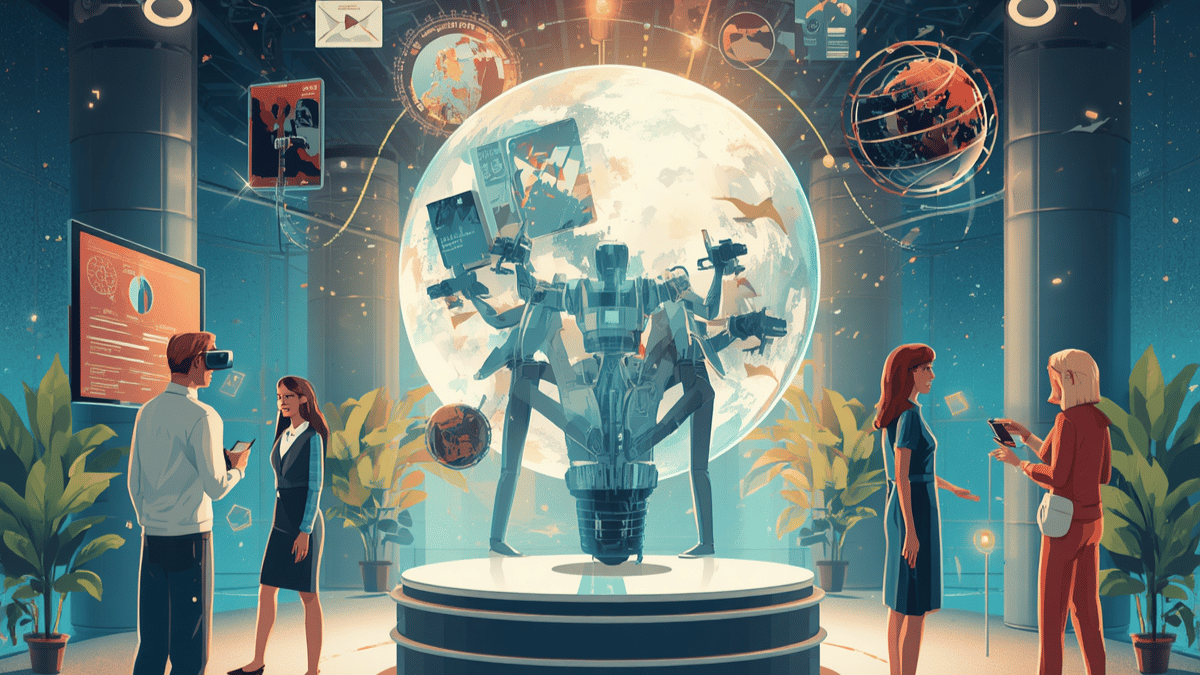
The first wave of Artificial Intelligence focused on automation. The next wave will focus on intelligence embedded within every aspect of the exhibition experience. Visitors will no longer think about using AI because it will operate quietly in the background, supporting every stage of the event journey. Registration, scheduling, networking, translation, personalised recommendations, venue navigation, content discovery, lead management, and post-event engagement will become increasingly intelligent without requiring active effort from participants. For organisers, AI will evolve into a strategic decision-making partner capable of forecasting attendance, optimising exhibition layouts, improving operational efficiency, enhancing security, and measuring commercial outcomes with remarkable precision. Exhibitors will use intelligent systems to identify qualified buyers, personalise conversations, and strengthen customer relationships long after exhibitions conclude.
The competitive advantage will no longer belong to organisations that simply adopt Artificial Intelligence. It will belong to those that integrate it so seamlessly that technology enhances every interaction while remaining almost invisible to the people it serves.
2. Sustainability Will Become a Business Strategy Rather Than a Compliance Requirement
Environmental responsibility is rapidly moving beyond regulatory obligations and corporate reporting.Visitors increasingly prefer exhibitions that demonstrate responsible environmental practices. Exhibitors expect organisers to reduce waste, improve resource efficiency, and support sustainable operations. Investors are evaluating environmental performance alongside financial returns, while governments are incorporating sustainability into broader economic development strategies.
As a result, sustainability will influence every aspect of exhibition planning, from venue design and construction materials to transportation, catering, logistics, energy management, waste reduction, and digital documentation. Convention centres will increasingly operate as intelligent green buildings, while reusable exhibition structures, circular economy principles, renewable energy systems, and carbon measurement tools become standard practice across the global industry. The most competitive destinations will not necessarily be those with the largest venues. They will be those capable of demonstrating responsible growth.
3. Business Communities Will Replace Standalone Events
Business Communities Will Replace Standalone Events For decades, exhibitions followed a familiar rhythm. Planning began months before the event. Business activity peaked during a few days. Engagement gradually declined until preparations for the following year began.
That model is rapidly disappearing. Digital platforms now enable organisers to maintain continuous engagement through webinars, educational programmes, networking communities, market intelligence, certification courses, industry research, podcasts, newsletters, and virtual collaboration.
The exhibition itself is becoming the centrepiece of a much larger ecosystem operating throughout the year. Successful organisers will increasingly view themselves not simply as event managers but as community builders connecting industries every day rather than only during exhibition week. This continuous engagement will strengthen exhibitor loyalty, improve visitor retention, generate recurring revenue, and create richer business relationships across the entire industry.
4. Geography Will Become More Balanced
For many decades, international exhibitions were concentrated within a relatively small number of mature markets. That landscape is changing rapidly. Asia continues expanding through manufacturing growth, entrepreneurship, and infrastructure investment. The Middle East is positioning itself as a strategic bridge connecting Europe, Asia, and Africa.
Africa and Latin America are developing new exhibition ecosystems supported by regional trade, digital transformation, and urbanisation. Europe continues leading through quality, sustainability, and specialist expertise, while North America remains the global centre of innovation and commercialisation.
Rather than replacing one another, these regions are becoming increasingly interconnected. The future exhibition industry will therefore be defined less by regional competition and more by global collaboration. Organisers, exhibitors, and destinations that develop international partnerships rather than isolated regional strategies will be best positioned for long-term success.
5. Experience Will Become the Ultimate Competitive Advantage
Perhaps the most profound transformation taking place within the exhibition industry is philosophical rather than technological. Products can be compared online. Specifications can be downloaded instantly.
They seek experiences that help them make better business decisions.
This is why the Experience Economy will continue defining the future of business events. Visitors will remember how efficiently they navigated a venue.
They will remember conversations that solved important business challenges. They will remember demonstrations that changed the way they viewed an industry. They will remember the partnerships that began unexpectedly during networking sessions.
Technology may support these moments. Only people can create them. The organisers, exhibitors, venues, and destinations that place human experience at the centre of every decision will become the industry’s long-term leaders.
Looking Towards 2030
Taken together, these five forces reveal a clear direction for the future of global business events. The exhibition industry will become more intelligent.
- More sustainable.
- More connected.
- More geographically diverse.
- More experience-driven.
Yet despite extraordinary technological progress, its fundamental purpose will remain remarkably consistent.
innovation, strengthen industries, build trust, and create opportunities that shape the global economy.