history, The digital revolution has fundamentally changed how businesses buy, sell, communicate, and make decisions. Information that once required a visit to a trade show is now available instantly through websites, webinars, virtual demonstrations, and online marketplaces. Buyers can compare products, review specifications, and communicate with suppliers from virtually anywhere in the world without leaving their offices. This raises an important question. If information has become universally accessible, why do millions of business professionals continue to invest significant time and resources in attending exhibitions every year?
The answer lies in something technology alone cannot replicate—experience. The world’s most successful exhibitions are no longer competing merely by attracting more exhibitors or building larger venues. Instead, they are competing to create richer experiences that educate visitors,
encourage collaboration, inspire innovation, and build long-term business relationships. In today’s marketplace, memorable experiences have become just as valuable as the products themselves. This is the essence of the Experience Economy, and it is rapidly redefining the future of exhibitions.
From Transactions to Transformations
Not long ago, the success of a trade exhibition was judged primarily by numbers. Larger exhibition halls, bigger booths, higher visitor footfall, and stacks of collected business cards were considered the strongest indicators of a successful event. Exhibitors focused on displaying products, distributing catalogues, and generating as many enquiries as possible during a limited exhibition period. While this model served the industry well for many years, today’s business environment demands much more.
Modern buyers arrive at exhibitions exceptionally well prepared. Before stepping onto the exhibition floor, they have often researched exhibitors, watched product videos, compared technical specifications, and shortlisted potential suppliers. Their objectives are far more strategic than simply gathering information. They seek expert guidance, practical solutions, meaningful conversations, and trusted partners capable of supporting their long-term business goals. As a result, exhibitions have evolved from transactional marketplaces into transformational business environments.
Visitors no longer measure the value of an exhibition by the number of brochures they carry home. Instead, they remember the product demonstration that solved a complex operational challenge, the conference session that introduced a disruptive industry trend, or the conversation that eventually developed into a long-term business partnership. These experiences leave a far greater impression than traditional sales presentations ever could.
For organisers and exhibitors alike, creating these memorable interactions has become the new benchmark of success.
Understanding the Experience Economy
The Experience Economy represents a shift in how value is created. Rather than focusing solely on selling products or delivering services, organisations now seek to design meaningful experiences that engage people emotionally, intellectually, and professionally. Across industries—from hospitality and retail to healthcare and education—customer expectations have evolved beyond functionality. People increasingly value personalised, engaging, and memorable interactions. The exhibition industry is following the same path.
Today’s visitors expect every stage of their journey to feel relevant and personalised. They expect seamless registration, intelligently curated conference sessions, personalised exhibitor recommendations, networking opportunities aligned with their business interests, and interactive demonstrations that help them evaluate solutions in real-world scenarios. Every touchpoint contributes to the overall experience.
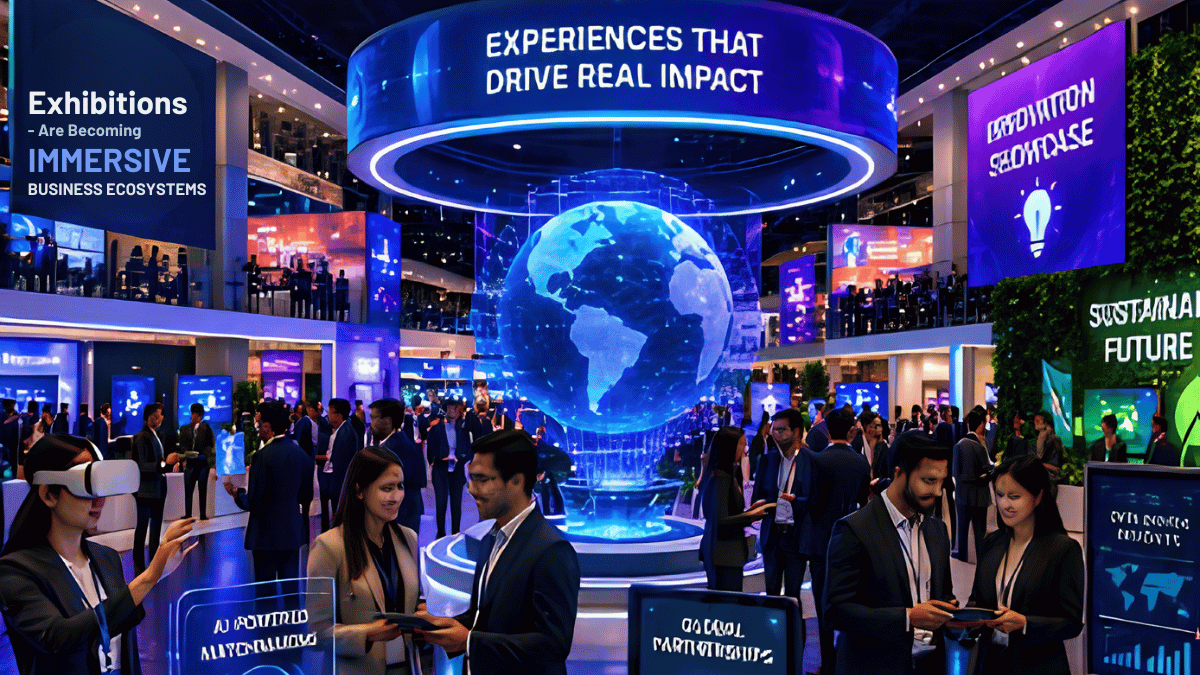
For exhibitors, this transformation requires a completely different mindset. Rather than relying on static displays and printed catalogues, successful companies now focus on creating immersive brand experiences. Interactive demonstrations, experiential marketing, live product testing, innovation zones, storytelling, and hands-on engagement have become powerful tools for attracting attention and building lasting impressions. People rarely remember every product they encounter during an exhibition, but they almost always remember how an experience made them feel. Those memorable moments become the foundation of stronger relationships, increased trust, and future business opportunities.
Human Connections Remain the Industry’s Greatest Strength
Despite remarkable advances in Artificial Intelligence, automation, and digital communication, one element of the exhibition industry remains irreplaceable—the human connection. Business is ultimately built on trust, and trust develops through genuine interaction. A handshake between two entrepreneurs, an unscripted conversation over coffee, a live product demonstration, or a spontaneous introduction during a networking session often creates opportunities that no digital platform can fully replicate. These moments continue to define the true value of face-to-face events.
Every exhibition functions as a vibrant ecosystem where manufacturers, buyers, distributors, investors, policymakers, researchers, startups, technology providers, industry associations, and media organisations come together with a shared purpose. The diversity of perspectives and expertise creates an environment where innovation flourishes naturally.
Many of the most successful partnerships are not the result of scheduled meetings. They begin unexpectedly—in conference corridors, networking lounges, panel discussions, or informal conversations between professionals who discover common challenges and shared ambitions. These authentic interactions remain one of the exhibition industry’s most valuable assets. Technology has undoubtedly transformed how professionals connect, but it has not diminished the importance of personal relationships. Instead, it has made meaningful face-to-face engagement even more valuable.