Sport event marketing is the work of planning, promoting, and delivering the fan experience for a sporting event so that seats fill, sponsors renew, and media pay attention. It starts when you announce a date and ends with the follow-up after the final whistle. You will also see it written as sports event marketing or sporting event marketing. The meaning is the same, and it applies to a stadium final as much as a Saturday youth tournament.
What sets it apart from general sports marketing is the fixed date. A team can sell jerseys all year. An event sells a product that expires the day it happens, so every unsold seat, registration, or sponsor slot is lost for good. That pressure shapes the countdown timelines, the ticket offers, and the sponsor packages covered below.
This guide explains why sport event marketing matters, how to plan a campaign, the marketing mix behind it, the tactics that promote an event, how to attract sponsors, what to do on event day, five real examples, and how to measure results. At Exhibition Globe we cover trade shows and expos. Sport events borrow the same mechanics: exhibitors, sponsors, press, and visitors who need a reason to show up.
Why sport event marketing matters
Sport event marketing matters because an event is perishable inventory. You get one date to turn interest into attendance, revenue, and goodwill. Action on the field does not fill seats on its own. People need to know the event exists, believe it is worth their time, and find it easy to attend.
Perishable inventory and a fixed deadline
A ticket for next Saturday has no value on Sunday. That is why event marketers work backward from the event date and treat each week of the countdown as a checkpoint. If sales are slow at six weeks out, you still have time to change the offer, the message, or the channel. At two days out you do not.
The fixed date also gives you urgency, an asset most products lack. "Last chance for early-bird prices" is honest when it is true, and it moves fence-sitters. Use it sparingly and keep your promises, or fans stop believing your deadlines.
Where the money comes from
An event earns from several streams, and marketing supports each one differently. Seeing them side by side shows why a campaign aimed only at ticket buyers leaves money on the table.
| Revenue source | What marketing does for it |
|---|---|
| Tickets and registrations | Builds awareness, sets price tiers, creates urgency |
| Sponsorship | Proves audience size and quality to brands |
| Media and streaming | Creates a story and an audience that broadcasters can sell |
| Merchandise, food, and drink | Raises attendance and the time people spend on site |
| Local spending | Shows hotels, shops, and the host city the value of hosting |
Who does the work
At a large event, a marketing manager oversees promotion, a communications manager handles press, community coordinators work with schools and clubs, and a partnerships lead sells sponsorship. At a small event, one volunteer may do all four jobs. The tasks are the same either way: research the audience, plan the campaign, sell sponsors, run promotions, support the event day, and report results.
If you are asking what someone in sports and event marketing actually does, that list is the answer. The daily work is mostly scheduling, writing, negotiating, and checking numbers, with a few hectic days around the event itself.
An event sells only once, so your marketing has to start early enough to fix its own mistakes.
How to plan a sport event marketing campaign
Plan a campaign by setting measurable goals, defining your audience, building a countdown timeline, and fixing a budget before you create any content. The order matters. Teams that start with posters and posts, then work out goals later, usually discover too late that they promoted to the wrong people.
Set goals you can measure
Start with one primary goal and two supporting ones. A primary goal might be 400 tickets sold for a 500-seat venue. Supporting goals might be one signed sponsor and 300 email sign-ups. Specific numbers let you judge progress each week, and they tell you which tactics deserve more money.
Write the goal in one sentence that anyone on the team can repeat. "Sell 400 of 500 seats and sign one local sponsor by event day" is clear. "Create buzz" is not.
Know who you are selling to
Different audiences attend for different reasons. Families want a safe, affordable outing. Hardcore fans want stakes and rivalry. Students want a social night out. Audience research can be simple: look at past attendance, survey your email list, and ask five likely attendees what would make them show up.
Then write one short message per segment. A family message says "Bring the kids, kids under 12 free." A fan message says "The top two teams meet for the title." Same event, two pitches.
Build a countdown timeline
A timeline keeps every tactic tied to the date. Here is a practical 10-week version you can adapt.
| Weeks out | Main actions |
|---|---|
| 10 | Lock date and venue, set goals, start sponsor outreach |
| 8 | Launch the event page and ticket sales, open early-bird pricing |
| 6 | Announce a headliner or ambassador, send a press release |
| 4 | Start the email countdown, begin paid social and local ads |
| 2 | Push group sales, close early-bird pricing, pitch local media |
| 1 | Daily posts, logistics details, parking and entry reminders |
| Event day | Live content, on-site activations, sponsor deliverables |
| 1 to 2 days after | Thank-you email, highlights, short survey |
Work through a budget
Here is an illustrative example for a local tournament with 500 seats and $10 tickets. Full capacity would bring in $5,000. You aim for 400 tickets, or $4,000, and set a marketing budget of $750.
| Item | Amount |
|---|---|
| Paid social ads | $250 |
| Posters and flyers | $150 |
| Giveaway prizes | $200 |
| Email tool, photos, and short video | $100 |
| Contingency | $50 |
| Total | $750 |
If you hit the goal, you spend $750 for 400 tickets, about $1.88 per ticket sold. One local sponsor paying $1,000 would cover the whole marketing spend and leave the ticket income intact.
Pick a goal, a date, and a budget first, and every tactic gets easier to choose.
The marketing mix for a sporting event
The marketing mix for a sporting event covers five things you control: product, price, place, promotion, and people. Sources list the "5 Ps of sport marketing" with slight variations, but this version is the most useful for events. Use it as a checklist before you spend money on promotion.
The five Ps applied to an event
| P | What it means for an event | Question to ask |
|---|---|---|
| Product | The competition, the entertainment around it, and the overall experience | Why is this worth someone’s evening? |
| Price | Ticket tiers, discounts, registration fees, and sponsor rates | Does the price match what the audience values? |
| Place | The venue, access, parking, seating, and the online ticket page | Can people find us and get in easily? |
| Promotion | Advertising, PR, social media, partners, and giveaways | Does each message reach the right segment? |
| People | Athletes, ambassadors, staff, volunteers, and the crowd itself | Who will make attendees feel welcome and excited? |
Product is where many organizers fall short. The game is only part of it. Music, announcers, food, mascots, and a good view all shape whether someone returns, so think of the event as a package rather than a fixture.
Pricing that fills the building
Tiered pricing is the most dependable tool. Early-bird tickets reward people who commit and give you cash flow before the event. Group deals, such as five tickets for the price of four, bring in friends and families. Student, senior, and local resident rates open specific segments.
Be careful with deep discounts close to the event. If fans learn that prices always drop in the last week, they will wait. Keep premium options too, such as better seats or a meet-and-greet, since some fans will pay more for access.
Place: venue and access are marketing too
A venue that is hard to reach undermines even the best campaign. Put parking, transit, and entry details on the ticket page and in every reminder email. Accessibility information belongs there too, because it answers a question that many fans have and few organizers address.
Online, your ticket page is also a "place." If checkout takes more than a few steps or fails on a phone, you lose buyers you already paid to reach. Test it on a phone before you launch.
Fix the product, price, and place first. Promotion cannot rescue an event people find hard to attend.
How to promote a sports event
Promote a sports event by combining social media, local press, ticket offers, and credible partners on a fixed countdown. No single channel does the job. The mix depends on your audience and budget, and the tactics below work at nearly any scale.
Digital and social media
Social media is where most fans now hear about events. Create one event page as the home base for dates, prices, and a ticket link, then feed it with short videos, athlete introductions, and countdown posts. Choose one short, clear hashtag and print it on tickets, signs, and screens so fans can spread the word for you.
Email still converts better than most social posts, because the people on your list have already shown interest. Segmented emails work best: a note to past attendees about the new date, a different one to first-time visitors. Paid social lets you target by location and interest, which suits a budget of a few hundred dollars.
Local media, PR, and community outreach
Newsworthy angles earn free coverage: a first-ever tournament, a charity cause, a local player returning, a record number of teams. Write a short press release with the who, what, when, where, and one quotable line, and send it to local sports and community outlets four to six weeks ahead.
If your event has an expo area, exhibitors, or a business-facing sponsor program, trade media is worth adding to the list. Exhibition Globe, for example, publishes press releases from event organizers and has covered expo openings such as the Delhi Half Marathon expo. Community outreach is the other half of PR: talk to schools, clubs, and workplaces and offer them group rates or a team entry.
Ticket offers and giveaways
Offers turn interest into action. Early-bird prices, family bundles, and "bring a friend" codes give people a reason to decide today. Giveaways such as free tickets for sharing a post, or a prize for the first 100 entrants, add reach without large costs. Sponsors can often fund prizes in exchange for a logo on the item.
Keep rules simple and honest. A contest that needs five steps to enter will get fewer entries than one that needs a single share or sign-up.
Ambassadors and borrowed credibility
A new event has no reputation, so borrow one. An ambassador is a respected local athlete, coach, or personality who agrees to attend and mention the event. A well-known club or organization as a partner tells fans the event is worth their time. Credibility transfers quickly, so line up these names before the public launch and feature them in your first announcement.
For smaller events, "influencers" may simply be well-connected players and community members with big personal networks. Ask them for one post and give them a specific link to share.
Promotion works best as a sequence: announce, build credibility, offer a reason to act, then remind.
How to attract sponsors to a sporting event
Attract sponsors by showing them an audience they want, a package that gives clear exposure, and a plan for activation. Sponsors do not buy logos. They buy access to people, so lead with who attends and what they will do on the day.
What sponsors actually buy
Most sponsors want one or more of four things: audience reach, brand exposure, direct sales or sampling opportunities, and content they can use afterward. A local gym wants new members. A drinks company wants trial. A bank wants goodwill with families. Ask each prospect what result they want before you offer a package.
Prepare simple proof: expected attendance, audience profile, past event photos, email list size, and social following. If this is your first edition, offer a smaller founding-sponsor deal at a lower price and a promise of renewal terms. That also helps you "borrow" a brand’s credibility for your own promotion.
Build packages in tiers
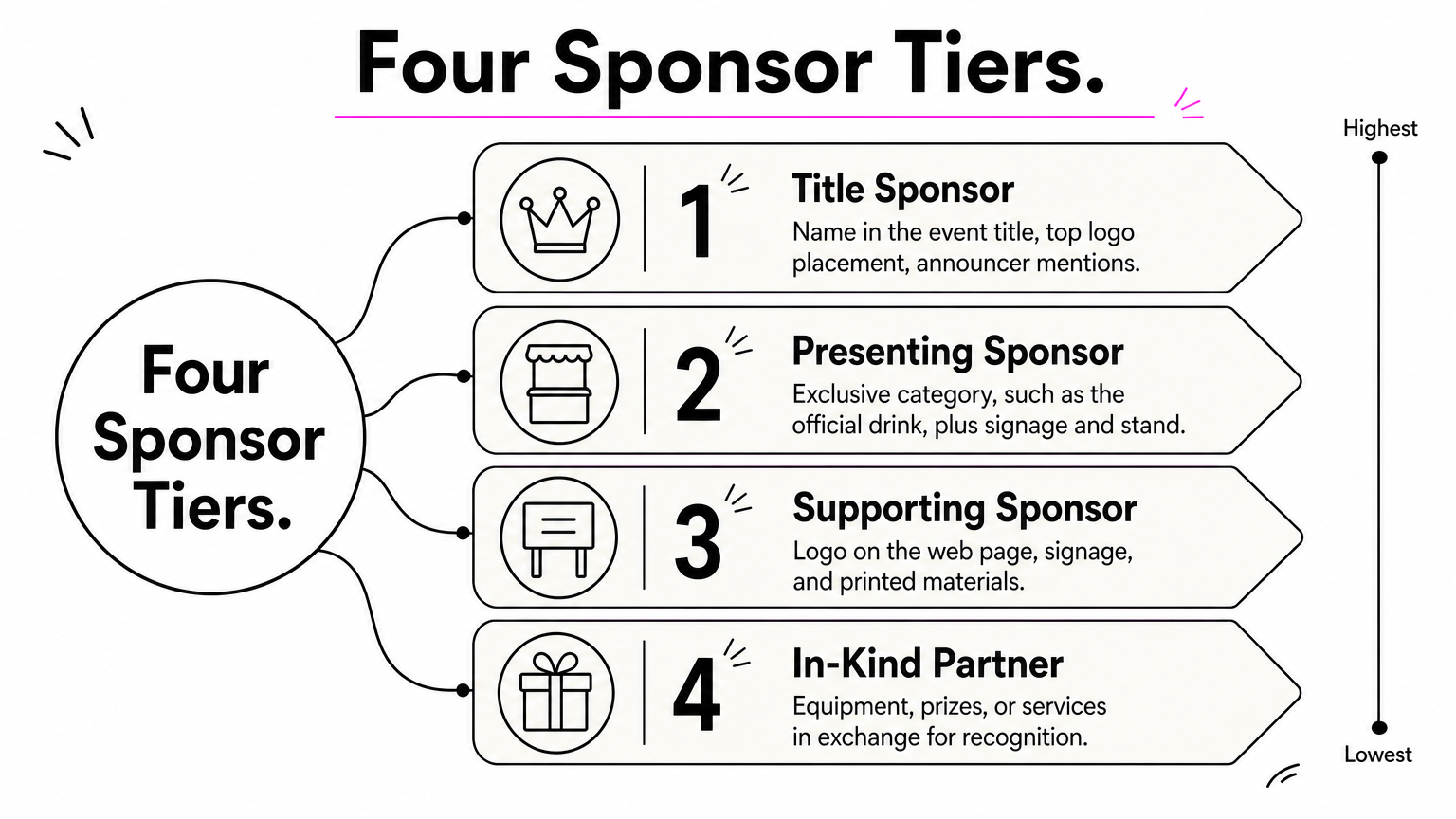
Three or four tiers keep the conversation simple. Describe benefits in terms of exposure and access, and set prices based on your audience and market.
| Tier | Typical benefits |
|---|---|
| Title sponsor | Name in the event title, top logo placement, announcer mentions, hospitality |
| Presenting or category sponsor | Exclusive category (for example, the official drink), signage, on-site stand |
| Supporting sponsor | Logo on web page, signage, and printed materials |
| In-kind partner | Equipment, prizes, or services in exchange for recognition |
If a sponsor wants a stand or sampling space, treat it as a small expo booth. Exhibition-style activations give brands a place to meet fans face to face, which is often worth more to them than a banner.
Activate, report, and renew
Sponsors renew when they see results. Deliver every promised item, such as logo placement, announcements, and social mentions, and document it with photos and screenshots. Within a week of the event, send a short report with attendance, reach, and a few highlights.
Then ask for next year’s commitment while the memory is fresh. A sponsor who gets a clear report is far more likely to say yes than one who has to chase you for it.
Sponsors renew when you show them proof, so collect it from day one.
Event-day marketing and fan experience
On event day, marketing shifts from promising to delivering. What fans experience determines whether they return, tell friends, and post online. A good day validates your campaign, and a bad day can undo weeks of promotion.
Make arrival easy and welcoming
Fans form an impression in the first ten minutes. Clear signage, quick entry, friendly staff, and visible branding set the tone. Place volunteers at gates and info points to answer questions, and make sure sponsor logos, event colors, and the hashtag are visible from the entrance onward.
Put the same schedule you promoted online on a sign at the venue, and have a plan for delays. A short announcement that explains a change keeps goodwill. Silence makes people suspicious.
Create moments worth sharing
Engagement keeps the crowd involved between action. Halftime contests, a trivia round with prizes, a crowd cheer competition, a kids’ run onto the field, and a photo spot with your hashtag all give fans reasons to post. Shareable moments are free marketing, because each photo reaches friends who may buy tickets next time.
A good announcer or host is worth more than most extras. They set the energy, thank sponsors naturally, and remind everyone of what is happening next.
Capture content and feedback
Assign one person to take photos and short videos for social media and for the sponsor report. Collect a few fan quotes and a head count at the busiest moment. Place a QR code on the exit signs that links to a three-question survey.
Here is a quick checklist for the day:
- Confirm every sponsor deliverable is in place before gates open
- Post a live update at least once an hour
- Photograph each sponsor activation
- Keep a notebook of issues and what you did about them
- Send a thank-you message the next day
A great event day is your best marketing, and a poor one cancels out your best campaign.
Sport event marketing examples at every scale
Strong sport event marketing examples share a pattern: a clear audience, a memorable hook, and a link between the event and a feeling. The five examples below cover very different scales, so you can see what carries over to your own event.
Five examples compared
| Example | Scale | What they did | What to take from it |
|---|---|---|---|
| Super Bowl | Global | Turned game week and the broadcast into a showcase, with ads, host-city events, and brand activations | A big event becomes a cultural moment when sponsors and city partners build their own events around it |
| FIFA World Cup 2010 "Waka Waka" | Global | Shakira’s official song and video turned the first World Cup in Africa into a shared celebration | Music and story can spread an event far past its audience |
| This Girl Can (Sport England, 2015) | National | Used real women of all shapes and abilities to encourage participation, with the hashtag #ThisGirlCan | Relatable people and a clear cause can drive participation, not only spectatorship |
| Minor league baseball promotions | Regional | Fireworks nights, theme nights, and giveaways make an ordinary game feel special | When the sport is not the draw, the experience is |
| Local community tournament | Local | Student or club ambassadors, posters, a local figure as guest, a simple event page | Personal invitations beat paid reach at small scale |
What each scale teaches
At the top end, the Super Bowl shows how a game can become the center of a week, with ads, concerts, and city events competing for attention alongside the match. Few organizers have those budgets. The lesson you can borrow is to create reasons to engage before and around the match, not only the match itself.
For mid-sized events, promotional nights are the most transferable idea. Minor league teams cannot guarantee star players, so they sell the evening: fireworks, a giveaway, a theme. You can do the same with a family day, a charity cause, or a first-time visitors’ deal.
At the local level, personal invitations matter more than any ad. A student ambassador telling classmates, a coach inviting parents, a former player attending as guest: these cost almost nothing and create trust. Pair them with a simple event page and you have a complete small-scale campaign.
You do not need a Super Bowl budget, only a clear hook and a reason for people to tell each other.
How to measure sport event marketing results
Measure results by comparing outcomes to the goals you set, using a handful of numbers that you can track weekly. Measurement tells you what to repeat, what to cut, and what to show sponsors.
The metrics that matter
You do not need a complicated dashboard. These seven numbers cover most events.
| Metric | How to calculate it | Why it matters |
|---|---|---|
| Sell-through rate | Tickets sold ÷ capacity | Shows how well you filled the venue |
| Cost per ticket sold | Marketing spend ÷ tickets sold | Compares channels and years |
| Sales pace | Tickets sold per week of the countdown | Flags problems early |
| Channel source | Tickets by referral link or code | Shows which tactic worked |
| Email and social growth | New followers and sign-ups | Builds your audience for next time |
| Sponsor satisfaction | Renewal rate and feedback | Predicts next year’s revenue |
| Attendee satisfaction | Survey score and comments | Predicts repeat attendance |
A worked example
Return to the 500-seat tournament. You sold 400 tickets and spent $750 on marketing. Sell-through is 400 ÷ 500 = 80%, and cost per ticket sold is $750 ÷ 400, about $1.88. If 220 of those tickets came from the ambassador link and 120 from paid social, you know where to put more effort next year.
Use unique links or discount codes per channel to make this possible. Without them, you only know how many people came, not why.
Follow up and avoid common mistakes
Within two days, send a thank-you email, a short highlight video, and a survey. Then write a one-page summary of what worked and what did not while it is fresh. Post-event follow-up feeds directly into next year’s plan and the sponsor report.
Common mistakes to watch for:
- Starting promotion too late to adjust
- Marketing only to existing fans and ignoring new audiences
- Discounting so heavily that full price looks unfair
- Promising sponsors exposure you cannot deliver
- Skipping the post-event review
Turning the basics into a plan
Sport event marketing comes down to a short list: set a clear goal, know your audience, work back from the date, offer a reason to attend, bring in credible partners and sponsors, deliver a great day, and measure what happened. The scale changes, but the sequence does not. A local tournament and a championship final both succeed when people know about them, trust them, and enjoy them.
If you organize or sponsor a sporting event with an expo area, exhibitors, or a business audience, reach that audience through trade media as well as fan channels. You can publish a press release or interview with Exhibition Globe to put your event in front of organizers, exhibitors, and service providers across the events industry.